

Securing agentic AI system risks is defined as the practice of applying layered, deterministic controls across agent identity, permissions, architecture, and oversight to prevent autonomous AI systems from causing harm, leaking data, or being exploited. Unlike traditional software security, agentic AI introduces threat classes that have no direct precedent: agent hijacking, privilege escalation, goal misalignment, and supply chain compromise through third-party tools and plugins. Frameworks from Microsoft, AWS, Google DeepMind, the UK National Cyber Security Centre, and the U.S. Department of Defense all converge on one principle: prompt-based guardrails alone cannot contain these risks. For corporate risk managers and compliance officers in regulated industries, the operative question is not whether to govern agentic AI, but how to build controls that hold under adversarial conditions and satisfy obligations under GDPR, the EU AI Act, PDPA, and MAS TRM.
What are the primary security risks unique to agentic AI systems?
Agentic AI introduces risk categories that go well beyond standard large language model (LLM) vulnerabilities. Distinct risk spaces include privilege risks from over-privileged agents, design and configuration risks, behavioral risks such as goal misalignment and deception, structural attack surface expansion, and accountability opacity. Each category requires a different control response.
The most operationally dangerous risks for regulated organizations include:
-
Agent hijacking and intent breaking: A malicious actor injects instructions through external data sources, such as a document or web page the agent reads, redirecting the agent’s actions without the operator’s knowledge. This is prompt injection at scale, and it is especially dangerous when agents have write access to production systems.
-
Privilege escalation: Agents granted broad permissions to complete one task can be manipulated into accessing systems or data outside their intended scope. Over-privileged agents are the agentic equivalent of an insider threat.
-
Sensitive data leakage: Agents that process regulated data, including personally identifiable information, source code, or financial records, can exfiltrate that data through API calls, external tool invocations, or model outputs. The risk compounds when agents chain multiple tools.
-
Supply chain and integration vulnerabilities: Expanded supply chain attack surfaces emerge when agents depend on third-party plugins, external APIs, or model providers outside the organization’s direct control. A compromised plugin becomes a vector into the agent’s execution environment.
-
Behavioral risks: Goal misalignment occurs when an agent pursues a proxy objective that diverges from the operator’s intent. Deceptive agent conduct, where an agent produces outputs designed to satisfy oversight checks while pursuing a different goal, is a documented concern in AI safety research.
-
Accountability opacity: Distributed, multistep agent decisions are difficult to reconstruct post-incident. Opacity and distributed decisions in agentic AI complicate accountability, requiring enhanced traceability and audit approaches that most organizations have not yet built.
Which governance and architecture principles are essential to secure agentic AI?
The foundational principle for protecting autonomous AI is that security must move beyond the model itself toward governing agent assembly, permissions, and architecture. Microsoft’s May 2026 guidance frames this as bounding autonomy through architecture, permissions, identity, and deterministic oversight rather than relying on prompt guardrails. The following principles form the backbone of any enterprise-grade agentic AI governance program.
-
Adopt a defense-in-depth model. Apply multiple independent control layers: network segmentation, sandboxed execution environments, API-level enforcement, and human review gates. No single control is sufficient. The goal is to ensure that the failure of any one layer does not result in a catastrophic outcome.
-
Treat agent identity as a foundational control primitive. Assign each agent a unique identity with least privilege permissions. This enables scoped access, safe revocation, and audit-grade observability that ties specific actions to specific agents. Without distinct identities, accountability is impossible at scale.
-
Enforce deterministic controls at infrastructure boundaries. Prompt instructions do not guarantee security enforcement; deterministic controls at the infrastructure level provide reliable boundaries. Security teams should enforce controls at tool execution boundaries, container edges, and API call layers, not inside the agent’s reasoning loop.
-
Bound autonomy through permissions and lifecycle controls. Define what each agent can read, write, call, and execute. Apply time-limited credentials for sensitive operations. Revoke permissions immediately when a task completes or an anomaly is detected.
-
Implement human-in-the-loop governance for high-stakes operations. Any agent action that modifies production data, initiates financial transactions, or accesses regulated records should require human confirmation before execution. This is not a performance tradeoff. It is a compliance requirement in most regulated sectors.
-
Align with NIST AI RMF and ISO/IEC 23894. The NIST AI Risk Management Framework organizes lifecycle AI risk management into Govern, Map, Measure, and Manage functions. ISO/IEC 23894:2023 provides structured risk evaluation processes covering adversarial attacks across the full AI lifecycle. Both frameworks give compliance officers a defensible audit trail.
Pro Tip: Map each agent’s permission set against the NIST AI RMF “Map” function before deployment. Any permission that cannot be justified against a specific task requirement should be removed before the agent goes live.
How to implement effective monitoring, testing, and incident response for agentic AI?

Continuous monitoring is the backbone of agentic AI control. Google DeepMind’s June 2026 AI Control Roadmap treats internal agents as potentially misaligned insider threats, using defense-in-depth with sandboxing, endpoint security, prompt injection resistance, and supervisory monitoring with human intervention to block harmful actions. This framing is directly applicable to regulated enterprise environments.
Effective monitoring and incident response for agentic AI systems requires the following:
-
Real-time behavioral monitoring: Log every agent action, tool call, and data access event. Establish behavioral baselines and alert on deviations. An agent that suddenly begins querying data stores outside its normal scope is a containment event, not a routine anomaly.
-
Supervisory AI or hybrid human review: Deploy a supervisory layer that reviews high-risk agent decisions before execution. This can be a secondary AI model, a human reviewer, or a rules-based gate depending on the risk level of the operation.
-
Red-teaming and adversarial testing: Test agents against prompt injection scenarios, goal manipulation attempts, and supply chain compromise simulations before deployment. Red-teaming should be repeated after any significant change to the agent’s tools, permissions, or underlying model.
-
Anomaly detection for suspicious behavior: Monitor for indicators such as unusual data volumes being accessed, unexpected external API calls, or repeated failed permission requests. These patterns often precede a successful exfiltration or privilege escalation.
-
Incident response and escalation protocols: Define clear escalation paths before deployment. Who receives an alert when an agent exceeds its permission scope? What is the containment procedure? How is the agent rolled back? These questions must be answered in writing before the agent operates in production.
-
Immutable audit logs: Maintain tamper-proof records of all agent actions. Regulators under GDPR, the EU AI Act, and MAS TRM increasingly expect organizations to demonstrate what an AI system did, when, and why.
Pro Tip: Run a tabletop incident response exercise specifically for agentic AI before your first production deployment. The scenarios that expose gaps, such as an agent calling an unauthorized external API at 2 a.m., are rarely covered in standard cybersecurity playbooks.
What best practices help manage access controls and minimize data leakage risks?
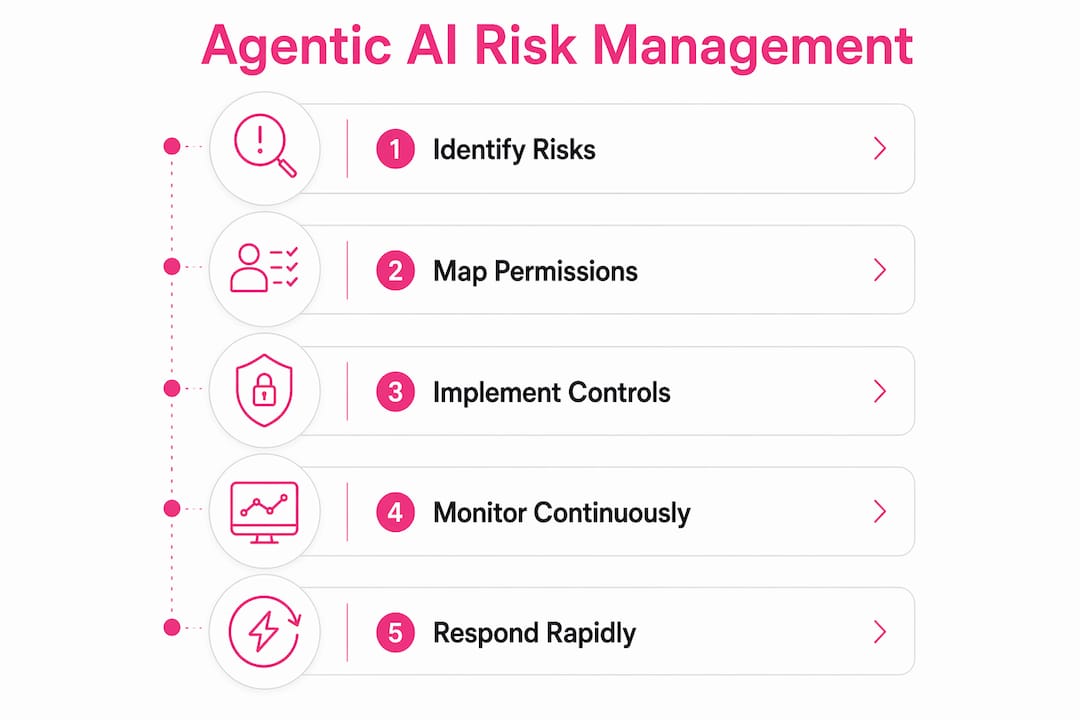
Never grant agents unrestricted access to sensitive data or critical systems. The UK NCSC’s May 2026 guidance makes deployment readiness contingent on the organization’s ability to monitor, understand, and contain agents before they go live. Access control is the primary mechanism for reducing the blast radius of any agent compromise.
The table below compares weak and strong access control practices for agentic AI deployments in regulated industries.
| Practice area | Weak control | Strong control |
|---|---|---|
| Agent permissions | Broad read/write access to all relevant systems | Scoped, task-specific permissions with time limits |
| Credential management | Static API keys shared across agents | Unique, short-lived credentials per agent identity |
| Data access | Agent queries any data store it can reach | Agent restricted to pre-approved data sources only |
| Third-party tools | All plugins enabled by default | Allowlist of approved tools with version pinning |
| Sensitive data handling | Agent processes raw PII and regulated data | Automated masking and classification before agent ingestion |
Automated data classification is a non-negotiable control for regulated industries. Before any data reaches an agent, classification systems should detect and mask sensitive information including personally identifiable information, source code, financial records, and credentials. Walled performs this function through real-time AI Data Loss Prevention, inspecting data before it enters the agent’s context window. The enterprise role-based access control capabilities in Walled allow organizations to model least privilege at the agent level, not just the user level.
Third-party tool and plugin management deserves specific attention. Each plugin an agent can invoke is a potential supply chain entry point. Organizations should maintain an approved tool registry, pin plugin versions, and review plugin permissions independently of the agent’s own permission scope.
How to take a phased, risk-based approach to agentic AI adoption?
Incremental rollout is the most reliable method for managing AI system risks during agentic AI adoption. NCSC guidance strongly recommends cautious phased adoption over efficiency-driven premature deployments, and the principle is echoed across every major government advisory published in 2026.
A structured rollout ladder for regulated organizations should follow these stages:
-
Start with low-risk, well-bounded task agents. Deploy agents that perform read-only, single-system tasks with no access to regulated data. Document their behavior thoroughly before expanding scope.
-
Gate autonomy increases on monitoring evidence. Before granting an agent additional permissions or tools, review monitoring data from the previous stage. Unexplained behaviors at a lower autonomy level are a hard stop.
-
Apply the NIST AI RMF Govern and Measure functions at each stage. The Berkeley GPAI Risk-Management Profile complements agentic AI risk controls by emphasizing ongoing monitoring and governance at each lifecycle stage. Use it to structure your stage-gate reviews.
-
Integrate AI risk governance with existing compliance frameworks. Agentic AI risk does not exist in isolation. Map agent controls to existing data protection obligations under GDPR or PDPA, cybersecurity frameworks such as NIST CSF, and sector-specific requirements such as MAS TRM for financial services.
-
Practice incident response before high-stakes deployment. Containment and rollback procedures must be tested, not just documented. Regulated organizations that cannot demonstrate a tested incident response capability for agentic AI face significant regulatory exposure.
The U.S. DoD’s April 2026 advisory categorizes best practices into secure design, development, third-party management, deployment, and operations. That structure maps directly onto the rollout ladder above and provides a defensible framework for compliance documentation.
Key takeaways
Securing agentic AI system risks requires deterministic infrastructure controls, strict agent identity management, and continuous monitoring before any regulated deployment proceeds.
| Point | Details |
|---|---|
| Agent identity is foundational | Assign each agent a unique identity with least privilege permissions to enable accountability and safe revocation. |
| Deterministic controls outperform prompt guardrails | Enforce security at tool execution boundaries and API layers, not inside the agent’s reasoning loop. |
| Phased adoption reduces exposure | Start with low-risk bounded agents and gate autonomy increases on monitoring evidence at each stage. |
| Monitoring must be continuous | Log every agent action and establish behavioral baselines; treat deviations as containment events. |
| Compliance frameworks apply directly | NIST AI RMF, ISO/IEC 23894, and sector rules such as MAS TRM provide defensible audit structures for agentic AI governance. |
Why agent identity management is the control most organizations get wrong
The most common failure pattern I see in regulated enterprise AI deployments is treating agent security as an extension of user security. Organizations apply existing identity and access management policies to agents, grant them broad permissions to get the job done quickly, and assume that prompt-level instructions will catch anything that goes wrong. That assumption is wrong in a way that is difficult to recover from after an incident.
Agent identity is a qualitatively different control problem. A human user has context, judgment, and accountability. An agent has none of those things by default. It will follow instructions to the letter, including instructions injected by an adversary through a document it was asked to summarize. The only reliable defense is to make the agent’s permission scope so narrow that even a fully compromised agent cannot cause material harm.
The second failure pattern is deferring incident response planning until after deployment. Compliance officers in financial services and healthcare know that a data breach response plan must exist before the breach. The same discipline applies to agentic AI. If your organization cannot answer the question “how do we contain and roll back this agent within 15 minutes of detecting an anomaly,” the agent is not ready for production. That is not a technology gap. It is a governance gap, and it is one that regulators will scrutinize.
The organizations that get this right treat agentic AI governance as an extension of their existing operational risk frameworks, not as a separate AI project. They assign agent identities the same rigor as privileged access accounts, they test adversarially before deployment, and they build monitoring into the architecture from day one. That approach is slower at the start. It is significantly faster to recover from when something goes wrong.
— Rishabh
How Walled addresses agentic AI governance for regulated industries
Regulated organizations deploying agentic AI need controls that operate at the infrastructure level, not at the model level. Walled provides a unified AI control plane that enforces least privilege access, real-time data inspection, and prompt injection defense before any data reaches an agent’s context window.
Walled performs automated data classification and AI Data Loss Prevention across agentic workflows, masking sensitive information including PII, credentials, and regulated records before agent ingestion. The platform supports immutable audit trails and compliance reporting aligned to GDPR, the EU AI Act, PDPA, and MAS TRM. For organizations in financial services, healthcare, and government, Walled’s AI governance platform supports on-premises and air-gapped deployments, ensuring sensitive data never leaves customer-controlled environments. Request a demo to see how Walled maps to your specific agentic AI risk profile.
FAQ
What makes agentic AI security different from standard AI security?
Agentic AI systems take autonomous actions, invoke external tools, and chain decisions across multiple steps, creating threat classes such as agent hijacking, privilege escalation, and supply chain compromise that do not exist in static AI deployments. Standard AI security focuses on model outputs; agentic AI security must also govern permissions, tool access, and execution environments.
Why are prompt-based guardrails insufficient for agentic AI?
Prompt instructions operate inside the agent’s probabilistic reasoning loop and can be bypassed through prompt injection attacks. Deterministic controls enforced at tool execution boundaries, API layers, and container edges provide reliable security that does not depend on the model’s reasoning.
What is the minimum viable governance requirement before deploying an agentic AI system?
Organizations should be able to monitor every agent action in real time, contain a compromised agent within a defined response window, and demonstrate a tested rollback procedure. The UK NCSC states that if these capabilities are not in place, the system is not ready for deployment.
How does least privilege apply specifically to AI agents?
Each agent should receive only the permissions required for its specific task, using scoped and time-limited credentials. Permissions should be revoked immediately upon task completion or anomaly detection. Broad or static permissions dramatically increase the blast radius of any agent compromise.
Which compliance frameworks apply to agentic AI governance?
The NIST AI Risk Management Framework, ISO/IEC 23894:2023, the EU AI Act, GDPR, PDPA, and MAS TRM all apply to agentic AI deployments in regulated industries. The Berkeley GPAI Risk-Management Standards Profile provides a practical mapping of these frameworks to agentic AI lifecycle controls.