
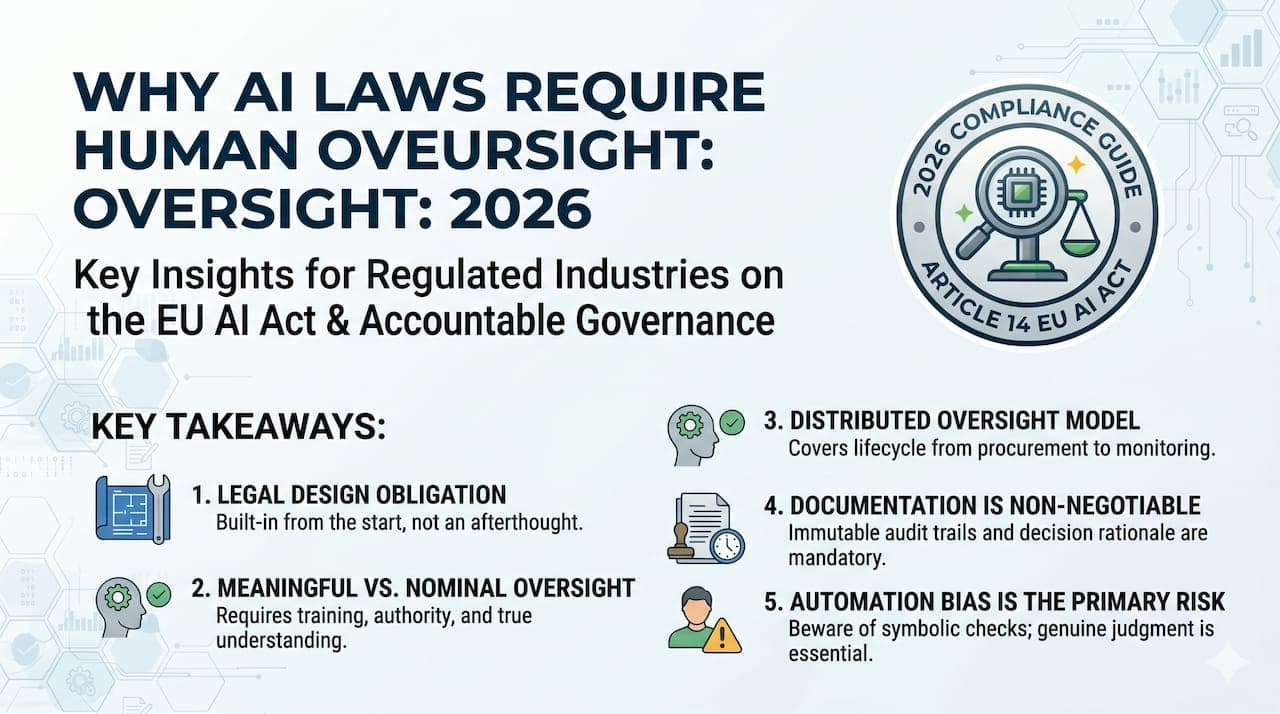
Human oversight in AI is defined as the ability of natural persons to understand, monitor, and intervene in AI system operations to uphold ethical, legal, and safety standards. Legal and compliance professionals in regulated industries now face binding obligations under frameworks like the EU AI Act that make this requirement explicit and enforceable. Understanding why AI laws require human oversight is no longer optional for organizations deploying high-risk AI systems. The stakes include regulatory penalties, failed due diligence, and accountability gaps that courts and regulators are increasingly willing to pursue.
What do AI laws require regarding human oversight?
Article 14 of the EU AI Act requires high-risk AI systems to be designed for effective human oversight, with measures proportional to the risks and autonomy of each system. This is the most detailed legal benchmark currently in force. It sets a design obligation, not merely a procedural one. Organizations cannot retrofit oversight after deployment and claim compliance.
The specific obligations under Article 14 cover four core capabilities:
-
Understanding: Humans must be able to comprehend the AI system’s capabilities, limitations, and intended purpose.
-
Awareness: Operators must remain alert to automation bias, the tendency to accept AI outputs without critical scrutiny.
-
Interpretation: Oversight personnel must correctly interpret AI outputs in context, not simply record them.
-
Intervention: Systems must include stop buttons or equivalent procedures allowing humans to override or halt AI decisions.
Oversight measures must also be proportional. A low-autonomy AI tool used for document drafting carries different oversight requirements than an AI system making credit decisions or flagging individuals for law enforcement review. The EU AI Act compliance guide published by Walled provides a detailed breakdown of how these proportionality requirements translate into organizational obligations before the august 2026 deadline.
Other regulatory frameworks reinforce the same principle. Singapore’s MAS TRM guidelines, the GDPR’s requirements for human review of automated decisions under Article 22, and emerging sector-specific AI rules in financial services and healthcare all reflect the same underlying logic. AI regulations and human involvement are not separate tracks. They are structurally linked.

Pro Tip: Document your oversight design decisions at the time of system procurement or build, not after an audit request. Regulators look for evidence that oversight was built in, not bolted on.
How is meaningful oversight different from nominal compliance?
Meaningful human oversight is not satisfied by having a person present in the workflow. Effective oversight spans the entire AI lifecycle, including design verification, context interpretation, threshold setting, and deciding when AI should not be used at all. A human who reviews AI outputs without the authority, training, or time to challenge them provides no real protection.
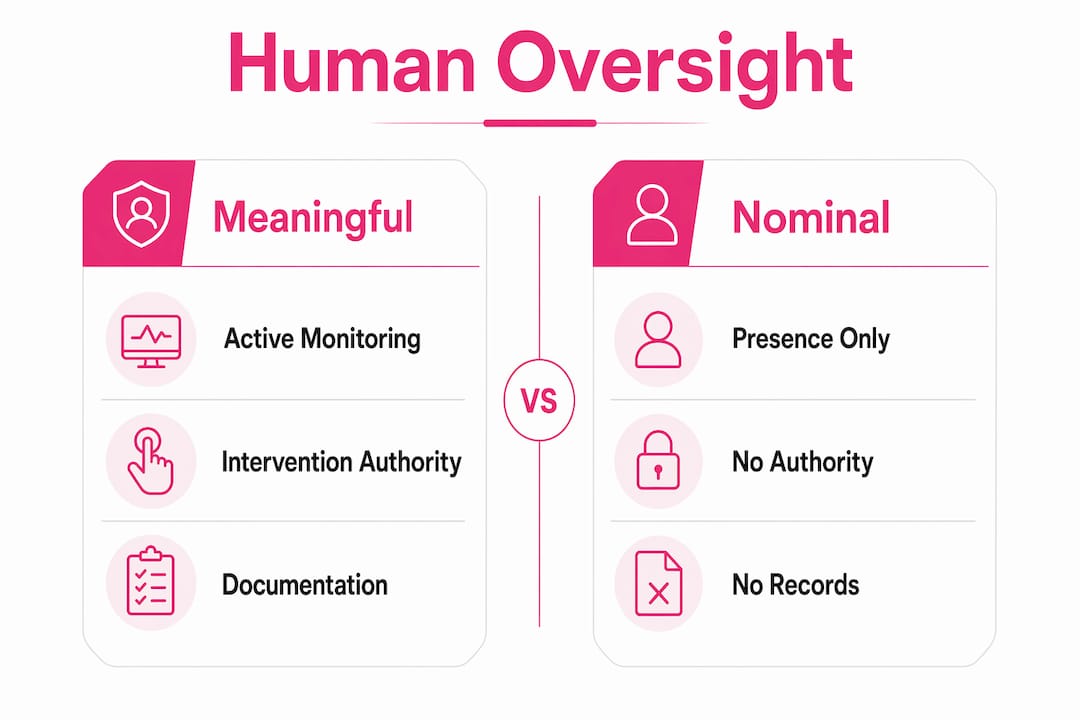
The distinction matters legally. Regulators expect companies to demonstrate meaningful human involvement and accountability in AI decisions, including documentation of oversight processes. Lack of explainability and documented oversight risks failing due diligence and non-discrimination obligations. A sign-off log without evidence of genuine review will not satisfy an auditor.
Operationalizing meaningful oversight requires a distributed model across two distinct phases:
-
Design-time oversight: Governance teams define acceptable use cases, set risk thresholds, select training data criteria, and specify intervention triggers before deployment.
-
Run-time oversight: Trained personnel monitor live AI outputs, apply contextual judgment, escalate anomalies, and exercise documented authority to override or halt the system.
-
Lifecycle review: Oversight does not end at deployment. Periodic audits, model drift assessments, and updated threshold reviews are part of the ongoing obligation.
-
Competency requirements: Oversight personnel must have system-specific knowledge. A generalist reviewer without domain expertise cannot detect subtle AI errors in a credit scoring or clinical decision support context.
-
Authority to act: Oversight is only real when the person conducting it has the organizational authority to stop or modify AI behavior. Oversight without authority is observation.
Pro Tip: Map your oversight roles to specific AI system functions, not to job titles. The person with authority to halt an AI decision may not be the same person who monitors its outputs daily.
What are the common pitfalls in implementing human oversight?
The most pervasive failure in AI oversight implementation is automation bias. Boards and review teams frequently misinterpret “human in the loop” as checkbox compliance rather than the exercise of genuine cognitive judgment over AI decisions. When reviewers consistently accept AI outputs without challenge, the oversight function becomes symbolic.
Several structural pitfalls compound this problem:
-
Token review: Oversight reduced to a sign-off step, where reviewers lack the time, tools, or competence to detect AI anomalies. This is the most common failure mode identified in governance audits.
-
Explainability gaps: When AI systems cannot explain their outputs in terms reviewers understand, oversight becomes guesswork. Regulators treat unexplainable AI decisions as a governance failure, not a technical limitation.
-
Documentation deficits: Organizations that cannot produce records of who reviewed an AI decision, when, and on what basis cannot demonstrate compliance. Audit trails must be immutable and specific.
-
Multi-agent complexity: As AI systems increasingly involve chains of autonomous agents, identifying where human oversight applies becomes structurally difficult. Each agent handoff is a potential accountability gap.
“Effective oversight requires higher-order situational judgment beyond AI output acceptance. Organizations that treat oversight as a procedural step rather than a governance function will fail both regulatory audits and real-world accountability tests.” — World Economic Forum, AI Governance and Human Judgment, 2026
The multi-agent problem deserves particular attention from compliance professionals. The EU AI Act’s Article 14 multi-agent oversight patterns guidance makes clear that oversight obligations apply to the overall system, not just individual components. Organizations deploying agentic AI workflows must map oversight responsibilities across the entire chain of automated decisions.
What practical steps can compliance professionals take?
Effective human oversight requires both technical interface design and governance processes. Auditors look for evidence of both: oversight-enabling technology and effective human governance, including staffing, training, and documented accountability. Neither element alone satisfies regulatory expectations.
The table below compares a minimal compliance approach with a governance-grade oversight program:
| Oversight Element | Minimal Approach | Governance-Grade Approach |
|---|---|---|
| Human involvement | Reviewer present in workflow | Trained reviewer with documented authority and competency |
| Intervention capability | Manual escalation path exists | Stop button or override procedure tested and logged |
| Documentation | Sign-off log maintained | Immutable audit trail with decision rationale recorded |
| Risk thresholds | Default system settings used | Organization-defined thresholds reviewed periodically |
| Lifecycle coverage | Oversight at output review stage | Oversight integrated from design through decommission |
Compliance professionals should prioritize five concrete actions. First, map every high-risk AI system to a named oversight owner with documented authority. Second, design or procure human-machine interfaces that surface AI confidence levels, flagged anomalies, and intervention options in plain language. Third, establish training programs specific to each AI system, not generic AI literacy courses. Fourth, implement governance dashboards that provide real-time monitoring and compliance reporting across AI deployments. Fifth, schedule periodic oversight audits that test whether reviewers are actually exercising judgment, not just completing sign-off steps.
Pro Tip: Run a tabletop exercise where oversight personnel are asked to identify and halt a simulated AI error. If they cannot do it within your defined response window, your oversight design has a gap.
How does human oversight support accountability in AI governance?
Human oversight is foundational to trustworthy AI governance, ensuring AI systems serve organizational and societal values rather than optimizing for narrow metrics. This is not a philosophical claim. It is a legal and operational one. When AI systems make decisions that affect individuals, such as loan approvals, medical triage, or employment screening, the law requires a human to be accountable for those outcomes.
Oversight enables transparency and contestability. When a person affected by an AI decision has the right to challenge it, the organization must be able to explain what the AI did and why a human approved it. Without documented oversight, that explanation is impossible. The responsible AI framework developed by Walled addresses this directly, connecting oversight obligations to the broader requirements of GDPR, the EU AI Act, and sector-specific regulations.
“Verification and oversight should be integrated throughout AI system design and deployment, not only as a final output check.” — MIT Sloan Management Review, Responsible AI Demands
Oversight also prevents harm through timely intervention. An AI system making real-time decisions in a high-risk context, such as fraud detection or clinical support, can cause significant damage in the time between an error and its detection. Human oversight with defined intervention triggers reduces that window. The responsible AI demands framework from MIT Sloan Management Review confirms that combining model thresholds, audit logs, and human decision authority is the approach that supports both regulatory compliance and real-world risk management.
Key Takeaways
Effective human oversight in AI is a legally mandated, design-level obligation that requires trained personnel, documented authority, and governance processes integrated across the full AI lifecycle.
| Point | Details |
|---|---|
| Legal design obligation | Article 14 of the EU AI Act requires oversight built into AI systems, not added after deployment. |
| Meaningful vs. nominal oversight | A human present in the workflow without authority or training does not satisfy regulatory requirements. |
| Distributed oversight model | Oversight must cover both design-time decisions and run-time monitoring, not just output review. |
| Documentation is non-negotiable | Immutable audit trails and decision rationale records are required to demonstrate compliance to regulators. |
| Automation bias is the primary risk | Reviewers who consistently accept AI outputs without challenge reduce oversight to a symbolic function. |
The case for treating oversight as a governance discipline
The compliance community has spent years building frameworks for financial controls, data protection, and risk management. Human oversight of AI deserves the same institutional treatment. What I see repeatedly in regulated industries is organizations that have invested in AI systems but have not invested proportionally in the governance infrastructure around them. The oversight function gets assigned to whoever is available, not whoever is qualified.
The World Economic Forum’s 2026 analysis on AI governance and human judgment puts it plainly: effective oversight requires higher-order situational judgment, not procedural sign-off. That distinction should change how organizations staff, train, and evaluate their oversight programs. A compliance officer who cannot explain what a specific AI model does in operational terms cannot provide meaningful oversight of it.
The EU AI Act’s august 2026 enforcement timeline is creating urgency, but the real driver should be organizational accountability. AI systems that operate without genuine human oversight are liability exposures, not efficiency gains. The organizations that treat oversight as a governance discipline rather than a compliance checkbox will be better positioned when regulators, courts, or affected individuals demand an explanation.
Professionals who want to lead on this issue should push for oversight to be included in AI procurement criteria, not just post-deployment audits. The time to define intervention authority is before a system goes live.
— Rishabh
Walled’s AI governance platform for regulated industries
Regulated industries need more than policy documents to satisfy AI oversight requirements. Walled provides a unified AI governance platform that operationalizes human oversight across the full AI lifecycle, from pre-deployment data inspection to real-time monitoring and immutable audit logging.
Walled supports financial services compliance, healthcare, government, and technology organizations with governance tools designed to meet the EU AI Act, GDPR, MAS TRM, and PDPA obligations. The platform’s governance dashboard delivers real-time visibility into AI interactions, intervention controls, and compliance reporting in a single control plane. For organizations that need fast deployment without sacrificing oversight depth, the mid-market governance solution deploys in minutes and includes the audit trail and policy enforcement features regulators expect to see.
FAQ
What is human oversight in AI law?
Human oversight in AI law is the legally required ability of natural persons to understand, monitor, and intervene in AI system operations. Article 14 of the EU AI Act defines the specific design and operational requirements for high-risk AI systems.
Why do AI regulations require human involvement in decisions?
AI regulations require human involvement because AI systems can produce errors, reflect bias, or cause harm that automated processes cannot self-correct. Human oversight creates an accountability chain that regulators, courts, and affected individuals can examine.
What does “human in the loop” mean under the EU AI Act?
Under the EU AI Act, “human in the loop” means more than having a person present. It requires that the person has the competence, authority, and tools to understand AI outputs and intervene when necessary, not simply approve them.
How should organizations document human oversight for compliance?
Organizations should maintain immutable audit trails recording who reviewed each AI decision, what information they had, and what action they took. Regulators treat documentation gaps as evidence of inadequate oversight, not administrative oversight.
What is automation bias and why does it matter for AI oversight?
Automation bias is the tendency of human reviewers to accept AI outputs without critical scrutiny. It is the primary failure mode in oversight programs and directly undermines the effectiveness of human supervision in AI governance.