

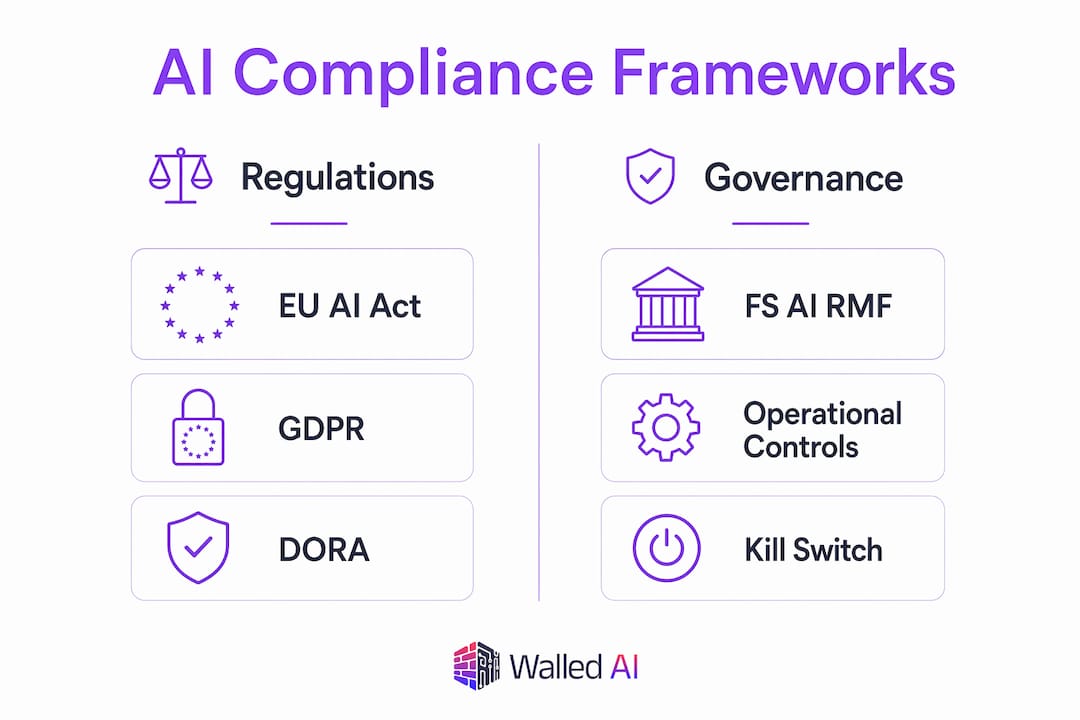
AI compliance in financial services is the systematic adoption of policies, controls, and oversight mechanisms that ensure AI systems operate within legal, ethical, and regulatory boundaries. Financial institutions now face at least seven concurrent regulatory frameworks, including the EU AI Act, GDPR, DORA, FINRA rules, and SEC regulations. That overlap creates a compliance burden unlike anything the sector has managed before. Failure to meet these obligations carries consequences ranging from fines of up to €35 million or 7% of global annual turnover under the EU AI Act, to reputational damage that erodes client trust and triggers supervisory intervention.
What are the main regulatory frameworks shaping AI compliance in financial services?
Financial institutions must satisfy multiple AI regulations in finance simultaneously, each with distinct focus areas and enforcement mechanisms. No single framework covers the full scope of risk. Compliance professionals need a clear map of what each regulation demands.
The table below summarizes the primary frameworks and their core requirements:
| Framework | Jurisdiction | Core Focus | Key Obligation |
|---|---|---|---|
| EU AI Act | European Union | Risk classification of AI systems | Transparency, human oversight, fines up to €35 million |
| GDPR | European Union | Data privacy and processing | Lawful basis for AI data use, data subject rights |
| DORA | European Union | ICT and operational resilience | Third-party ICT risk management, incident reporting |
| FINRA Rules | United States | Broker-dealer conduct | Supervision of AI-generated communications |
| SEC Regulations | United States | Investor protection | Recordkeeping, disclosure of AI-driven advice |
| RBI Framework | India | Model risk governance | Kill switch mandate, annual risk tiering |
| FS AI RMF | United States | Enterprise AI risk | 230 specific controls scaled for all entity sizes |
The US Treasury's Financial Services AI Risk Management Framework (FS AI RMF) is particularly significant. Its 230 controls apply to institutions ranging from community banks to multinationals. That breadth signals that regulators expect proportionate, not minimal, compliance programs.
Several themes cut across all frameworks:
- Data privacy and transparency: AI systems must document data sources, processing logic, and output rationale.
- Human oversight: Regulators require human review at key decision points, particularly in customer-facing AI.
- Risk tiering: Models must be classified by risk level and reassessed periodically.
- Third-party accountability: Vendors providing AI services are subject to the same scrutiny as internal systems.
The EU AI Act's penalty structure deserves particular attention. Fines scale with the severity of the violation and the size of the organization. For a global bank, 7% of worldwide turnover is an existential number. That reality is forcing boards to treat AI governance as a first-order risk management obligation, not a technology department concern.
How do financial institutions operationalize AI compliance governance frameworks?
Most financial institutions have AI policies on paper. The gap between policy and operational control is where regulatory exposure actually lives. Embedding AI risk into existing enterprise risk management frameworks is the primary challenge compliance teams face in 2026.
A written AI Systems Program (AIS Program) provides the structural foundation. Grant Thornton identifies four pillars that every AIS Program must address:
- Guidelines and standards: Define acceptable AI use cases, prohibited applications, and documentation requirements for all AI systems in production.
- Governance and accountability: Assign named owners for each AI system. Board-level accountability is non-negotiable. Senior management cannot delegate AI risk oversight without maintaining direct visibility.
- Risk management and internal controls: Integrate AI risk assessments into existing model risk management processes. This includes pre-deployment validation, ongoing performance monitoring, and defined escalation paths.
- Third-party AI systems and data: Document every external AI service, assess its risk profile, and apply the same controls used for internal models.
The Reserve Bank of India's framework adds a concrete operational requirement that other regulators are watching closely. The RBI mandates a kill switch for all AI models at banks, enabling immediate override of AI decisions without human delay. Annual risk tiering of models is also required, with human-in-the-loop controls mandatory for any customer-facing AI application.
Kill switch architecture is not simply a technical feature. It requires defined trigger conditions, tested override procedures, and documented recovery protocols. Institutions that treat it as a checkbox will fail supervisory review.

Pro Tip: Map each AI system to its corresponding regulatory obligation before building controls. A system used for credit decisioning carries different obligations under ECOA, FINRA, and the EU AI Act than one used for internal document summarization. Conflating them creates gaps in both directions.
What are the best practices for managing third-party AI model risks and ensuring vendor compliance?
Third-party AI risk is the fastest-growing source of unmanaged exposure in financial services. Most institutions rely on external AI providers for core functions, yet vendor oversight programs have not kept pace with deployment speed.
Under DORA, AI vendors are classified as ICT third parties subject to formal risk assessments and incident reporting obligations. That classification has practical consequences for every contract, every integration, and every renewal decision.
Effective third-party AI risk management requires the following:
- Pre-contract due diligence: Assess the vendor's operational resilience, security controls, data handling practices, and regulatory standing before signing. Request evidence of independent audits and penetration testing results.
- Concentration risk assessment: Regulators are increasingly concerned about the financial sector's dependence on a small number of AI infrastructure providers. Document concentration exposure and maintain contingency plans for provider failure or withdrawal.
- Contractual protections: Contracts must specify data residency requirements, audit rights, incident notification timelines, and the vendor's obligations under GDPR and DORA. Vague service agreements create compliance gaps that supervisors will identify.
- Ongoing monitoring: Vendor compliance is not a one-time assessment. Establish quarterly reviews of vendor performance, security posture, and regulatory status. Require vendors to notify you of material changes to their AI systems.
- Incident reporting: DORA requires financial institutions to report significant ICT-related incidents within defined timeframes. Vendor-caused AI failures fall within scope. Incident response plans must include vendor-originated events.
Supply chain concentration risk deserves specific attention. A significant portion of the financial sector's generative AI workloads runs on a handful of foundation model providers. If one of those providers faces a regulatory action, a security breach, or a service outage, the downstream impact across the sector could be systemic. Regulators have flagged this explicitly, and institutions that cannot demonstrate alternative sourcing strategies will face scrutiny.
Which compliance automation tools and monitoring frameworks support financial services organizations?
AI-enabled compliance monitoring uses real-time detection of policy violations and automates regulatory tracking across AI systems. That capability directly addresses the scale problem: no compliance team can manually review every AI interaction across a large institution.
Effective compliance automation in financial services covers several distinct functions:
- Regulatory change tracking: Automated systems monitor regulatory publications from bodies including the FSB, SEC, FINRA, and the European Banking Authority, flagging changes that affect existing AI deployments.
- Model performance monitoring: Continuous tracking of AI output quality, drift detection, and fairness metrics. Degradation in model performance is a compliance event, not just a technical issue.
- Policy violation detection: Real-time inspection of AI inputs and outputs against defined policy rules. This includes detecting sensitive data exposure, prohibited content, and outputs that contradict regulatory requirements.
- Audit trail generation: Immutable logs of AI decisions, data inputs, and human override events. Regulators expect complete audit trails for any AI system involved in regulated activities.
- Incident escalation: Automated alerts when AI systems breach defined thresholds, with documented escalation paths to named accountable officers.
The FS AI RMF's 230 controls provide a structured baseline for building these monitoring capabilities. Institutions can map each control to a specific monitoring function and assign ownership accordingly.
Walled provides a unified AI control plane that addresses several of these requirements directly. The platform performs real-time AI Data Loss Prevention (AI-DLP) before data reaches any AI model, detects prompt injection attacks and policy bypasses, and generates immutable audit trails aligned with EU AI Act compliance requirements. For financial institutions managing multiple AI deployments, that centralized visibility is operationally significant.
Pro Tip: Do not build compliance monitoring as a separate layer on top of AI systems. Integrate policy enforcement at the point of AI interaction. Retrospective review of AI outputs is too slow to prevent regulatory harm and too expensive to scale.
How can financial professionals prepare for evolving AI regulations and future-proof their frameworks?
The regulatory direction is clear: AI oversight will tighten, not loosen. Compliance has shifted from asking whether to use AI to how to govern its use within existing regulatory frameworks. That shift requires a different posture from compliance teams.
Technology-neutral compliance is the most durable approach. Existing conduct rules, recordkeeping obligations, and supervision requirements apply to AI outputs the same way they apply to human outputs. Institutions that build AI governance on top of existing regulatory obligations, rather than treating AI as a separate compliance domain, will adapt more efficiently as new rules emerge.
Practical steps for future-proofing a financial services AI compliance framework include:
- Annual AI model risk tiering: Reassess every AI system's risk classification each year. Business context changes, model behavior drifts, and regulatory thresholds shift. Static risk classifications become inaccurate quickly.
- Regulatory horizon scanning: Assign responsibility for monitoring emerging AI regulations across all jurisdictions where the institution operates. The FSB's 2026 consultation on responsible AI adoption signals that global coordination on AI governance standards is accelerating.
- Cross-functional governance committees: AI compliance cannot sit solely within the legal or technology function. Effective governance requires representation from risk, operations, data science, and business lines.
- Continuous training programs: Compliance staff need working knowledge of how AI systems function, not just what regulations say. Training that bridges technical and regulatory understanding reduces the gap between policy and control.
- Embedding AI governance into enterprise risk culture: Treating AI governance as a paper exercise produces audit-ready documents and operationally exposed institutions. Governance must be embedded in how decisions are made, not just how they are documented.
Pro Tip: Run a tabletop exercise simulating a regulator-initiated AI model review. Most institutions discover that their documentation is incomplete, their audit trails are fragmented, and their escalation paths are untested. The exercise costs a day. A supervisory finding costs far more.
Key Takeaways
Effective AI compliance in financial services requires integrating governance, risk management, and automated controls across every AI system, vendor relationship, and regulatory jurisdiction the institution operates within.
| Point | Details |
|---|---|
| Multi-framework compliance is mandatory | Financial institutions must satisfy at least seven concurrent AI regulatory frameworks, each with distinct obligations and penalties. |
| Operationalize governance, not just policy | Written AIS Programs with four defined pillars convert compliance intent into auditable operational controls. |
| Kill switches are a regulatory requirement | The RBI mandates immediate AI override capability; other regulators are adopting similar requirements for customer-facing AI. |
| Third-party risk requires formal programs | DORA classifies AI vendors as ICT third parties subject to risk assessments, contractual controls, and incident reporting. |
| Automation supports continuous adherence | Real-time policy enforcement and immutable audit trails are the foundation of scalable AI compliance monitoring. |
The compliance gap that most institutions are not closing
The hardest part of AI compliance in financial services is not understanding the regulations. Most compliance teams have read the EU AI Act, the FS AI RMF, and the DORA technical standards. The hard part is the distance between a well-written policy document and a control that actually fires when something goes wrong.
I have seen institutions with detailed AI governance frameworks that could not answer a basic supervisory question: which team is responsible when an AI model produces a discriminatory credit decision at 2 a.m. on a Sunday? The policy said "risk management." The risk team said "technology." The technology team said "the vendor." That ambiguity is not a policy failure. It is a governance failure.
Board engagement is the variable that separates institutions that close this gap from those that do not. When boards ask specific questions about AI risk, named accountable officers produce specific answers. When boards treat AI as a technology update, compliance teams produce slide decks. The FSB's 2026 consultation makes clear that regulators expect boards to own AI risk, not observe it.
The other area most firms underestimate is vendor concentration. Institutions that have mapped their AI dependencies often discover that three or four providers underpin the majority of their AI-assisted functions. That is a systemic risk that no internal control can fully mitigate. The mitigation is diversification, contractual resilience, and documented contingency planning.
By 2027, I expect regulators in the US, EU, and UK to require institutions to demonstrate, not just document, their AI governance capabilities. That means live testing of kill switches, evidence of model performance monitoring, and audit trails that regulators can query directly. Institutions that start building those capabilities now will be in a materially better position than those waiting for final guidance.
— Rishabh
How Walled supports AI governance for financial institutions
Financial institutions deploying AI at scale need governance infrastructure that operates at the same speed as the AI systems it governs.
Walled provides a sovereign AI governance platform purpose-built for organizations with strict compliance requirements. The platform delivers real-time AI-DLP, prompt injection defense, and immutable audit trails that align with the EU AI Act, GDPR, DORA, and the FS AI RMF. For financial services organizations managing multiple AI deployments across business lines, Walled's centralized policy enforcement reduces the manual overhead of compliance monitoring while maintaining the audit readiness regulators expect. Institutions of all sizes can deploy Walled on-premises or in a private cloud, keeping sensitive data within controlled environments. Mid-market financial firms can be operational within minutes, with governance controls that scale as AI adoption grows.
FAQ
What is AI compliance in financial services?
AI compliance in financial services is the practice of ensuring AI systems operate within applicable legal, regulatory, and ethical boundaries through documented policies, technical controls, and ongoing oversight. It covers model risk management, data privacy, transparency, and human oversight requirements across multiple regulatory frameworks.
Which regulations apply to AI use in financial services?
Financial institutions must comply with at least seven frameworks simultaneously, including the EU AI Act, GDPR, DORA, FINRA rules, SEC regulations, and jurisdiction-specific mandates such as the RBI's model risk framework. Each framework carries distinct obligations and penalty structures.
What is a kill switch in AI compliance?
A kill switch is an automated mechanism that immediately overrides or halts an AI system's decisions without requiring human intervention. The Reserve Bank of India mandates kill switches for all AI models at banks, and the architecture requires defined trigger conditions, tested override procedures, and documented recovery protocols.
How does the FS AI RMF help financial institutions?
The US Treasury's Financial Services AI Risk Management Framework provides 230 specific controls scaled for institutions from community banks to multinationals. It gives compliance teams a structured baseline for building AI risk programs that satisfy supervisory expectations across the full AI lifecycle.
What is the biggest operational risk in AI compliance programs?
The primary risk is treating AI governance as a documentation exercise rather than an operational control program. Embedding AI risk management into existing enterprise risk workflows, with named accountable officers and tested escalation paths, is what converts policy into audit-ready compliance.