

Choosing an AI security and governance platform that balances audit automation, deployment control, integration, and regulatory coverage increases complexity for compliance teams. Many competitors lock governance functions behind cloud-only setups, restrict integration scope, or require high spend for advanced features. This comparison covers deployment options, compliance features, and pricing transparency across five alternatives so compliance teams can match one to operational and regulatory requirements.
Table of Contents
WalledAI
At a Glance
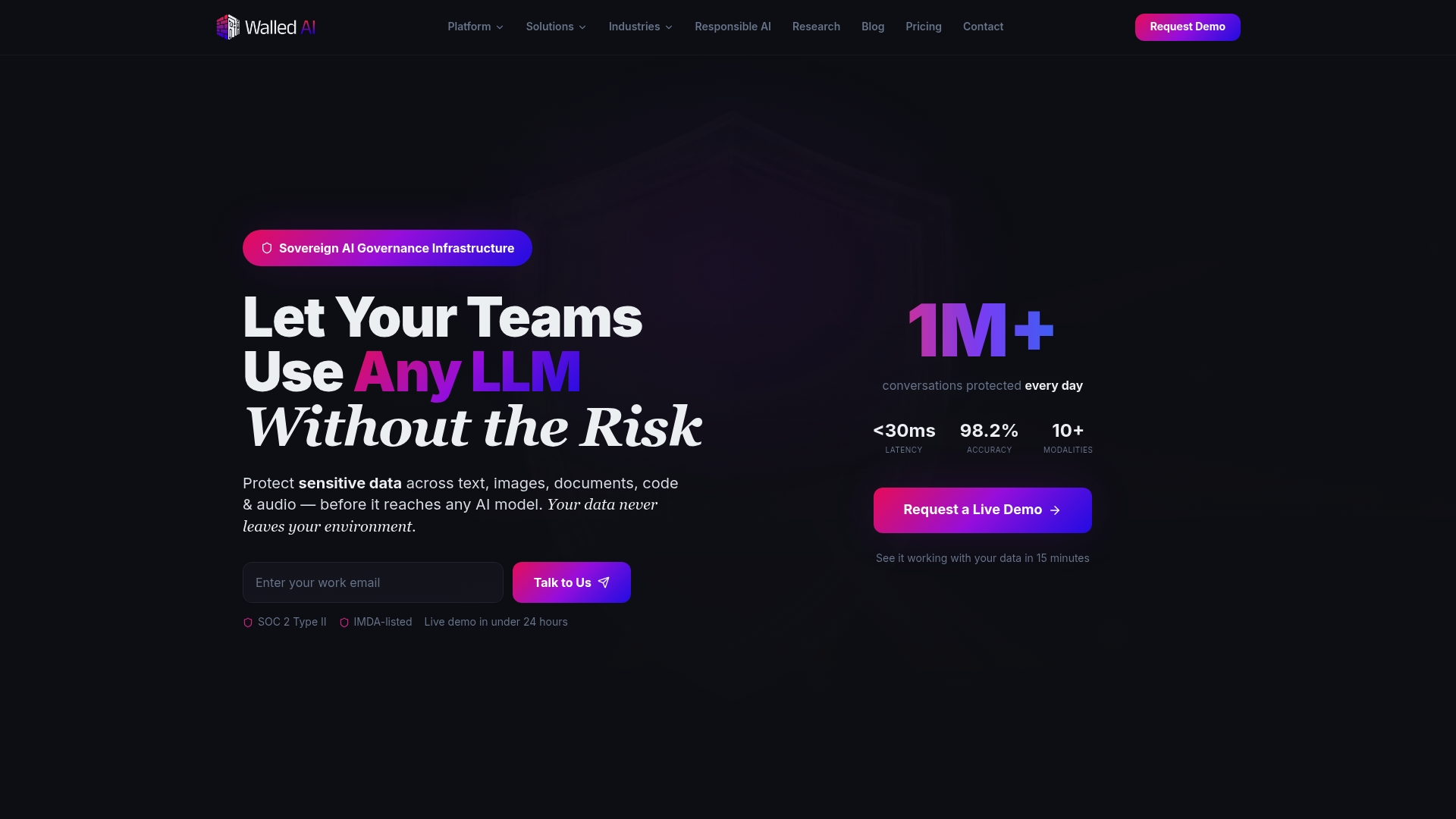
On-premise and air-gapped deployments keep sensitive data inside customer-controlled environments while WalledAI inspects and masks data in real time before it reaches any LLM. The platform logs every AI interaction and produces immutable audit trails mapped to regulatory frameworks. That combination targets regulated sectors that cannot accept cloud-only data flows.
Core Features
WalledAI intercepts AI requests at runtime and applies PII masking and data redaction across text, images, documents, code, and audio. It adds prompt injection and content safety guardrails and validates model responses against ground truth with hallucination detection. Centralized policy enforcement, granular role-based access control, and automated compliance reporting give auditors a single source of record for AI activity.
Key Differentiator
WalledAI is built for high-regulation environments with native on-premise and air-gapped deployment and pre-configured compliance frameworks. That design places governance controls and audit data inside enterprise infrastructure rather than pushing controls to third-party cloud providers. Organizations with strict data residency or air-gap requirements get a governance control plane that runs where their data already lives.
Pros
The platform covers runtime interception, AI data loss prevention, and logging in a single control plane, reducing the number of separate tools needed for governance. It applies masking and redaction across modalities, which helps protect intellectual property, source code, credentials, and regulated data. WalledAI provides automated audit trails and compliance reports aligned to MAS TRM, the EU AI Act, and HIPAA, which simplifies regulator-facing evidence collection. The vendor advertises low latency under <30ms, making the platform suitable for real-time enterprise workflows according to the company.
Cons
- Deployment complexity may require technical expertise for an on-premise or air-gapped installation.
Who It's For
Large enterprises and regulated organizations in finance, healthcare, and government that require on-premise or air-gapped AI governance and strict data sovereignty. Data protection officers and compliance teams that must retain full control of audit logs and regulator-ready reports will find the platform aligned to their operational constraints. Teams with minimal regulatory obligations may find the scope larger than necessary.
Unique Value Proposition
Automated, regulator-ready audit trail generation mapped to MAS TRM, the EU AI Act, and HIPAA reduces manual evidence collection during audits. That capability turns runtime enforcement events into exportable reports and immutable records, shortening the time compliance teams spend assembling documentation. For organizations under frequent regulatory scrutiny, that creates a measurable workflow change in how audit responses are assembled.
Real World Use Case
A healthcare provider routed AI summarization requests through WalledAI to mask PHI and redact identifiers before model inference. Audit logs captured every interaction and produced reports used during a HIPAA audit, supporting risk management and investigator queries. The deployment ran on private infrastructure to prevent patient data from leaving the provider's environment.
Pricing
Pricing is not explicitly stated; the vendor describes enterprise-tier licensing that varies by deployment scale and features. Prospective buyers should budget for enterprise procurement and factor in integration effort for on-premise or air-gapped rollouts.
Website: https://walled.ai
Vanta
At a Glance
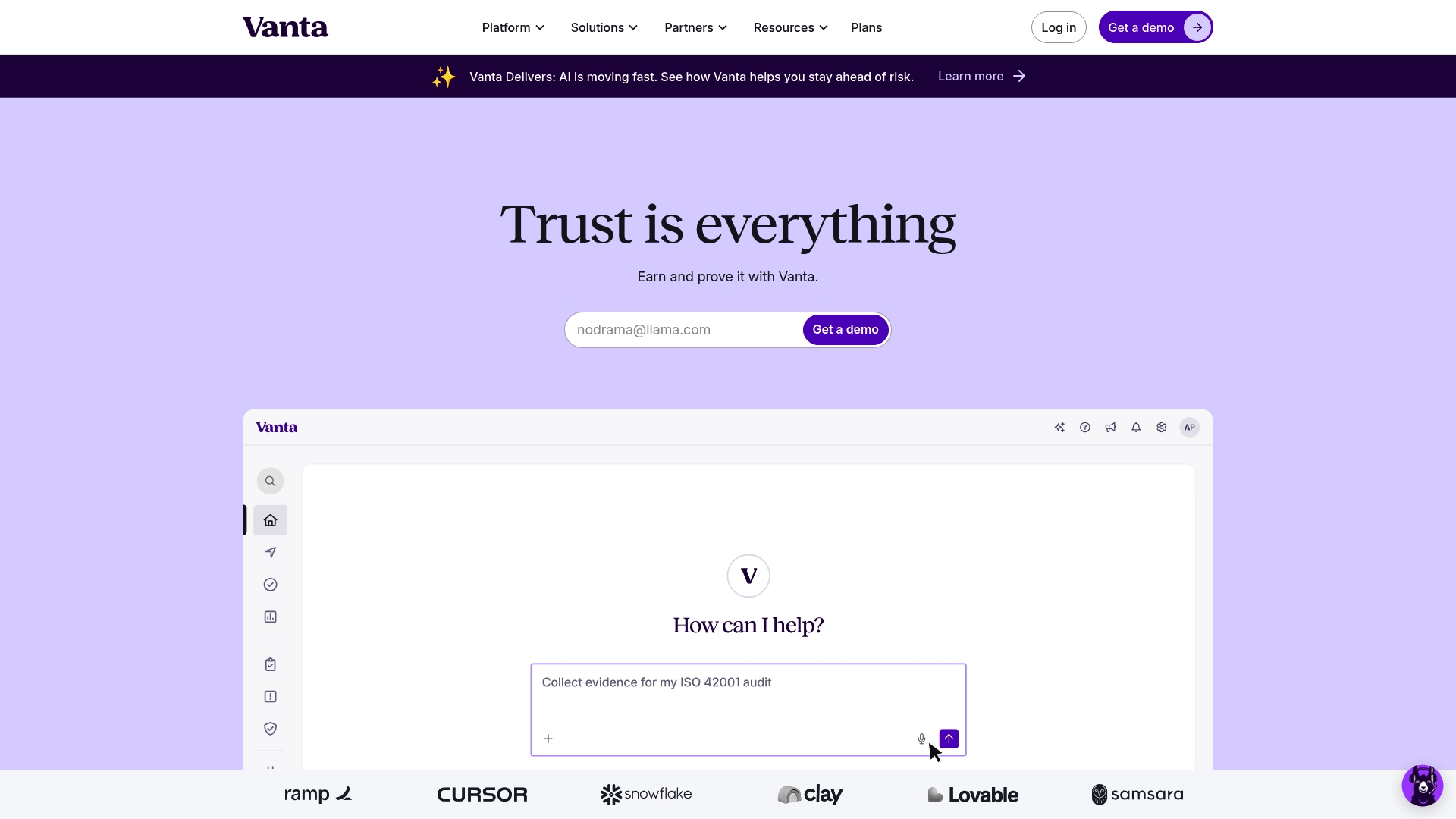
Vanta reports being trusted by over 16,000 customers. The product centers on an agentic trust approach that automates compliance work and evidence collection. It targets security and compliance teams at mid sized and large organizations that need continuous control monitoring.
Core Features
Vanta combines an agentic policy generator with an AI powered agent for drafting policies, mapping controls, and creating evidence artifacts. The platform runs continuous monitoring of controls and maintains vendor risk workflows that include vendor onboarding and security reviews. Audit preparation automation gathers evidence and produces reports to reduce manual audit tasks.
Key Differentiator
The defining element is the platform's agentic AI that drafts policies, maps controls, and pulls evidence into audit-ready bundles. That agent reduces repetitive manual work across control owners and auditors. The vendor emphasizes automation across policy, vendor risk, and audit operations.
Pros
Vanta automates complex compliance and risk management processes, which cuts routine work for security teams and internal auditors. The platform offers real time visibility into control status and evidence collection, which helps teams track readiness and respond to gaps faster. It supports scale through integrations and a custom API, so teams can connect existing security and productivity tools into workflows.
Cons
- Dependence on platform automation may miss nuanced or bespoke security controls that need manual review.
- Pricing is provided only via personalized quotes, which can make budgeting difficult for smaller organizations.
- Advanced enterprise customization may require professional services or engineering effort to integrate complex workflows.
When It May Not Fit
Organizations that require a fully bespoke control framework with minimal vendor workflow influence may find the platform restrictive. Teams with very small security staffing and tight fixed budgets may struggle with a quote based pricing model. Buyers seeking turnkey, one off point solutions for a single control often prefer lighter tools.
Notable Integrations
Vanta integrates with 400+ tools spanning common security and productivity platforms and supports a custom API for workflow automation. Integration coverage includes identity providers, cloud platforms, ticketing systems, and source control providers. The integration set lets teams automate evidence collection from existing services.
Who It's For
Security and compliance teams at mid sized and large software or technology organizations seeking automated trust documentation match Vanta well. Teams preparing for certifications or managing vendor risk will find its continuous monitoring capabilities relevant. Organizations that plan to centralize audit workflows and use APIs for automation will extract the most value.
Real World Use Case
According to the company, a SaaS startup automated its SOC 2 compliance process, reducing audit preparation time from months to weeks while keeping continuous risk monitoring. That example shows how automated evidence collection and monitoring speed audit readiness. The same pattern applies to vendor risk reviews that require repeated evidence pulls.
Pricing
Vanta requires a demo request for personalized pricing and commercial terms. Pricing depends on scope, number of integrations, and required customization. Prospective buyers should request a demo to obtain a tailored quote and implementation estimate.
Website: https://vanta.com
OneTrust
At a Glance
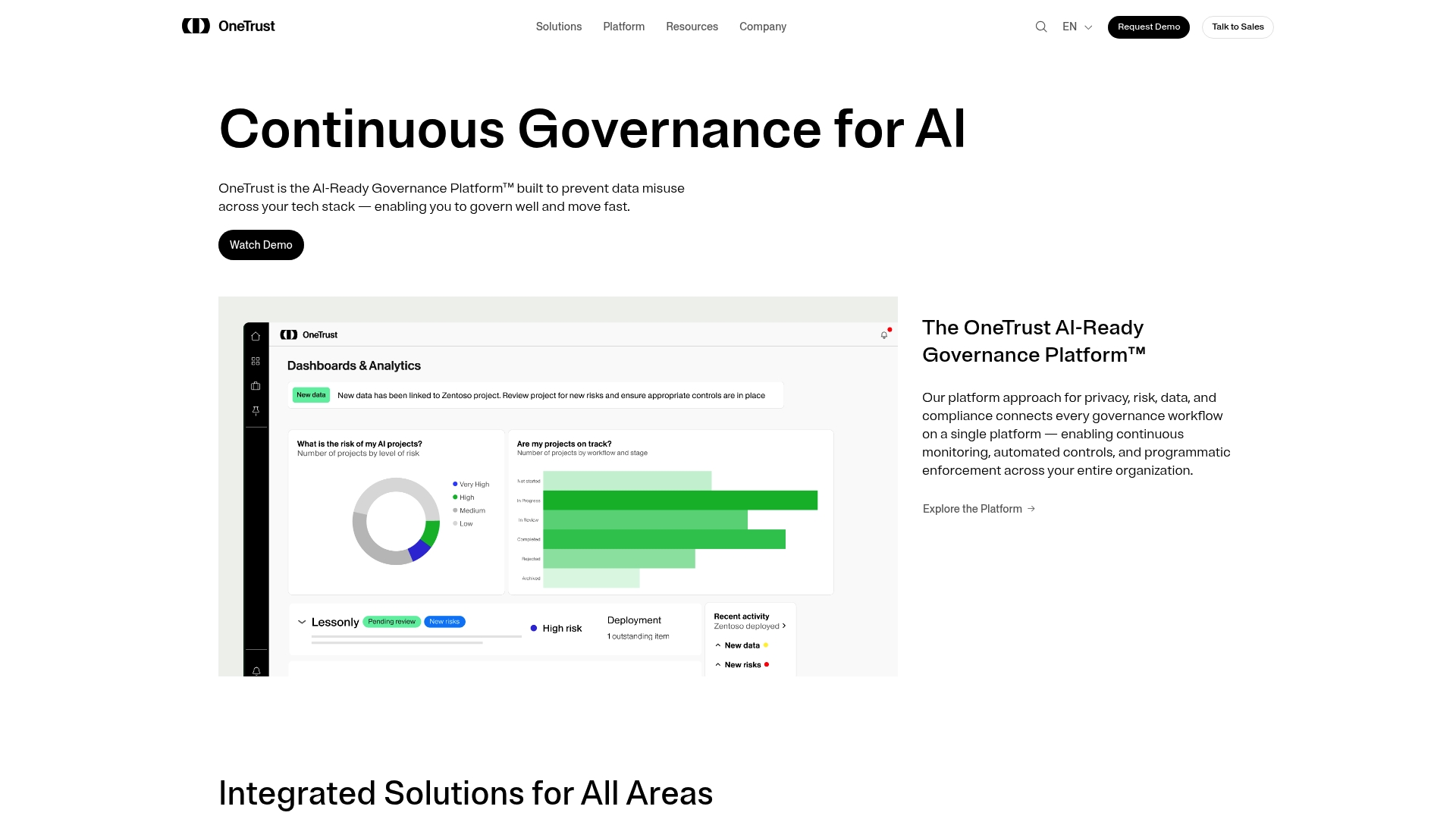
OneTrust's marketing materials state it was recognized as a Visionary in the 2026 Gartner Magic Quadrant for AI Governance Platforms. The platform combines privacy, risk, data, and AI governance into a single control plane for enterprise programs. That scope suits organizations that must monitor AI use and enforce policies across many systems.
Core Features
OneTrust provides a unified platform that links privacy management, AI governance, tech risk, and third-party oversight, while offering automated controls and programmatic enforcement. Real-time monitoring flags AI and data use issues before they propagate, and prebuilt connectors simplify mapping inventory to controls. The platform also includes consent management and data use governance workflows for regulated environments.
Key Differentiator
OneTrust centers its approach on connecting governance workflows end to end, combining privacy automation with AI risk controls and vendor oversight. That Gartner recognition accompanies an emphasis on integrations and cross-domain enforcement rather than point solutions focused only on model testing or data loss prevention.
Pros
OneTrust delivers a broad integration ecosystem that helps map AI inventory to enterprise controls and vendor risks. Automated policy enforcement and monitoring reduce manual review load and make recurring audits easier to reproduce. The platform fits large organizations that need combined privacy, third-party risk, and AI governance tools under one operational program. Flexible packaging supports scaling enforcement as inventories and regulatory obligations grow.
Cons
-
Deployment complexity. Third-party reviews report a nontrivial implementation effort and the need for dedicated implementation resources.
-
Cost sensitivity. Pricing can rise with larger AI inventories and more admin seats, which may strain smaller compliance budgets.
-
Learning curve. The platform’s breadth can overwhelm teams without prior governance program experience or training resources.
When It May Not Fit
Organizations with minimal compliance needs or only a handful of AI models will likely pay for far more capability than they use. Small teams without dedicated governance staff may find setup and ongoing rule tuning burdensome. Projects that require a lightweight, single-purpose tool for model validation rather than enterprise governance will not get the best return from this platform.
Notable Integrations
OneTrust provides prebuilt connectors for common enterprise systems, including Adobe, Microsoft, Snowflake, and Amazon Web Services. Those integrations help link data profiles and consent records to cloud storage, analytics, and marketing stacks. The connector list supports inventory discovery and automated enforcement across those environments.
Who It's For
Large and enterprise organizations that must manage privacy, AI ethics, third-party risk, and compliance across many business units. Data protection officers, legal teams, and centralized risk functions that require automated controls and audit trails will find the platform aligned with their governance mandates. Teams expecting to scale inventories and enforcement policies over time will gain the most value.
Real World Use Case
Iberia Airlines used OneTrust to upgrade privacy and incident management capabilities ahead of emerging regulation. The deployment helped unify privacy records and incident workflows, making evidence collection faster for regulatory reporting. That implementation illustrates how governance and operational processes can be combined for regulated enterprises.
Pricing
Explore the website for detailed pricing because costs depend on admin users, AI inventory size, data profiles, or visitor volumes per package. Enterprise license models typically involve per-seat or inventory-based components plus implementation fees. Prospective buyers should request a tailored quote to map scope to budget.
Website: https://onetrust.com
AssurAI
At a Glance
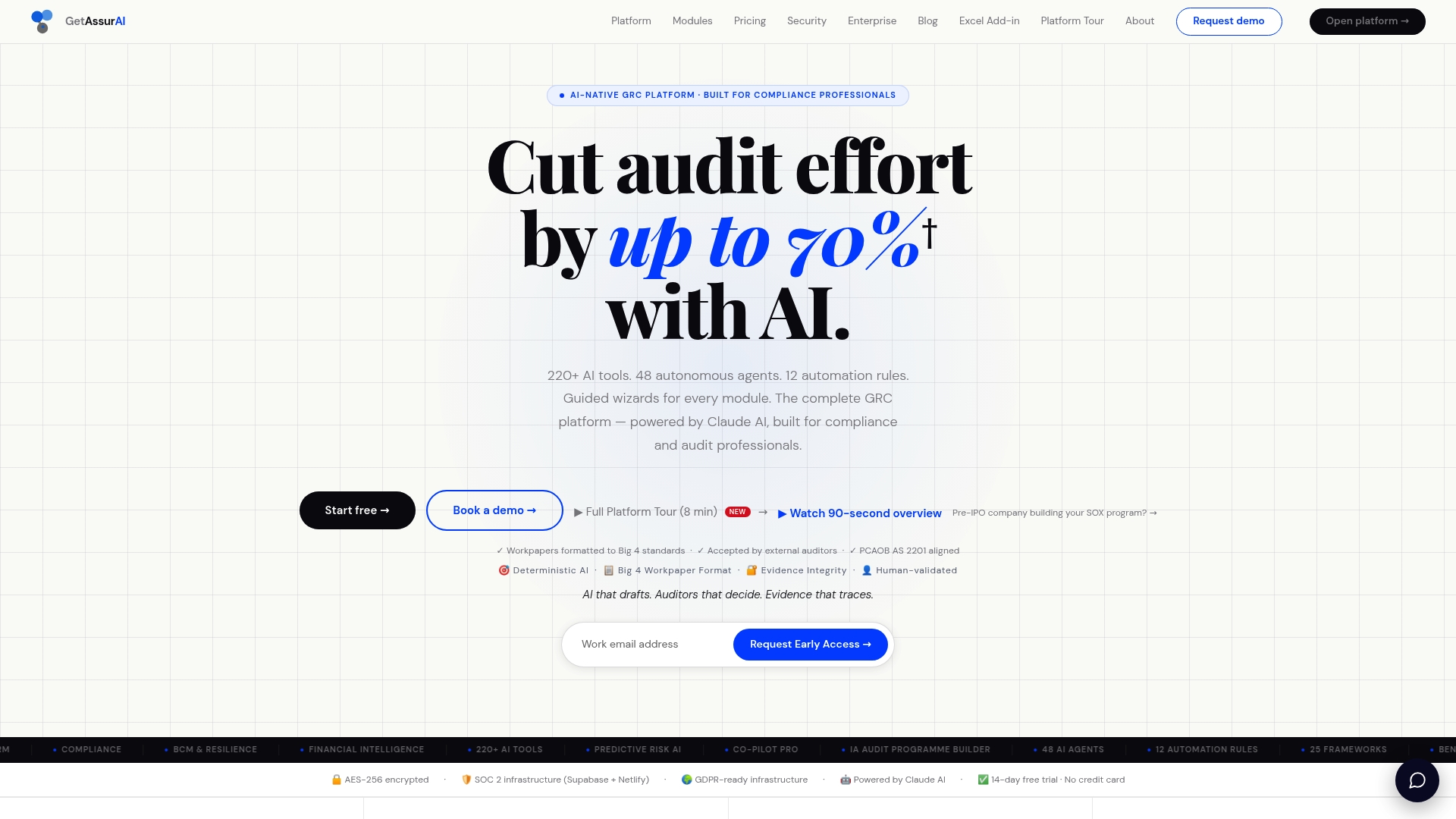
AssurAI reports 192 AI tools and 46 autonomous agents that automate audit workflows from scoping to reporting. The platform performs full population testing across entire data sets rather than relying on samples. It includes an Excel add in, guided wizards, and evidence classification to accelerate workpaper generation. These capabilities target audit and compliance teams preparing for SOX and internal control testing.
Core Features
AssurAI combines AI powered templates and an Evidence Intelligence tool to classify evidence, evaluate controls, and generate workpapers. Autonomous agents execute multi step audit processes and the platform drafts, reviews, and signs off reports while mapping controls across frameworks. Collaboration features include decision logs, continuous monitoring, and flexible deployment options for cloud or on premise use.
Key Differentiator
The vendor positions AssurAI as an AI native GRC platform purpose built for audit and compliance workflows. Its standout capability is autonomous agents that orchestrate complex, multi step testing sequences and cross framework control mapping. That operational focus narrows the product to audit heavy use cases rather than general purpose GRC activity.
Pros
The vendor advertises reductions in audit effort of up to 70%. Full population testing and cross framework mapping improve control coverage and reduce reliance on sampling. Being built by practitioners gives the product templates and guided workflows that match audit methodologies and SOX needs. Flexible deployment covers cloud, private cloud, and on premise requirements, and pricing is presented as transparent across tiers.
Cons
- The platform’s breadth and workflow automation require formal training to reach peak efficiency.
- Premium features and enterprise deployment are subscription based and may increase costs for very large programs.
- AI generated outputs still need professional review to confirm accuracy and regulatory alignment.
When It May Not Fit
Organizations with small audit teams and limited training bandwidth may find onboarding time intensive. Very small firms with constrained budgets could face higher per seat costs for enterprise grade features. Teams unwilling to review machine assisted outputs manually would not match the product’s operational model.
Who It's For
AssurAI suits internal audit, risk, and compliance teams in medium to large organizations pursuing automation for SOX, ICFR, and internal audit workflows. It fits teams that need wide control coverage, full population transaction testing, and practitioner aligned templates. It is also relevant for companies preparing for a pre IPO SOX program.
Real World Use Case
According to the company, a large multinational reduced audit hours by 50% after adopting AssurAI for SOX testing. That deployment used full population transaction testing to improve control coverage and shorten reporting cycles. The example highlights the platform’s role in high volume, time sensitive compliance programs.
Pricing
Plans start at $499/month for the Starter plan. More comprehensive options exist for growing teams, and enterprise plans are customized for large deployments. The vendor describes pricing as transparent with no hidden fees.
Website: https://getassurai.com
WitnessAI
At a Glance
WitnessAI applies intent based machine learning to analyze conversations across sessions and flag suspicious behavior. The product pairs activity observation with automated red teaming to surface attack vectors before deployment. That combination focuses on visibility and proactive defense for complex AI estates.
Core Features
WitnessAI captures AI activity across applications, agents, and user sessions and displays that activity for investigation. The platform offers protection against adversarial attacks and model manipulation while enforcing policies, masking sensitive data, and keeping granular audit trails. Automated security testing runs simulated attacks against models before production to uncover vulnerabilities.
Key Differentiator
The platform's standout mechanism is its use of intent based ML models to read conversation context across sessions and detect unusual patterns. That behavioral approach prioritizes suspicious intent over single event triggers and reduces alert noise from benign activity. Organizations with many chat driven workflows will find this proactive signal detection particularly relevant.
Pros
WitnessAI delivers broad visibility and a single control plane for human and machine actors, which simplifies oversight across a sprawling AI inventory. The security feature set combines runtime defenses, data protection, and policy enforcement with automated testing, so teams can validate model hardening before rollout. Native support for desktop AI applications such as Windows Copilot and Office 365 helps capture shadow AI that other network only tools miss.
Cons
- Deployment complexity reported by third party reviews. Integration and tuning can require experienced security staff or vendor support.
- Cost is likely higher than small scale tools. Pricing appears aimed at enterprise customers rather than small teams.
- Public information lacks specific detail on onboarding and day one usability. Buyers must plan for a learning curve.
When It May Not Fit
Organizations without a mature cybersecurity baseline may struggle with integration and operational overhead. Smaller teams with limited AI assets will likely find the platform expensive relative to their needs. If rapid, low friction pilots are the priority, WitnessAI may feel heavyweight.
Who It's For
Large enterprises with complex AI environments and established security operations will gain the most value. Security and compliance teams that must monitor agents, enforce audit trails, and prove regulatory controls are the primary audience. Organizations running desktop AI at scale or managing many conversational flows will see clearer returns.
Real World Use Case
A global airline used WitnessAI to catalog deployed AI tools, monitor agent and employee interactions, and enforce security policies across regions. Automated red teaming surfaced prompt injection scenarios before models reached staff support systems. The team used audit trails from the platform to support regulatory reporting during deployment.
Pricing
Pricing is not specified publicly and is presented as enterprise tier with custom quoting. Buyers should expect per deployment or seat arrangements and request a tailored quote from sales. Budget planning must include professional services for deployment and tuning.
Website: https://witness.ai
Comparison of alternatives
WalledAI, Vanta, OneTrust, AssurAI, and WitnessAI each offer unique approaches to AI governance and security. Among these, WalledAI positions itself as a leader in environments with strict regulatory requirements.
Deployment and Customization Constraints
WalledAI excels in handling on-premise and air-gapped requirements, ensuring compliance where sensitive data must remain entirely within controlled infrastructures. WitnessAI demonstrates strengths in detecting adversarial AI activity with its automated red-teaming features, catering to organizations with heightened security concerns. While Vanta and AssurAI provide automated evidence collection capabilities streamlined for SOC 2 and compliance audits respectively, these depend on cloud integrations. OneTrust delivers broad integration for privacy-centric governance workflows, benefiting teams managing large, international data sets.
Specialized AI Governance Functions
WitnessAI showcases proactive defense mechanisms, including intent-based ML models, providing refined monitoring against security breaches in conversation-driven workflows. AssurAI offers transaction testing and audit templates aligned with SOX. These two competitors stand out for narrow, security-focused use cases, whereas Vanta and OneTrust capture broader compliance goals through centralized frameworks and policy automation.
Best fit
- Large organizations with data sovereignty needs will benefit most from WalledAI's air-gapped deployments and regulator-aligned capabilities.
- Teams focused heavily on SOC 2 evidence collection may gravitate toward Vanta's automation capabilities.
- Clients requiring broad-spectrum AI attack detection and prevention should consider WitnessAI for its automated vulnerability-testing features.
- Enterprises managing diverse governance needs across multiple regions and operational domains might prioritize OneTrust's privacy and ethical AI workflows integration.
Our pick
WalledAI offers capabilities in protecting regulated environments through its distinctive on-premise infrastructure and real-time data masking capabilities. Enterprises requiring full control over AI interactions and compliance reporting will find it. Yet, organizations centered around adversarial AI threat detection may find WitnessAI's approach highly compelling instead.
Choosing the appropriate AI governance platform depends significantly on the specific requirements for data security, compliance, feature robustness, and pricing transparency.
| Product | Key Feature | Target Audience | Pricing | Limitation |
|---|---|---|---|---|
| Walled | On-premise / air-gapped deployment | Regulated sectors like finance, healthcare, government | Price not published | Deployment complexity may require technical expertise |
| Vanta | Agentic automation for compliance workflows | Security and compliance teams in tech organizations | Price not published | May not suit highly customized security frameworks |
| OneTrust | Unified AI, privacy, and tech risk governance | Large enterprises managing multi-domain compliance | Price not published | Comprehensive features require training and a mature setup |
| AssurAI | Autonomous agents for audit and compliance | Audit teams focusing on SOX and ICFR | Starting at $499/month | AI outputs need manual review for accuracy |
| WitnessAI | Intent-based conversation analysis | Enterprises with complex AI environments | Price not published | Resource-intensive integration and initial setup efforts |
How Can Organizations Address AI Audit and Compliance Challenges in Regulated Environments?
Enterprises preparing for SOX, ICFR, and internal audit workflows face pressure to minimize manual effort while maintaining trust in AI governance. Walled offers a sovereign AI security and governance platform that preserves sensitive data within controlled environments. Key capabilities include real-time AI Data Loss Prevention, prompt injection protection, and immutable audit trails aligned to regulatory frameworks such as MAS TRM and the EU AI Act.
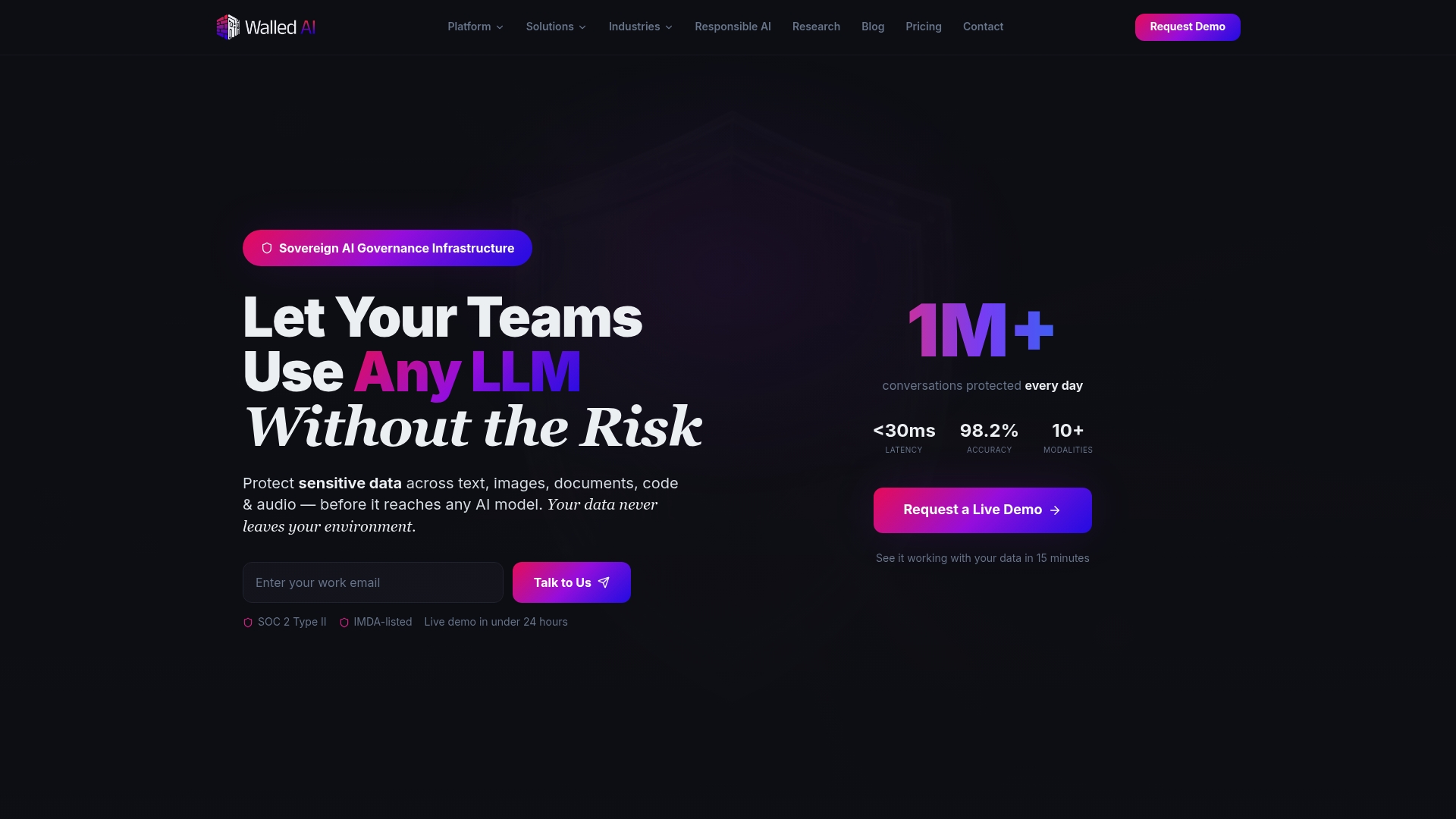
Compliance teams seeking a unified AI control plane with on-premise and air-gapped deployment options can explore Walled to improve data sovereignty and reduce risks of data exposure. Visit Walled to learn how to govern AI interactions securely and assemble regulator-ready reports with less manual effort.
FAQ
What feature makes Walled particularly suitable for regulated sectors?
Walled specializes in providing on-premise and air-gapped deployments, which ensures sensitive data remains within customer-controlled environments. The platform inspects and masks data in real time before it reaches any large language model (LLM), making it ideal for organizations with strict regulatory compliance needs. The ability to log every AI interaction with immutable audit trails mapped to regulatory frameworks helps meet compliance obligations. Prospective users in regulated sectors should consider Walled for its strong emphasis on data protection and compliance.
How does Walled differ from Vanta in automation capabilities?
Vanta excels in automating continuous control monitoring and vendor risk workflows, which helps reduce audit preparation time significantly. Organizations focused on continuous visibility and automation in compliance reporting will find Vanta appealing. Walled, meanwhile, offers comprehensive masking and redaction services specifically designed for AI data loss prevention. Interested teams should evaluate their specific needs regarding either real-time masking or continuous compliance monitoring.
Which platform is better for teams requiring rapid deployment?
Vanta provides streamlined audit preparation automation that can greatly reduce the manual effort required for audits. This rapid deployment capability benefits teams aiming for faster compliance cycles. In contrast, Walled's complex deployment may require technical expertise for on-premise or air-gapped installations, which might not suit teams looking for a quick start. Depending on your team's capability, select the platform that best fits your immediate deployment needs.
Will Walled's real-time data protection capabilities suit my organization?
Walled's ability to apply PII masking and data redaction across various data types, such as text and images, makes it a robust choice for organizations that handle sensitive data. This aligns well with the needs of compliance teams in regulated sectors. Users should ensure they assess their specific governance requirements to determine if Walled’s features match their operational constraints.
What kind of organizations benefit most from using Walled?
Walled is particularly effective for large enterprises and regulated organizations, especially in finance, healthcare, and government sectors. These organizations often require strict data sovereignty and governance controls over AI operations. Data protection officers and compliance teams will find Walled’s capabilities especially relevant, as the platform allows for full control of audit logs and regulator-ready reports.