

Enterprise AI risk assessment is the structured process of identifying, evaluating, and mitigating the specific risks that AI systems introduce into an organization's operations, data environment, and governance structure. Unlike traditional IT risk management, AI risk assessment must account for model behavior, data drift, autonomous decision-making, and the propagation of errors across interconnected systems. Frameworks such as ISO 27001, NIST CSF, and adaptive standards like the BK-GA³™ framework are shaping how enterprises approach this discipline in 2026. Compliance officers and risk managers who treat AI risk as a subset of general IT risk will consistently underestimate their exposure.
What are the key risks enterprises face when deploying AI systems?
AI systems introduce risk categories that traditional enterprise risk analysis frameworks were never designed to handle. The speed, autonomy, and interconnected nature of AI deployments create a risk profile that requires its own assessment methodology.
Operational risks are the most immediately visible. AI models degrade over time as the data they were trained on diverges from real-world inputs, a phenomenon known as model drift. Without continuous observability, a drifting model can produce flawed outputs for weeks before anyone detects the problem. Insufficient monitoring infrastructure means these failures often surface only after they have affected business decisions.

Security risks go beyond standard data breach scenarios. Adversarial attacks, prompt injection, and jailbreak attempts target AI systems specifically to extract sensitive data or manipulate outputs. Agentic AI introduces risks beyond traditional IT boundaries by adding autonomy, intent, and multiagent collaboration. That autonomy means a single compromised agent can trigger cascading failures across organizational assets.
Ethical and compliance risks are less visible but carry significant regulatory consequences. Biased model outputs, unexplainable decisions, and accountability gaps all create exposure under frameworks like the EU AI Act and GDPR. Enterprises that cannot document how an AI system reached a decision face direct liability in regulated industries.
AI risk in enterprises propagates through autonomous decision-making and interconnected systems, amplifying the impact of errors or malicious manipulation rapidly across organizational assets. This propagation effect means that a single point of failure in an AI pipeline can become an enterprise-wide incident within hours.
The combined effect of these risk categories is that AI autonomy creates a propagation risk multiplier. Compliance officers must treat AI risk as a distinct discipline, not a footnote to existing cybersecurity programs.
How can organizations effectively assess AI risk at the enterprise level?
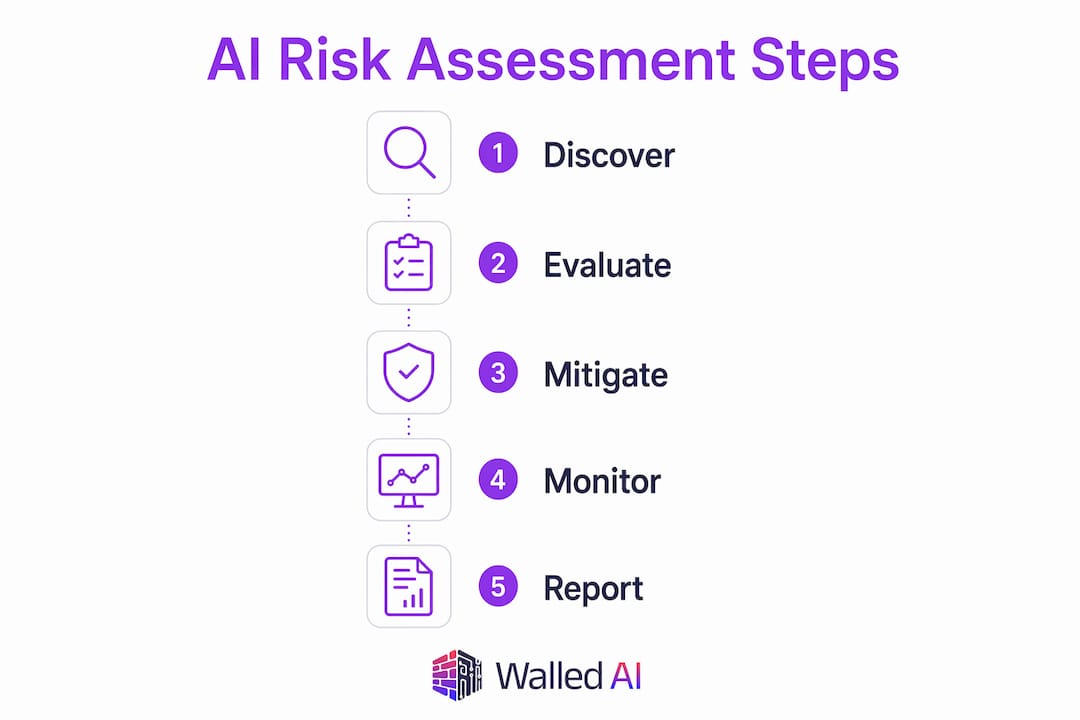
A credible enterprise AI risk assessment follows a structured methodology that covers discovery, classification, continuous monitoring, and integration with existing enterprise risk management (ERM) processes.
-
Catalog all AI assets, including shadow AI. Many organizations underestimate how many AI tools are in active use. Browser-based AI assistants, third-party copilots, and departmental automation tools often operate outside IT visibility. A complete asset inventory is the foundation of any meaningful assessment.
-
Apply an adaptive assessment framework. The BK-GA³™ framework consolidates over 50 international security standards including ISO and NIST into a single adaptive model. Traditional multi-year vendor risk questionnaires are inadequate for AI risks that evolve on a monthly basis. Adaptive frameworks update continuously, which matches the pace at which AI threat vectors actually change.
-
Classify risks across four dimensions. Technical risks cover model behavior and infrastructure. Operational risks cover process dependencies and failure modes. Ethical risks cover fairness, bias, and explainability. Third-party supply chain risks cover vendors, APIs, and upstream model providers.
-
Build a Known Limits Register. A Known Limits Register catalogs known AI model failure scenarios, preventing teams from running redundant tests and sharpening targeted mitigation. This document becomes a living reference that feeds directly into your incident response planning.
-
Embed AI risk into existing ERM processes. AI risk assessment should not operate as a standalone program. Connecting it to your existing ERM structure ensures that AI-related findings reach the right decision-makers and inform capital allocation, audit schedules, and board reporting.
Pro Tip: When conducting your initial AI asset discovery, include procurement and finance teams. They often hold contracts for AI-enabled SaaS tools that IT has never reviewed.
The full value chain scope of AI risk assessment extends beyond individual systems to cover upstream data providers and downstream business processes. Compliance officers who limit their scope to internally built models miss the majority of their actual exposure.
What tools and practices support continuous AI risk monitoring?
Completing a point-in-time assessment is not sufficient. AI systems change, and so do the threats targeting them. Continuous monitoring is the operational layer that keeps your risk posture current.
| Control Category | Function | Governance Benefit |
|---|---|---|
| AI observability platforms | Detect model drift, data quality issues, and pipeline failures in real time | Reduces unplanned AI downtime and accelerates incident response |
| Automated alerting | Triggers notifications when AI outputs fall outside defined thresholds | Enables faster escalation before errors propagate |
| AI ethics committees | Review high-risk use cases and approve deployment decisions | Creates documented accountability for AI-assisted decisions |
| Identity and access controls | Enforce least-privilege access for AI agents and APIs | Limits blast radius of compromised or misbehaving agents |
| Immutable audit trails | Record all AI interactions and policy enforcement actions | Supports regulatory reporting and forensic investigation |
Enterprise users of dedicated AI observability platforms reported an average 375% ROI driven by operational efficiency. That figure includes an 80% reduction in data downtime and significant cost avoidance from proactively managing model drift and failures. The financial case for continuous monitoring is not theoretical.
Agentic AI demands a shift from isolated security silos to integrated governance models aligning identity, data protection, and Zero Trust architectures. Enterprises running agentic workflows need agent trust platforms that provide end-to-end observability across every action an AI agent takes, not just the inputs and outputs at the boundary.
AI governance models require embedding AI ethics into policy frameworks with structured use case risk classifications, oversight committees, and continuous monitoring. Without this structure, ethics reviews become ad hoc and accountability gaps persist.
Pro Tip: Tie your automated alerting thresholds directly to your Known Limits Register. When a model approaches a documented failure scenario, your alert fires before the failure occurs, not after.
The enterprise AI governance framework that supports these controls must be reviewed at least quarterly. AI threat vectors evolve faster than annual review cycles can accommodate.
How do AI risk assessments align with regulatory compliance obligations?
Enterprise AI compliance obligations are expanding rapidly. Compliance officers who treat AI risk assessment as a governance exercise separate from regulatory compliance will find themselves managing two parallel programs that should be one.
The alignment between AI risk assessment and regulatory frameworks is direct:
- EU AI Act: Requires risk classification of AI systems before deployment, with high-risk systems subject to conformity assessments, technical documentation, and human oversight requirements.
- GDPR and PDPA: Mandate data minimization, purpose limitation, and the ability to explain automated decisions affecting individuals. AI risk assessments that cover data flows and model explainability directly satisfy these obligations.
- ISO 27001: Provides the information security management foundation that AI risk controls must integrate with. AI-specific controls map onto existing ISO 27001 control domains.
- NIST AI RMF: Offers a four-function structure (Govern, Map, Measure, Manage) that aligns directly with enterprise AI risk assessment methodology.
- MAS TRM: Applies to financial institutions in Singapore and requires technology risk governance that explicitly covers AI and algorithmic systems.
Corporate AI risk assessment must cover the entire upstream and downstream value chain, enabling visibility of AI risks at executive and board levels to support formal financial and sustainability disclosures. This is not just a governance best practice. Regulators and investors increasingly expect it.
Compliance officers should document AI risk findings in a format that maps directly to the regulatory frameworks their organization is subject to. A single assessment that produces outputs readable by both the CISO and the general counsel eliminates duplication and reduces the risk of inconsistent disclosures. For organizations managing agentic AI system risks, this documentation layer becomes especially critical because agent behavior is harder to predict and audit than deterministic software.
Standardized assessments also support third-party due diligence. When your AI vendors can demonstrate alignment with ISO, NIST, or the BK-GA³™ framework, your own compliance reporting becomes more defensible.
Key Takeaways
Effective enterprise AI risk management requires adaptive frameworks, continuous monitoring, and direct integration with regulatory compliance obligations.
| Point | Details |
|---|---|
| AI risk is distinct from IT risk | AI autonomy, drift, and propagation effects require dedicated assessment methodology beyond standard cybersecurity programs. |
| Adaptive frameworks outperform static ones | Frameworks synthesizing 50+ standards like BK-GA³™ update continuously, matching the pace of evolving AI threat vectors. |
| Continuous monitoring delivers measurable ROI | Enterprises using AI observability platforms report 375% ROI and 80% reduction in data downtime from proactive risk controls. |
| Regulatory alignment requires full value chain scope | AI risk assessments must cover upstream vendors and downstream processes to satisfy EU AI Act, GDPR, and NIST obligations. |
| Known Limits Registers sharpen mitigation | Documenting AI model failure scenarios prevents redundant testing and enables targeted, evidence-based risk controls. |
The gap most compliance teams don't see until it's too late
The most common failure I see in enterprise AI risk programs is not a lack of frameworks. Most organizations have access to ISO, NIST, and a dozen vendor-supplied assessment templates. The failure is scope. Teams assess the AI systems they built or procured through formal channels, and they stop there.
Shadow AI is where the real exposure lives. A finance analyst using a browser-based AI assistant to summarize earnings calls, a sales team running customer data through an unapproved copilot, a developer using an AI coding tool that sends proprietary source code to an external model. None of these show up in a traditional asset inventory. All of them create genuine compliance exposure under GDPR, PDPA, and the EU AI Act.
The second gap is treating agentic AI the same as deterministic software. An AI agent that can browse the web, write and execute code, and call external APIs is not a chatbot. Its risk profile is closer to an autonomous employee with system access. The governance controls you apply to a static model, output filtering and basic logging, are insufficient for an agent that can take actions with real-world consequences.
The organizations that get this right share one characteristic: cross-functional ownership. Risk, compliance, IT, legal, and business unit leaders all participate in the assessment process. No single team has the full picture. The compliance officer knows the regulatory obligations. The CISO knows the threat vectors. The business unit leader knows which AI tools are actually in use. You need all three in the same room.
The future of enterprise AI risk assessment is continuous and automated. Manual quarterly reviews will not keep pace with the rate at which AI capabilities and threats evolve. The teams investing now in observability infrastructure, automated policy enforcement, and integrated governance will be significantly better positioned when regulators start asking for evidence.
— Rishabh
How Walled supports enterprise AI governance and risk assessment
Walled provides enterprise AI governance infrastructure designed for organizations that cannot afford gaps between their AI deployment pace and their compliance posture. The platform delivers real-time AI Data Loss Prevention, prompt injection defense, and immutable audit trails across browser-based tools, desktop applications, and agentic workflows. Walled supports on-premises, private cloud, and air-gapped deployments, so sensitive data stays within customer-controlled environments. For financial services, healthcare, government, and technology organizations, Walled maps directly to GDPR, PDPA, the EU AI Act, and MAS TRM obligations. Organizations seeking fast deployment can explore mid-market AI governance options built for rapid operationalization without sacrificing compliance depth.
FAQ
What is enterprise AI risk assessment?
Enterprise AI risk assessment is the structured process of identifying, evaluating, and mitigating risks that AI systems introduce across an organization's operations, data environment, and governance structure. It covers technical, operational, ethical, and third-party supply chain dimensions.
How does AI risk assessment differ from traditional IT risk management?
AI risk assessment addresses model-specific threats such as drift, adversarial attacks, and autonomous agent behavior that traditional IT risk frameworks were not designed to handle. AI autonomy creates a propagation risk multiplier that amplifies the impact of failures across interconnected systems.
Which regulatory frameworks require AI risk assessments?
The EU AI Act mandates conformity assessments for high-risk AI systems. GDPR and PDPA require explainability and data protection controls. NIST AI RMF and ISO 27001 provide the governance structures that most enterprise AI risk programs map to.
How often should enterprises conduct AI risk assessments?
AI risk vectors evolve on a monthly basis, making traditional annual or multi-year assessment cycles inadequate. Enterprises should implement continuous monitoring with automated alerting, supplemented by formal reviews at least quarterly.
What is a Known Limits Register in AI risk management?
A Known Limits Register is a documented catalog of known AI model failure scenarios. It prevents redundant testing, sharpens targeted risk mitigation, and feeds directly into incident response planning for compliance and risk teams.