

Compliance challenges in AI adoption are defined as the regulatory, technical, and organizational barriers that prevent enterprises from deploying AI systems within legal and governance boundaries. 77% of companies rank AI compliance as a top priority, yet only 25% have governance frameworks strong enough to act on that priority. The gap is not a matter of intent. It reflects the structural complexity of governing AI systems that evolve faster than the regulations written to control them. Frameworks like the EU AI Act, GDPR, and the NIST AI Risk Management Framework (AI RMF) now define the outer boundaries of legally compliant AI deployment, and the cost of missing those boundaries is severe.
1. What are the major regulatory challenges AI adoption presents in 2026?
The regulatory environment for AI is not a single law. It is a layered stack of overlapping obligations that vary by jurisdiction, industry, and use case. Compliance officers must simultaneously satisfy the EU AI Act, GDPR, U.S. AI Executive Orders, Singapore's PDPA, MAS TRM guidelines, and a growing body of U.S. state privacy laws. Each framework carries its own definitions, risk tiers, and enforcement mechanisms.
The financial exposure is significant. Non-compliance with the EU AI Act can trigger fines up to €35 million or 7% of global annual turnover. GDPR violations carry penalties up to €20 million or 4% of global turnover. These are not theoretical maximums reserved for egregious cases. Regulators in the EU have demonstrated a willingness to pursue large enterprises.

The deeper problem is conflict between frameworks. GDPR's data minimization principle directly clashes with the data-intensive requirements of agentic AI systems. An AI agent that must access broad organizational data to complete a task may violate GDPR by design. Governance guardrails must be custom-built to resolve this conflict, and no off-the-shelf policy template covers it adequately.
Compliance officers cannot treat regulatory challenges as a one-time legal review. The regulatory scope is expanding to cover multi-agent AI systems, foundation model providers, and AI-assisted decision-making in high-risk domains including hiring, credit, and healthcare.
2. How does the "black-box" nature of AI complicate compliance?
Regulatory transparency obligations assume that an organization can explain how an automated decision was made. Modern large language models cannot satisfy that assumption. The complex decision processes of LLMs are non-interpretable by design, which directly conflicts with the EU AI Act's explainability requirements for high-risk AI systems.
This is not a minor technical limitation. Auditability depends on the ability to trace a decision back to its inputs, logic, and data sources. When an AI model produces a credit denial, a hiring recommendation, or a medical triage output, regulators expect a documented rationale. Black-box models cannot provide one without additional interpretability tooling layered on top.
The problem compounds with agentic AI. An AI agent that takes multi-step actions across systems creates a chain of decisions, each of which may require independent justification. Existing model-level safety filters were not designed to satisfy regulatory audit requirements. They were designed to reduce harmful outputs, which is a different objective entirely.
Pro Tip: Deploy an interpretability layer alongside any high-risk AI system. Tools that log input-output pairs, flag decision thresholds, and generate human-readable rationale summaries are not optional for EU AI Act compliance. Build them into the deployment architecture before go-live, not after.
3. What organizational hurdles obstruct effective AI governance?
Shadow AI is the largest single compliance gap in most enterprises. 73% of AI compliance failures are uncovered during discovery, meaning the AI tools causing the problem were not on the compliance team's radar. Employees adopt browser-based AI tools, AI-assisted coding environments, and AI copilots without formal procurement or security review. Each undisclosed deployment is a potential regulatory exposure.
The organizational hurdles break down into four categories:
- Lack of AI inventory. Most organizations cannot produce a complete list of AI models in active use across business units. Without inventory, governance is impossible.
- Absent ownership. AI systems deployed by product teams, marketing, or operations often have no designated compliance owner. Accountability gaps create audit failures.
- Point-in-time audits. Annual or quarterly compliance reviews do not reflect the continuous risk profile of AI systems that update, retrain, or change behavior over time.
- Disconnected MLOps. Compliance controls that exist only in policy documents are not enforced at the model or data layer. Engineering teams and compliance teams operate in separate workflows.
Pro Tip: Conduct a Shadow AI discovery audit before any formal governance program launch. Use network traffic analysis and endpoint monitoring to surface AI tool usage that bypasses procurement. You cannot govern what you cannot see.
The organizational fix requires embedding compliance ownership directly into the AI development and deployment lifecycle. Compliance officers must have a seat in MLOps governance reviews, not just in legal sign-off processes.
4. What best practices enable scalable AI compliance?
Scalable AI compliance requires a shift from policy-based governance to engineering-based governance. Embedding compliance controls into the MLOps lifecycle is the only approach that scales with the speed and volume of modern AI deployment. Manual human review gates create bottlenecks that slow deployment without improving compliance outcomes.
The core technical practices that enable scalable governance include:
- Tamper-evident audit logs. Every AI interaction, decision, and data access event must be logged in an immutable format. Compliance auditors require continuous evidence, not point-in-time documentation, and audit logs are the primary evidence source.
- Automated policy enforcement. Compliance rules must be enforced at the data layer, not described in a policy document. Real-time inspection of AI inputs and outputs catches violations before they create regulatory exposure.
- Model drift detection. AI models change behavior as they retrain or receive new data. Automated monitoring for output distribution shifts flags compliance-relevant changes without requiring manual review.
- Authenticated agent identity. Agentic AI systems must have verified, logged identities so that every action taken by an AI agent can be attributed and audited.
The following table compares point-in-time audit approaches against continuous compliance monitoring:
| Dimension | Point-in-time audit | Continuous monitoring |
|---|---|---|
| Frequency | Annual or quarterly | Real-time |
| Coverage | Sampled outputs | All interactions |
| Drift detection | Retrospective | Proactive |
| Audit readiness | Periodic preparation | Always audit-ready |
| Scalability | Low | High |
Organizations with mature governance frameworks deploy AI faster and pass audits more easily. Governance maturity is not a compliance cost. It is a deployment accelerator.
5. How do data privacy obligations intersect with AI compliance risks?
Data privacy law is the most immediate compliance risk for AI systems that process personal data. GDPR, PDPA, HIPAA, and CCPA each impose obligations on how personal data is collected, stored, processed, and used in AI workflows. AI systems that ingest customer records, employee data, or health information without proper classification and access controls violate these obligations by default.
The structural tension between GDPR's data minimization requirement and agentic AI's data needs is the clearest example of this conflict. GDPR requires that only the minimum necessary data be processed for a defined purpose. Agentic AI systems, by contrast, often require broad data access to complete complex tasks. Resolving this conflict requires purpose-limitation controls built into the AI architecture, not just stated in a privacy notice.
AI Data Loss Prevention (AI-DLP) addresses this gap directly. Real-time inspection of data flowing into AI models detects and masks sensitive information including personally identifiable information, source code, credentials, and regulated health data before it reaches the model. This approach satisfies data minimization obligations without blocking AI functionality. For compliance officers managing regional AI regulatory compliance across multiple jurisdictions, AI-DLP is a foundational control.
6. What role does AI governance play in high-risk industry sectors?
The role of compliance in AI deployment is most acute in regulated industries. Financial services organizations face MAS TRM guidelines, Basel III model risk requirements, and consumer protection laws that govern AI-assisted credit and fraud decisions. Healthcare organizations must satisfy HIPAA's privacy and security rules for any AI system that processes protected health information. Government agencies face additional requirements around data sovereignty and air-gapped deployment.
AI governance for financial services requires model risk management frameworks that document model purpose, validation methodology, and ongoing performance monitoring. These requirements predate the EU AI Act but are now being reinforced by it. A financial services compliance officer managing AI adoption must satisfy both legacy model risk standards and new AI-specific regulations simultaneously.
The common thread across high-risk sectors is the need for sector-specific governance controls layered on top of general AI compliance frameworks. A single governance policy that applies equally to a marketing AI tool and a credit-scoring model does not satisfy either set of requirements. Risk-tiered governance, where controls scale with the risk level of the AI application, is the standard that regulators across sectors are converging on.
Key takeaways
Overcoming compliance challenges in AI adoption requires continuous, engineering-embedded governance that covers regulatory obligations, data privacy controls, transparency requirements, and organizational visibility into all AI systems in use.
| Point | Details |
|---|---|
| Governance gap is structural | Only 25% of enterprises have frameworks strong enough to match their stated AI compliance priorities. |
| Regulatory penalties are material | EU AI Act fines reach €35 million or 7% of global turnover, making non-compliance a board-level financial risk. |
| Shadow AI is the largest gap | 73% of compliance failures surface during discovery, meaning undisclosed AI tools are the primary exposure. |
| Continuous monitoring is required | Point-in-time audits do not satisfy regulatory evidence standards; compliance must be embedded in the MLOps lifecycle. |
| Data privacy conflicts require engineering fixes | GDPR data minimization and agentic AI data needs cannot be reconciled by policy alone; AI-DLP controls are required. |
The compliance function has to become an engineering discipline
The compliance officers I have worked alongside who struggle most with AI governance share one pattern: they treat compliance as a policy function rather than an operational one. They write frameworks, approve use cases, and conduct annual reviews. Then they are surprised when an audit uncovers Shadow AI deployments, undocumented model changes, or data flows that violate GDPR.
The enterprises that get AI compliance right treat it the way they treat security. They instrument it. They automate it. They make it continuous. Governance frameworks like the NIST AI RMF and the EU AI Act are not just checklists. They are architectural requirements. The organizations that read them that way build compliance controls into their data pipelines, their model deployment workflows, and their agent identity management systems from day one.
The hardest lesson I have seen compliance teams learn is that 80% of AI agents performed acts banned by the EU AI Act in tested scenarios. That is not a vendor problem. That is a governance problem. The models were deployed without controls that would have caught prohibited behaviors before they occurred.
The future of AI compliance is not more policy. It is better instrumentation. Compliance officers who build that case internally, and who partner with engineering teams to make it real, will find that governance maturity actually accelerates AI deployment rather than slowing it down. The organizations that treat compliance as a barrier will keep fighting the same audit findings year after year.
— Rishabh
How Walled addresses enterprise AI compliance at scale
Compliance officers managing AI governance across multiple business units, jurisdictions, and AI tool categories need infrastructure, not just policy templates.
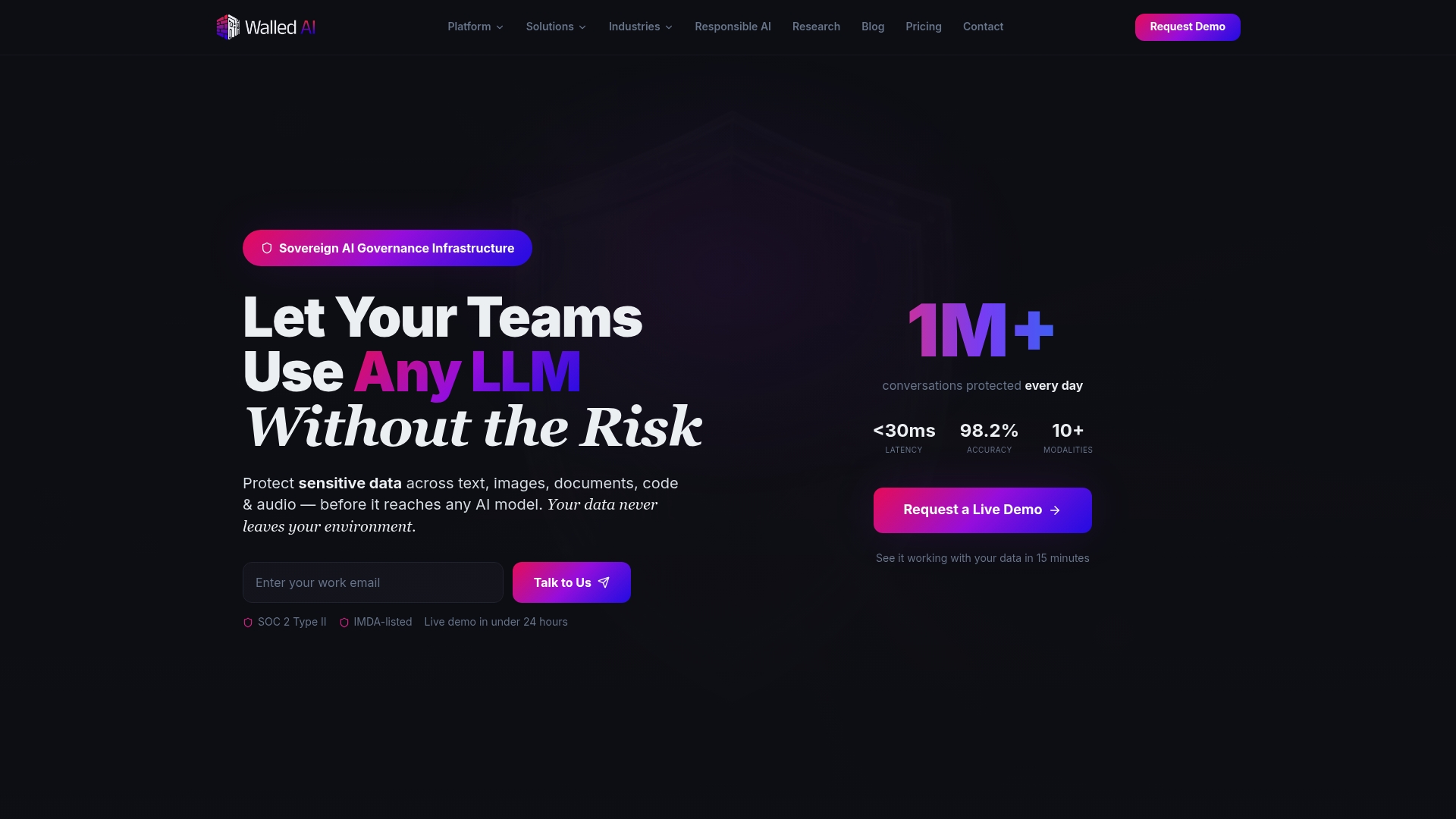
Walled provides a unified AI control plane that enforces compliance policies in real time across browser-based AI tools, desktop applications, custom AI applications, and agentic workflows. Before any data reaches an AI model, Walled performs AI-DLP inspection, detecting and masking sensitive information including personal data, credentials, and regulated content. Immutable audit logs and centralized compliance reporting support GDPR, PDPA, the EU AI Act, and MAS TRM obligations. For enterprises requiring data sovereignty, Walled supports on-premises and air-gapped deployments that keep sensitive data within customer-controlled environments. Mid-market compliance teams can explore rapid deployment governance options designed to reduce time-to-compliance without sacrificing control depth.
FAQ
What are the biggest compliance challenges in AI adoption?
The three largest compliance challenges in AI adoption are Shadow AI discovery gaps, the black-box transparency problem in LLMs, and the structural conflict between GDPR data minimization and agentic AI data requirements. Each requires engineering-level controls, not policy documents alone.
What fines apply under the EU AI Act for non-compliance?
Non-compliance with the EU AI Act can result in fines up to €35 million or 7% of global annual turnover, depending on the violation category. GDPR violations carry separate penalties up to €20 million or 4% of global turnover.
What is Shadow AI and why does it matter for compliance?
Shadow AI refers to AI tools deployed within an organization without formal procurement, security review, or compliance oversight. It represents the largest compliance gap in most enterprises, with 73% of AI compliance failures surfacing during discovery audits.
How does continuous monitoring differ from a point-in-time audit?
A point-in-time audit samples AI outputs at a fixed interval and cannot detect model drift, new data flows, or policy violations that occur between reviews. Continuous monitoring inspects every AI interaction in real time and maintains always-current audit evidence that satisfies regulatory requirements.
How can compliance officers address the GDPR and agentic AI conflict?
Compliance officers should implement purpose-limitation controls and AI-DLP at the data layer to restrict what personal data agentic AI systems can access and process. This satisfies GDPR's data minimization requirement without blocking the AI system's core functionality.