

An enterprise AI governance framework is the structured system of policies, roles, controls, and oversight mechanisms that manages AI risk and ensures legal and ethical compliance across an organization. The industry standard term for this discipline is AI governance, formalized through frameworks like the NIST AI Risk Management Framework and ISO/IEC 42001. In 2026, governance shifted from voluntary best practice to legal obligation. Texas RAIGA took effect january 1, 2026, Colorado's AI Act on june 30, 2026, and EU AI Act enforcement began august 2, 2026. Executives and compliance officers who treat AI governance as a secondary control layer will find themselves exposed to regulatory penalties, reputational damage, and operational failure.
What are the core components of an enterprise AI governance framework?
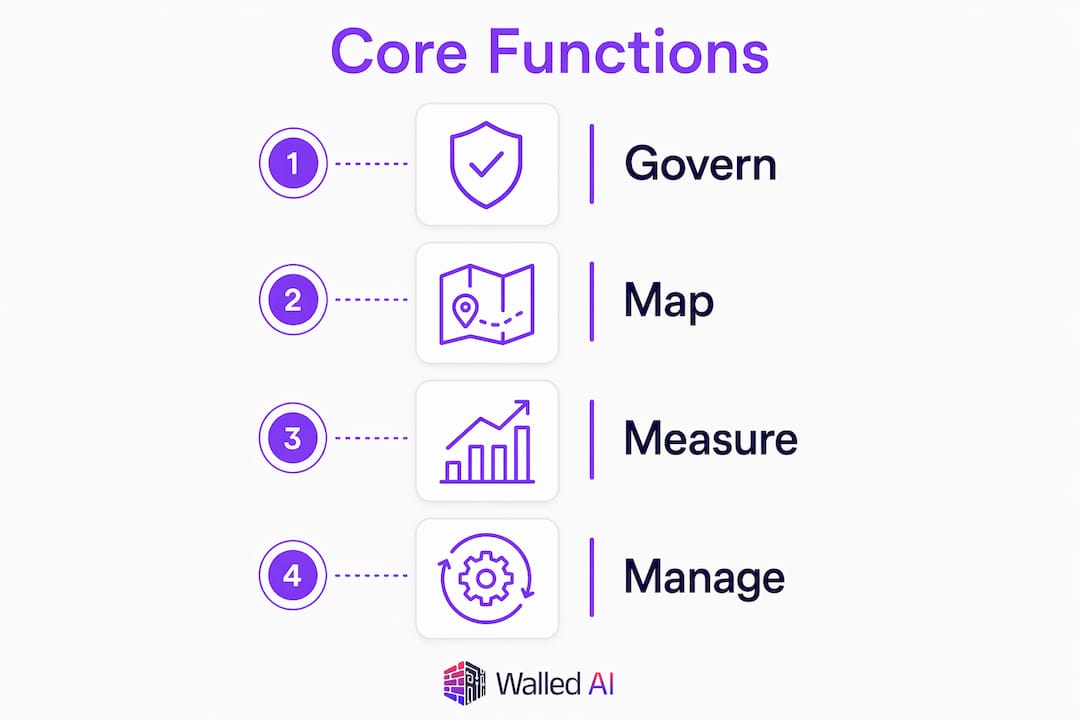
The NIST AI RMF defines four core functions that structure every credible AI governance program: Govern, Map, Measure, and Manage. Published in january 2023, this voluntary framework has become the dominant vocabulary for enterprise AI governance globally. Each function addresses a distinct governance need, from setting organizational accountability to actively controlling AI risk in production.
ISO/IEC 42001 is the first international certifiable AI management system standard. It mirrors ISO 27001's Plan-Do-Check-Act cycle and applies to organizations of any size, covering AI risk assessments, impact evaluations, and lifecycle controls. Certification under ISO/IEC 42001 gives compliance officers a recognized audit trail that regulators and partners can verify.
Six operational pillars translate these standards into day-to-day practice:
- Policy management: Acceptable use rules, data handling standards, and procurement criteria for third-party AI tools
- AI inventory: A live catalog of all AI systems in use, including shadow AI and vendor-supplied models
- Model documentation: Model cards, training data provenance, and intended use statements for each system
- Continuous monitoring: Real-time tracking of model outputs, drift, and policy violations
- Audit trails: Immutable logs of AI decisions and human overrides for regulatory review
- Remediation workflows: Defined escalation paths when a model produces non-compliant or harmful outputs
The table below maps these pillars to the three dominant frameworks:
| Governance pillar | NIST AI RMF function | ISO/IEC 42001 clause | EU AI Act obligation |
|---|---|---|---|
| Policy management | Govern | 6.2 AI policy | Article 9 risk management |
| AI inventory | Map | 8.4 AI system lifecycle | Article 51 registration |
| Model documentation | Map / Measure | 8.6 documentation | Article 11 technical docs |
| Continuous monitoring | Measure | 9.1 performance evaluation | Article 72 post-market monitoring |
| Audit trails | Manage | 9.2 internal audit | Article 12 record-keeping |
| Remediation workflows | Manage | 10.1 nonconformity | Article 20 corrective action |
Pro Tip: Start with the NIST AI RMF Govern function before building any other pillar. Without clear accountability structures, monitoring and remediation controls have no owner and will not be acted upon.
How to set up an enterprise AI governance framework effectively?
A mature AI governance program takes approximately 24 months to reach continuous assurance, with the first 3–6 months focused on core policy setup and cross-functional committee formation. That timeline is not a reason to delay. The first 90 days determine whether governance becomes embedded in operations or remains a compliance document on a shared drive.
The setup sequence that works in practice follows these steps:
- Form a cross-functional governance committee. Include legal, IT security, data privacy, business unit leads, and at least one executive sponsor. Governance without executive sponsorship stalls at the policy drafting stage.
- Conduct an AI risk assessment. Catalog every AI system currently in use, classify each by risk level, and identify which fall under high-risk categories defined by the EU AI Act or similar regulations.
- Draft five baseline policies. Five core policies form the operational baseline: Acceptable Use, Data Handling, Third-Party AI Procurement, Model Documentation, and AI Incident Response. These documents define what is permitted, what is protected, and what happens when something goes wrong.
- Assign accountability, not just responsibility. Every AI system needs a named owner who answers for its compliance posture. Generic team ownership creates phantom accountability.
- Build the audit trail infrastructure. Immutable logs must be in place before models go into production, not retrofitted afterward.
Two common pitfalls undermine early implementation. First, organizations draft policies that are too complex for business units to follow. Complicated policies cause shadow AI, where employees bypass approved tools and use unmonitored alternatives. Second, governance committees meet quarterly but AI deployments happen weekly. The review cadence must match the deployment cadence.
Pro Tip: Automate evidence collection from day one. Manual documentation of model cards and audit logs introduces errors and falls behind quickly. Automated inventory updates keep your compliance posture current without adding headcount.

How does an AI governance strategy navigate 2026 multi-jurisdictional compliance?
Three major legal mandates define the 2026 compliance environment for enterprises operating across jurisdictions. Texas RAIGA, Colorado AI Act, and EU AI Act each impose distinct obligations, and no single policy document satisfies all three simultaneously. Compliance officers must map their governance controls to each regulation's specific requirements.
The EU AI Act is the most structurally demanding. It classifies AI systems by risk tier, prohibits certain applications outright, and requires conformity assessments, technical documentation, and post-market monitoring for high-risk systems. Detailed guidance on EU AI Act obligations is available for organizations preparing for august 2026 enforcement. Texas RAIGA and Colorado's AI Act focus on algorithmic discrimination, consumer notification, and impact assessments for consequential decisions.
The practical mapping looks like this:
- EU AI Act, Article 9: Requires a documented risk management system for high-risk AI. Maps directly to the NIST AI RMF Manage function and ISO/IEC 42001 clause 8.
- Colorado AI Act: Requires annual impact assessments for AI used in consequential decisions. Maps to the Measure function and ISO/IEC 42001 clause 9.1.
- Texas RAIGA: Requires disclosure when AI makes or substantially assists in consequential decisions. Maps to audit trail and model documentation pillars.
Governance cycles must be iterative and synchronized with regulatory updates. A model approved under last year's risk assessment may become non-compliant when a regulation changes or a provider updates its terms of service. Quarterly control testing, not annual reviews, is the minimum cadence for organizations operating under multiple jurisdictions.
The responsible AI framework that underpins effective multi-jurisdictional compliance treats fairness, transparency, and accountability as operational requirements, not aspirational values.
How to operationalize AI risk management within enterprise strategy?
AI governance belongs inside AI strategy, not alongside it as a secondary control layer. Organizations that treat governance as a compliance checkbox separate from business execution create exactly the siloed accountability structures that cause governance programs to fail.
Nearly 83% of organizations tracking strategic measures struggle with phantom owners, where metrics are assigned but no individual is genuinely accountable for outcomes. AI governance amplifies this problem because AI systems cut across multiple business units. The solution is to embed AI governance KPIs into existing balanced scorecards and strategic execution rhythms, not create a parallel reporting structure.
Practical integration requires four disciplines:
- KPI alignment: Tie AI compliance metrics to existing risk management dashboards. Incident rates, policy violation counts, and model drift scores belong in the same review cycle as financial and operational KPIs.
- Named accountability: Every AI system in the inventory has one named executive owner. That person's performance review includes governance outcomes.
- Usability testing for policies: Governance policies that business units cannot follow in practice produce false assurance. Test policy usability with the teams who must apply them before finalizing.
- Automated evidence collection: Automating model card documentation and inventory updates reduces manual errors and keeps compliance evidence current without burdening operations teams.
The governance cycle should mirror the business strategy cycle. Risk assessments and control testing become iterative processes integrated with quarterly business reviews, not standalone annual audits. This cadence catches regulatory changes, provider term updates, and new AI deployments before they create compliance gaps.
Pro Tip: Present AI governance metrics in the same format as financial risk metrics at board level. Executives who see AI compliance data alongside credit risk and operational risk data treat it with the same urgency.
Key Takeaways
An enterprise AI governance framework succeeds only when it integrates accountability, policy usability, and iterative risk management into existing organizational strategy cycles rather than operating as a standalone compliance program.
| Point | Details |
|---|---|
| Start with NIST AI RMF | The four functions (Govern, Map, Measure, Manage) provide the foundational structure for any enterprise AI governance program. |
| Five baseline policies first | Acceptable Use, Data Handling, Third-Party Procurement, Model Documentation, and Incident Response form the operational baseline. |
| 2026 mandates are active | Texas RAIGA, Colorado AI Act, and EU AI Act each impose distinct obligations requiring separate control mapping. |
| Embed governance in strategy | AI governance KPIs belong in existing balanced scorecards, not parallel compliance structures that create phantom ownership. |
| Automate evidence collection | Automated model cards and inventory updates reduce errors and keep compliance posture current without adding manual overhead. |
Why governance programs fail before they start
The most common failure mode in enterprise AI governance is not a missing policy. It is a governance program that was designed by the compliance team, approved by legal, and never adopted by the business units who actually deploy AI systems. I have seen organizations produce 40-page AI governance frameworks that sat untouched because no one in the engineering or product teams could translate them into daily decisions.
The frameworks that work share one characteristic: they are built with the people who will use them, not handed down to them. Executive sponsorship matters enormously here. When a Chief Risk Officer or Chief Compliance Officer visibly owns AI governance outcomes, business units treat compliance as a shared obligation rather than an external constraint.
The 2026 regulatory environment removes the option of treating governance as aspirational. Texas RAIGA, Colorado's AI Act, and the EU AI Act each carry enforcement mechanisms. The organizations that will navigate this environment well are not the ones with the most detailed frameworks. They are the ones whose governance controls are simple enough to follow, specific enough to audit, and integrated deeply enough into strategy that they survive leadership changes and business pivots.
The enterprise AI governance programs worth building are the ones that make compliance the path of least resistance, not an obstacle to AI adoption.
— Rishabh
How Walled supports enterprise AI governance implementation
Walled provides the technical infrastructure that turns governance policy into enforceable controls. Before any data reaches an AI model, Walled performs real-time inspection and AI Data Loss Prevention, detecting and masking sensitive information including intellectual property, customer data, credentials, and regulated content. That capability directly supports the Data Handling and Model Documentation policies that form the baseline of any compliant AI governance program.
Walled maps its controls to GDPR, PDPA, the EU AI Act, and MAS TRM, giving compliance officers a unified compliance reporting layer across jurisdictions. The platform's immutable audit trails and governance dashboard provide the evidence collection that regulators require. For financial services organizations operating under MAS TRM and similar mandates, Walled's financial services governance deployment addresses sector-specific obligations. For enterprises that need to move quickly, Walled deploys in on-premises, private cloud, and air-gapped environments without requiring sensitive data to leave customer-controlled infrastructure.
FAQ
What is an enterprise AI governance framework?
An enterprise AI governance framework is the structured system of policies, roles, controls, and oversight mechanisms that manages AI risk and ensures legal and ethical compliance. It typically aligns with standards like the NIST AI Risk Management Framework and ISO/IEC 42001.
How long does it take to implement an AI governance framework?
A mature AI governance program takes approximately 24 months to reach continuous assurance maturity. The first 3–6 months focus on core policy setup, cross-functional committee formation, and initial risk assessment.
What are the five baseline policies for AI governance?
The five baseline policies are Acceptable Use, Data Handling, Third-Party AI Procurement, Model Documentation, and AI Incident Response. These documents define permitted use, data protection obligations, and escalation procedures.
Which 2026 regulations require an AI governance framework?
Texas RAIGA (effective january 1, 2026), the Colorado AI Act (effective june 30, 2026), and the EU AI Act (enforcement from august 2, 2026) each impose distinct governance obligations on enterprises deploying AI in covered use cases.
How does AI governance integrate with enterprise risk management?
AI governance integrates most effectively when AI compliance KPIs are embedded in existing balanced scorecards and strategic review cycles. Parallel governance structures create phantom ownership and increase the risk of compliance failure.