

Cross-border AI data compliance is the practice of governing international AI data flows under multiple overlapping privacy and sovereignty regulations to mitigate legal and financial risk. For compliance officers and data privacy professionals in multinational enterprises, this discipline sits at the intersection of data protection law, AI governance, and technical architecture. The stakes are concrete: violations of the EU AI Act can trigger financial penalties up to 7% of global annual revenue for serious infractions. That figure alone makes cross-border AI data compliance a board-level obligation, not a back-office function. The regulatory environment now spans GDPR, the EU AI Act, the US CLOUD Act, and a growing set of national AI governance frameworks, each with distinct requirements for how AI systems process, store, and transfer personal data across borders.
What are the core regulatory frameworks governing cross-border AI data?
The regulatory architecture for international AI data flows is built on several overlapping legal instruments. GDPR remains the foundational standard for personal data transfers out of the European Economic Area, requiring either an adequacy decision, Standard Contractual Clauses (SCCs), or Binding Corporate Rules (BCRs) before data moves to a third country. The EU AI Act adds a second layer, classifying AI systems by risk level and imposing documentation, transparency, and human oversight requirements that apply regardless of where the AI model is hosted.
The US CLOUD Act creates a direct conflict for multinational enterprises. Major cloud AI providers headquartered in the US remain subject to CLOUD Act disclosure obligations even when they operate regional data centers in the EU or Asia-Pacific. A regional data center does not insulate data from US government access requests. This extraterritorial reach means that data residency alone does not satisfy sovereignty requirements under frameworks like GDPR or Singapore's PDPA.
Contractual safeguards are the practical mechanism most organizations rely on. SCCs, Data Processing Addendums (DPAs), and Transfer Impact Assessments (TIAs) each serve a distinct function. SCCs establish the legal basis for the transfer. DPAs define the processor's obligations. TIAs assess residual legal risk for transfers to countries without an adequacy decision, and they are required under GDPR for those flows. Compliance officers who treat these documents as one-time exercises rather than living instruments create audit exposure.
- SCCs: Standardized contractual clauses approved by the European Commission for lawful data transfers.
- BCRs: Internal rules for multinational groups transferring data within their corporate structure.
- DPAs: Contracts defining processor obligations, retention limits, and breach notification timelines.
- TIAs: Documented assessments of the legal environment in the destination country, required for non-adequate jurisdictions.
Pro Tip: Review your DPA and SCC templates against the 2021 EU SCCs version. Many organizations still use pre-2021 templates, which are no longer valid for new contracts.
How does data sovereignty influence AI system design?
Data sovereignty is defined as the principle that data is subject to the laws and governance structures of the nation where it originates, regardless of where it is physically stored or processed. This is a broader concept than data residency, which refers only to the physical location of storage. Full-stack sovereignty extends further still, covering the entire AI lifecycle: model training, inference, deployment, and usage policy enforcement.

The distinction matters because data sovereignty cannot rely on physical storage location alone. An AI model trained on data stored in Frankfurt but fine-tuned on a US-based platform still creates a sovereignty exposure. Governance must extend across every stage of the AI lifecycle, including who can access model weights, where inference logs are written, and which subprocessors touch the data pipeline.
A sovereignty-first design approach addresses this by minimizing data movement. Operating AI workloads close to the data reduces the number of cross-border transfers that require legal justification and shrinks the attack surface for unauthorized access. This principle should be embedded at the architecture stage, not retrofitted after deployment.
"Designing AI systems with sovereignty and compliance embedded from the start avoids costly re-architecture later." — Leading AI governance experts
Four design decisions directly affect sovereignty compliance:
- Inference location: Route inference requests to models deployed within the relevant jurisdiction, not the nearest available endpoint globally.
- Log and memory controls: Audit controls at the data ingestion and AI context delivery layers prevent unauthorized foreign data exposure in logs or memory.
- Model access governance: Restrict who can access model weights and training data to personnel within the jurisdiction.
- Subprocessor mapping: Document every subprocessor that touches the AI pipeline and verify their geographic footprint against your transfer mechanisms.
What best practices establish a defensible compliance program?
A defensible cross-border AI compliance program starts with a complete inventory. All personal data flows must be mapped to destination countries, with each flow linked to a documented legal transfer mechanism. This inventory is not a one-time project. It requires an annual review cycle and an update trigger whenever a regulatory change occurs or a new AI system is deployed.
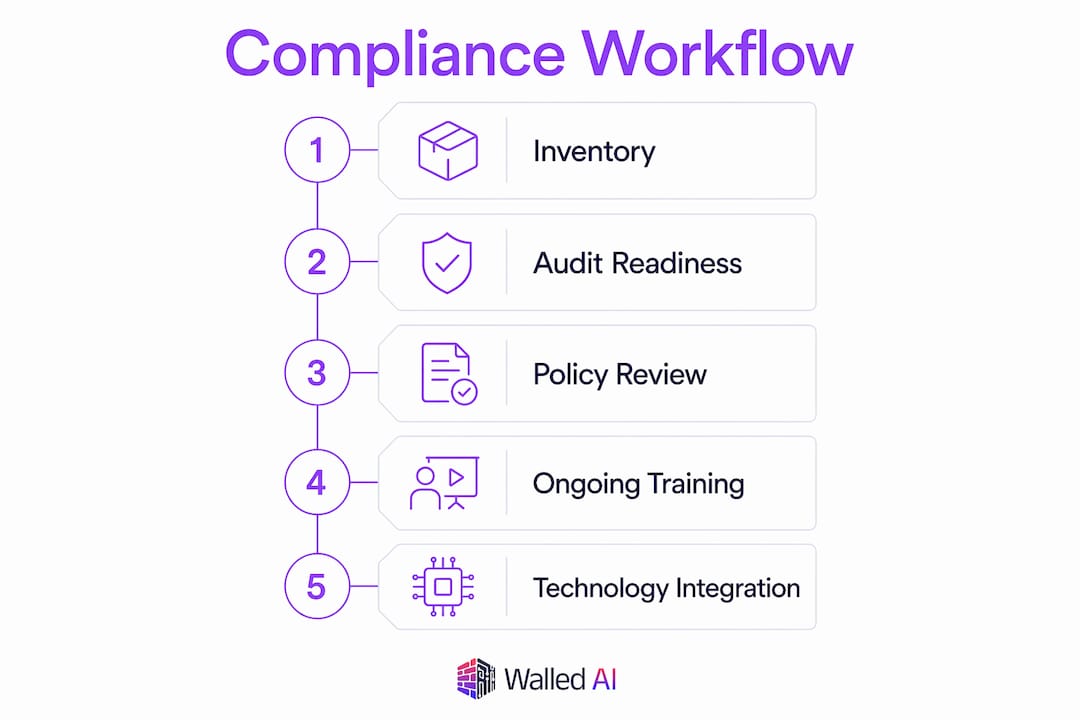
Audit readiness is the second pillar. Mismatches across the Master Service Agreement, Data Processing Addendum, and subprocessor disclosures are among the most common causes of compliance failures during regulatory investigations. A contract that names one set of subprocessors while the actual data pipeline routes through a different set creates an immediate enforcement exposure. Compliance officers should run a contract alignment audit at least annually.
Pro Tip: Build a subprocessor registry that maps each vendor to the specific AI workload, the data categories it processes, and the transfer mechanism in place. This registry becomes your primary evidence document during a regulatory inquiry.
The following elements form the core of a defensible program:
- Data flow inventory: Map every AI personal data flow to its destination country and legal basis.
- Transfer mechanism documentation: Maintain current SCCs, BCRs, or adequacy decisions for each flow.
- Annual TIA reviews: Update Transfer Impact Assessments when regulations change or new flows are added.
- Contract alignment audits: Verify that MSA, DPA, and subprocessor disclosures are consistent with actual data routing.
- Audit trail controls: Implement immutable logging at the data ingestion and AI response layers to support regulatory inquiries.
| Program element | Review frequency | Primary owner |
|---|---|---|
| Data flow inventory | Annual or on new deployment | Data Privacy Officer |
| Transfer mechanism documentation | Annual or on regulatory change | Legal / Privacy team |
| Transfer Impact Assessments | Annual or on new destination country | Legal / Privacy team |
| Contract alignment audit | Annual | Legal / Procurement |
| Audit trail integrity check | Quarterly | Security / Compliance |
What technologies support cross-border AI data compliance?
The technology architecture an organization chooses directly determines its compliance ceiling. Most SaaS AI contracts do not natively satisfy stringent compliance requirements. Highly regulated industries, including financial services, healthcare, and government, typically require on-premises or private cloud deployments to achieve full data sovereignty. SaaS-based AI tools may be appropriate for low-risk workloads, but they create structural gaps for regulated data categories.
On-premises deployment gives organizations the highest level of control. Data never leaves the customer-controlled environment, model weights are not shared with third-party infrastructure, and audit logs remain within the organization's own security perimeter. The tradeoff is infrastructure cost and the operational overhead of maintaining AI models internally. Private cloud deployments offer a middle path, providing dedicated infrastructure within a defined geographic boundary while reducing some operational burden.
Geographic inference routing offers a third option for organizations that cannot build local infrastructure. API consumers can meet regulatory restrictions by using routing constraints at the request level, directing inference traffic to models deployed within the required jurisdiction. This approach works well for organizations with moderate compliance requirements and avoids capital-intensive infrastructure buildout. The limitation is that routing controls depend on the provider's architecture and may not satisfy the most stringent sovereignty requirements.
Zero data retention APIs, where the AI provider contractually commits to not storing any input or output data, address one specific compliance risk. They do not address model training data provenance, subprocessor exposure, or audit log sovereignty. Encryption in transit and at rest is a baseline requirement, not a compliance strategy on its own.
Walled supports on-premises, private cloud, and air-gapped deployments, ensuring that sensitive data never leaves customer-controlled environments. The platform performs real-time AI Data Loss Prevention before data reaches any AI model, which directly addresses the data ingestion layer controls that audit frameworks require.
Key takeaways
Cross-border AI data compliance requires a combination of legal transfer mechanisms, sovereignty-first architecture, and continuous audit controls to satisfy overlapping international regulations.
| Point | Details |
|---|---|
| Regulatory frameworks overlap | GDPR, the EU AI Act, and the CLOUD Act each impose distinct obligations that apply simultaneously to multinational AI deployments. |
| Sovereignty exceeds residency | Data sovereignty requires governance across the full AI lifecycle, not just physical storage location within a jurisdiction. |
| Contracts must align | Mismatches between MSA, DPA, and subprocessor disclosures are a leading cause of regulatory enforcement actions. |
| Architecture determines compliance ceiling | On-premises and private cloud deployments provide sovereignty controls that SaaS AI tools cannot natively replicate. |
| Annual reviews are mandatory | Data flow inventories and Transfer Impact Assessments require annual updates and a trigger-based review on regulatory changes. |
The compliance mistake I see most often
The most persistent failure I observe in multinational AI programs is treating compliance as a procurement checkbox rather than a design constraint. Organizations spend months selecting an AI vendor, negotiating commercial terms, and signing a DPA, then discover six months into deployment that the vendor's subprocessors route inference traffic through jurisdictions that invalidate the transfer mechanism they documented.
The CLOUD Act problem is particularly underappreciated. Compliance officers who accept a vendor's regional data center commitment as sufficient sovereignty protection are working from an incomplete legal analysis. The vendor's headquarters jurisdiction determines disclosure obligations, not the location of the server rack. This is not a theoretical risk. It is the exact gap that regulators in the EU and Singapore have begun scrutinizing in AI-specific audits.
The organizations that handle this well share one practice: they embed a data sovereignty review into the AI project intake process, before any vendor is selected or any data is connected. That single process change eliminates the most expensive class of compliance failures, which is the re-architecture of a live AI system after a regulatory finding. Compliance officers who wait until the contract stage to raise sovereignty questions are already too late to influence the architecture.
Geopolitical shifts are accelerating the complexity. New national AI governance laws are passing in Southeast Asia, the Middle East, and Latin America at a pace that makes annual reviews insufficient for organizations operating in those regions. Quarterly monitoring of regulatory developments in each operating jurisdiction is now a practical necessity, not a best practice reserved for the most cautious organizations.
— Rishabh
Walled for cross-border AI governance
Multinational enterprises managing AI data privacy regulations across multiple jurisdictions need governance controls that operate at the data layer, not just the contract layer.
Walled provides a unified AI control plane that enforces data residency policies, performs real-time AI Data Loss Prevention, and generates immutable audit trails before any data reaches an AI model. The platform supports GDPR, the EU AI Act, PDPA, and MAS TRM obligations through centralized policy enforcement and compliance reporting. For organizations in financial services or other regulated sectors, Walled deploys on-premises, in private cloud environments, and in air-gapped configurations, giving compliance teams the architectural controls that SaaS AI tools cannot provide.
FAQ
What is cross-border AI data compliance?
Cross-border AI data compliance is the practice of governing how AI systems process, store, and transfer personal data across national borders in accordance with applicable privacy and sovereignty regulations. It covers legal transfer mechanisms, data residency controls, and audit obligations under frameworks including GDPR and the EU AI Act.
What is the difference between data residency and data sovereignty?
Data residency refers to the physical location where data is stored. Data sovereignty is the broader principle that data remains subject to the laws of its country of origin regardless of where it is stored or processed, covering the full AI lifecycle including training, inference, and logging.
Are Transfer Impact Assessments required for all cross-border AI data flows?
TIAs are required under GDPR for transfers to countries that do not have an adequacy decision from the European Commission. They assess the residual legal risks of the transfer and must be updated annually or when the regulatory environment in the destination country changes.
Does storing data in a regional cloud data center satisfy sovereignty requirements?
Not necessarily. Cloud providers subject to the CLOUD Act remain obligated to disclose data to US authorities regardless of where the data is physically stored. Organizations in regulated industries typically require on-premises or private cloud deployments to achieve full sovereignty compliance.
How often should a cross-border AI data compliance program be reviewed?
Data flow inventories and Transfer Impact Assessments require at least an annual review cycle. Organizations operating in jurisdictions with rapidly evolving AI governance laws, particularly in Southeast Asia and the Middle East, should monitor regulatory developments quarterly and update documentation whenever a material change occurs.