

Enforcing reliable AI security and governance across enterprise deployments is difficult as teams must control diverse models and workflows. Solutions with cloud-only architectures or static controls cannot guarantee data sovereignty or real-time enforcement during autonomous agent operation. This comparison covers deployment controls, governance frameworks, and audit support so enterprise AI teams can match one platform to their compliance and operational needs.
Table of Contents
WalledAI
At a Glance
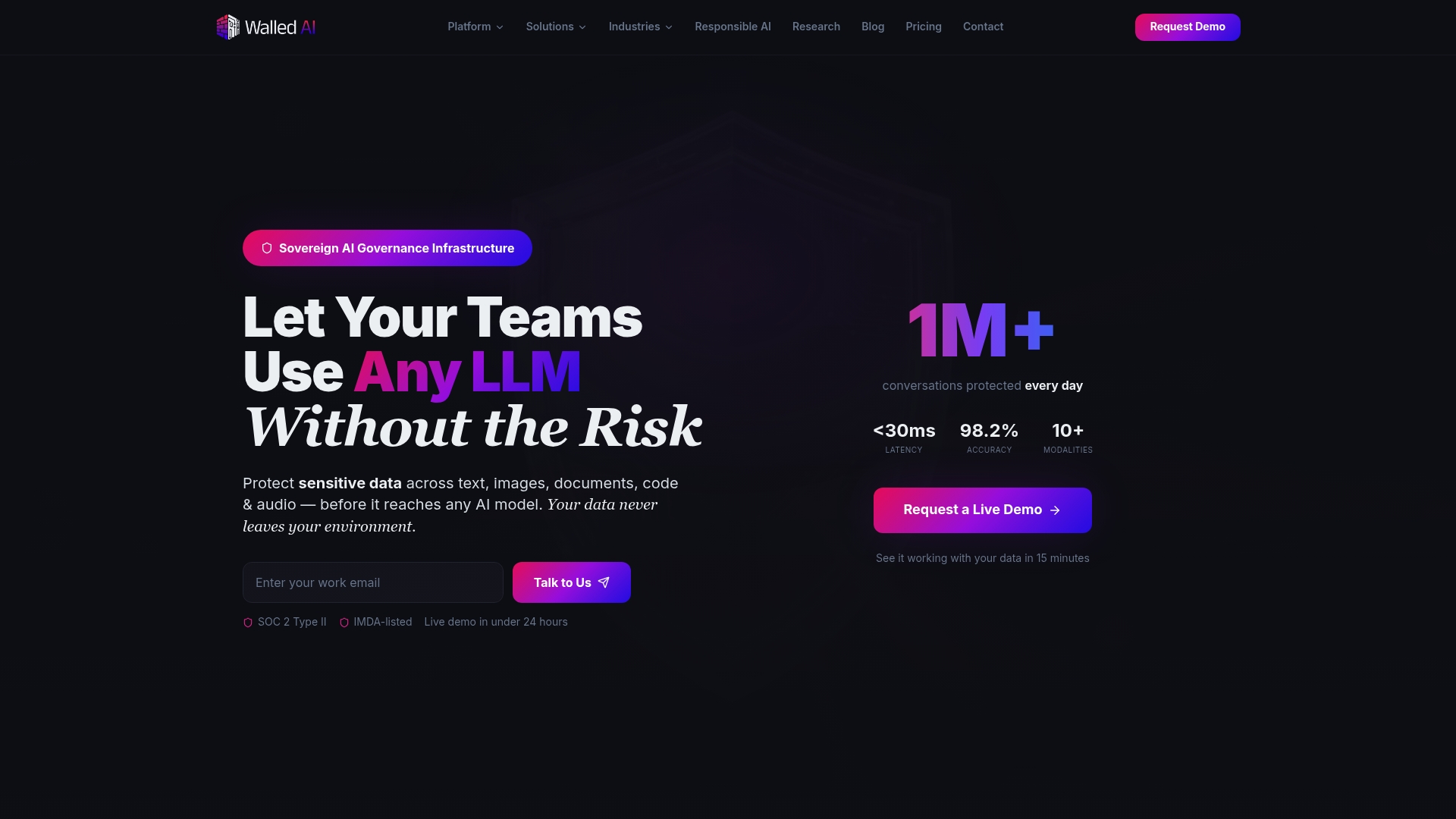
WalledAI's marketing materials state sub-30ms latency for real-time AI interaction governance. That claim highlights the platform's focus on low-latency inspection and control before models receive data. The system intercepts and masks sensitive content across text, images, code, and audio while keeping processing inside customer environments.
Core Features
The platform performs real-time inspection and AI-DLP to detect and mask intellectual property, credentials, and regulated data before it reaches LLMs. It supports on-premise, private cloud, and air-gapped deployment models and records comprehensive audit trails and logs for compliance reporting. Role-based access control, multi-model governance, and governance APIs extend policy enforcement across browsers, desktop apps, and agentic workflows.
Key Differentiator
The vendor positions the product as engineered for air-gapped and private cloud deployments that keep data under customer control while aligning with EU AI Act and PDPA frameworks. That focus on sovereign deployment separates it from cloud-only governance tools.
Pros
Strong data sovereignty and deployment flexibility let regulated organizations keep sensitive workloads inside their networks. The platform combines masking, validation, and logging in real time and supports multiple LLM vendors, which helps teams avoid vendor lock-in. Granular RBAC and governance APIs let security and compliance teams enforce policies across applications and collect audit-ready evidence for regulators and internal boards.
Cons
- Requires existing on-premises infrastructure for deployment, which increases implementation complexity for cloud-native organizations.
Notable Integrations
Connects to SIEM tools such as Splunk, Microsoft Sentinel, and Elastic for centralized logging, alerting, and incident investigation. These integrations allow security teams to ingest WalledAI logs into existing monitoring and response workflows.
Who It's For
Large enterprises and regulated organizations that must keep AI processing inside controlled environments will benefit most. Financial services, healthcare providers, and government agencies that need auditable evidence and strict data sovereignty receive the most value. Teams that lack mature infrastructure or a dedicated security operations function will face longer implementation timelines.
Unique Value Proposition
Governance APIs enforce the same masking and validation rules across browser tools, desktop applications, custom apps, and autonomous agents. That capability lets organizations apply a single control plane to diverse AI entry points while keeping all data and logs inside their private environments. The result is policy uniformity across teams without sending sensitive inputs to external services.
Real World Use Case
A bank deploys WalledAI inside its private cloud to govern employee queries to external LLMs. The platform masks PII and code snippets in real time, logs every interaction, and produces compliance reports for audit reviews. This setup lets analysts use AI for customer service and risk research while preserving regulatory evidence.
Pricing
Pricing is not publicly disclosed. The vendor typically provides custom quotes based on deployment scope, required modalities, and the chosen hosting model.
Website: https://walled.ai
Holistic AI Governance Platform
At a Glance
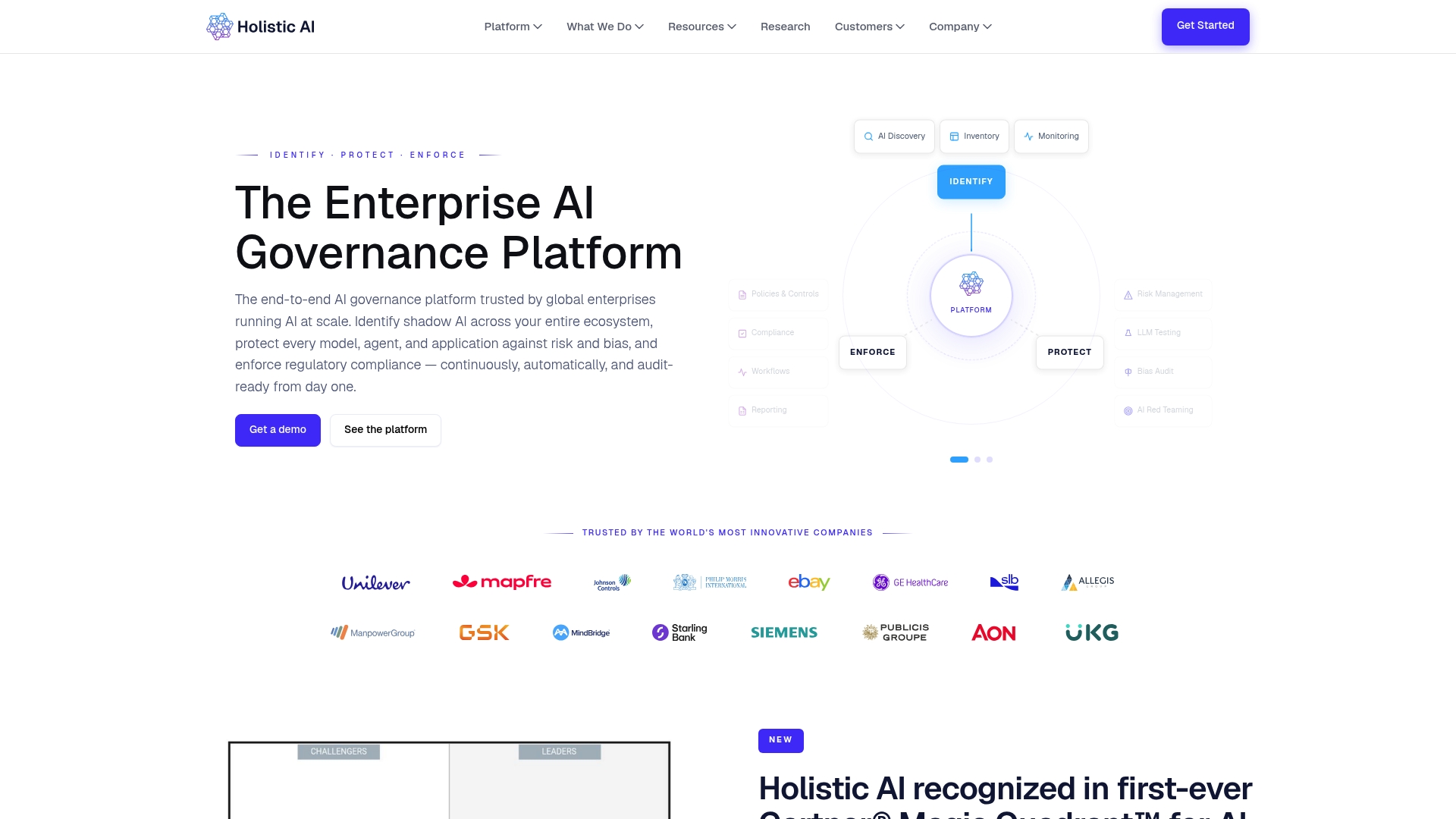
The vendor states the platform was recognized in Gartner’s Magic Quadrant for AI Governance Platforms. The product pairs automated discovery of shadow AI across cloud, code repositories, and SaaS with autonomous Guardian Agents that act on policies in real time. It targets large organizations that need continuous risk assessment and audit-ready evidence for regulatory frameworks.
Core Features
The platform discovers unmanaged AI assets across cloud services, repositories, and SaaS apps, then runs continuous risk assessments covering bias, safety, security, and model performance. Automated testing addresses toxicity, hallucination, prompt injection, adversarial attacks, and robustness while real-time monitoring detects drift and degradation. Policy enforcement maps controls to frameworks such as EU AI Act, NIST AI RMF, and ISO 42001 and produces evidence for audits.
Key Differentiator
The product combines full-lifecycle discovery with active enforcement by autonomous Guardian Agents, creating a closed loop from detection to remediation. That integration of discovery, continuous testing, and automated policy action at scale is the platform’s single distinguishing capability.
Pros
The platform offers full visibility into deployed and shadow AI, which reduces the blind spots compliance teams face. Automated risk assessment and built-in tests shorten the time between detection and mitigation, cutting manual effort during audits and deployments. Real-time policy enforcement with Guardian Agents lets operations respond to threats and drift without waiting for manual playbooks. The vendor recognition noted above adds market credibility for enterprise buyers.
Cons
- Deployment complexity can be high for legacy environments. Integration often requires cross-team coordination and dedicated configuration time.
- Full operational effectiveness depends on ongoing tuning and governance work after initial setup. Third-party reviews emphasize this dependency.
- Pricing details and detailed client case studies are not publicly listed, complicating procurement planning.
When It May Not Fit
Organizations with limited integration resources or few internal AI assets may find the platform too heavyweight. Small teams that lack dedicated compliance or MLOps staff could struggle to maintain the tuning and workflows required for its automated controls. Buyers seeking transparent self-service pricing or published client case studies will need to request that information directly from sales.
Notable Integrations
- AWS for cloud discovery and telemetry
- Azure for cloud and identity integration
- Google Cloud for model and data pipeline visibility
- GitHub for code repository scanning
- Databricks for pipeline and model lineage
- Weights & Biases for experiment tracking
- OpenAI and Anthropic for model access and telemetry
Who It's For
Large enterprise AI teams, risk officers, and compliance leaders responsible for governing many models and data flows will get the most value. Legal and audit teams that need continuous evidence against regulatory frameworks will find the enforcement and reporting capabilities relevant. Organizations running multi-cloud or hybrid deployments benefit from the broad integration set.
Real World Use Case
A multinational with AI deployments across finance, customer service, and R&D discovers unmanaged models via the platform. It automates bias and security testing on those assets and configures Guardian Agents to quarantine risky calls. The company uses the platform’s evidence package to support regulatory reporting and internal audits.
Pricing
Not specified on the website. Pricing appears to be enterprise tailored and likely depends on inventory size, deployment scope, and service levels. Procurement teams should request a customized quote and deployment plan from sales.
Website: https://holisticai.com
Credo AI
At a Glance
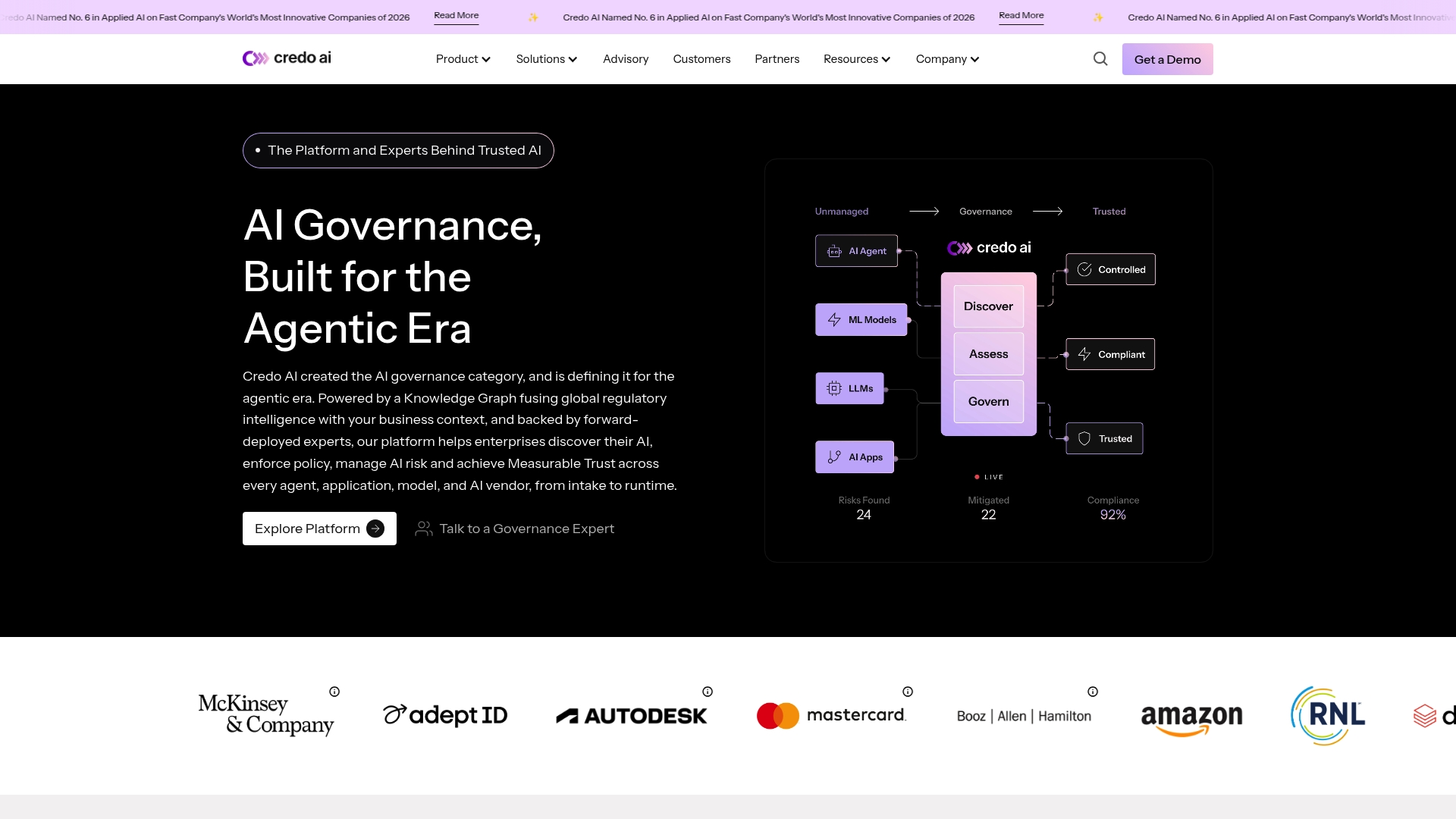
Credo AI uses a knowledge graph that fuses global regulation text with business context to enable policy-driven controls and continuous risk checks across AI assets. The vendor states it has been recognized as a most innovative company and holds top rankings in AI governance evaluations. The platform targets enterprises operating autonomous agents and complex AI systems.
Core Features
Credo AI catalogs models and agents in an AI Registry for discovery and shadow AI detection, and it runs continuous risk intelligence to surface drift and control gaps. A Policy Engine translates regulatory requirements into automated rules while Runtime Governance monitors live systems for compliance, safety, and policy violations. The Govern AI Assistant supports automation by helping teams generate assessments and remediate findings.
Key Differentiator
The product distinguishes itself with a knowledge graph that maps regulation clauses to business entities and AI assets, enabling contextual policy decisions in real time. That mapping connects discovery, assessment, and enforcement into a single governance loop. This design favors organizations that must trace regulatory obligations back to specific models and business processes.
Pros
Continuous monitoring and cataloging make it practical to detect shadow AI and to maintain an audit trail across model lifecycles. The platform links regulatory intelligence to operational controls, which reduces manual interpretation when new rules appear. Broad enterprise integrations let governance workflows plug into existing data and IT systems, and the Govern AI Assistant helps automate repetitive governance tasks.
Cons
- Platform complexity can require substantial onboarding and dedicated personnel. Implementation often needs cross functional involvement from legal, security, and ML teams.
- Buyers should budget time and resources for integration and mapping of legacy systems. That work can extend project timelines compared to lightweight tools.
- Smaller teams or organizations with only a few models may find the platform more depth than they need. Third party reviewers note the learning curve for newcomers.
When It May Not Fit
Organizations with minimal AI footprint or those seeking a lightweight compliance checklist will likely find Credo AI too large in scope. Small vendors and single team projects may lack the staff to operate its lifecycle workflows. Procurement cycles that require simple subscription pricing rather than enterprise negotiations will find the commercial model misaligned.
Notable Integrations
- Snowflake
- Databricks
- AWS
- Azure
- ServiceNow
- Jira
- Confluence
- Slack
Who It's For
Large enterprises and regulated organizations deploying autonomous agents or many production models that require continuous governance, auditability, and regulatory traceability. Legal, risk, and ML governance teams that need to align controls to specific regulations will extract the most value.
Real World Use Case
A multinational bank uses Credo AI to automate its compliance workflows across jurisdictions, mapping regulatory clauses to deployed models and agents. The platform reduced manual assessment steps and provided centralized evidence for audits. Governance teams used the AI Registry to locate unauthorized model deployments and trigger remediation.
Pricing
Not applicable — informational only. Pricing is typically enterprise oriented and depends on deployment scale, integration scope, and support options. Prospective buyers should contact sales for licensing and deployment details.
Website: https://credo.ai
Trussed AI
At a Glance
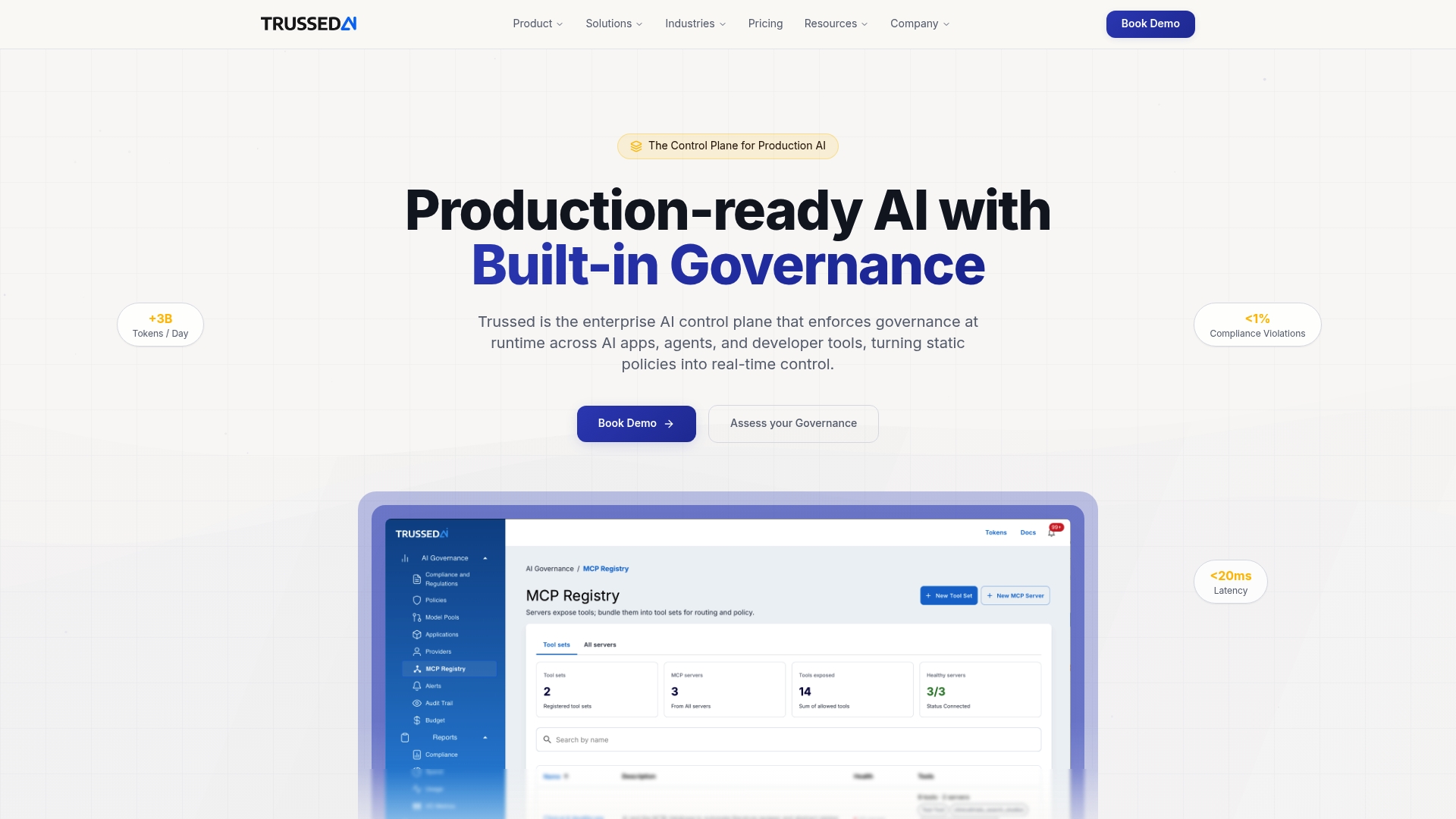
Trussed enforces governance at runtime across AI apps, agents, and developer tools. It converts static policies into active controls that evaluate and block requests as AI systems execute, and the platform emphasizes continuous observability and audit trail generation to support regulated enterprise review and compliance work.
Core Features
Trussed delivers runtime governance, tool level enforcement policies, and real-time policy evaluation, so rules apply while models and agents act. It governs multi-step workflows and inspects tool calls, producing detailed observability logs and audit trails for compliance review. Integration points include APIs and SDKs to connect existing AI stacks and developer tools.
Key Differentiator
Trussed focuses on live control and auditability for complex, agent driven AI deployments in regulated environments. Its operations model centers on enforcing policies at the moment an agent or tool executes a call, not only at deployment time. That live enforcement differentiates it from gatekeeper only approaches and targets enterprises that need traceable, auditable AI behavior.
Pros
Trussed provides detailed, real time oversight for multi step AI workflows and agent actions, which helps teams maintain traceable records of automated decisions. The platform supports continuous compliance by generating audit ready evidence and centralized logs for review. Integration via APIs and SDKs lets engineering teams attach governance to existing model endpoints and developer tools without rewriting core model code.
Cons
- Complex deployment and configuration. Implementation often requires engineering and policy expertise to map existing workflows and tool calls.
- Cost can increase for broad coverage. Enterprise scale use cases or managed deployment models may raise total ownership expenses.
- Integration and rollout may demand sustained operational oversight. Third party reviewers report significant resource requirements for large, customized environments.
When It May Not Fit
Organizations with lightweight or experimental AI usage will likely find Trussed overqualified and operationally heavy. Highly customized legacy stacks may require extensive adaptation to connect tool calls and agents to the governance plane. Teams without an operations function to maintain policies and audit rules will struggle to keep governance current as regulations and workflows change.
Who It's For
AI teams inside regulated enterprises such as banks, healthcare providers, and government agencies seeking strict runtime controls will find the product relevant. Security, compliance, and legal stakeholders who need immutable audit trails and demonstrable enforcement will value Trussed. Organizations that can allocate engineering and operations resources to governance will get the most value.
Real World Use Case
A financial services firm attaches Trussed to its agent fleet that handles customer inquiries and document retrieval. The platform inspects each tool call and enforces policies that redact sensitive fields before an agent responds. Auditors then review the generated trails to verify that agent decisions followed retention and privacy rules.
Pricing
Pricing is not published and the vendor lists the offering as informational only. Procurement typically requires direct engagement with sales for deployment options and cost estimates. Enterprises should plan for implementation and operations costs beyond any base license.
Website: https://trussed.ai
Comparison of alternatives
When selecting a platform for AI governance, the priorities of the organization play a role in determining the solution. Here, we compare several highly-regarded options to aid organizations in their decision-making process.
Deployment flexibility and data sovereignty
WalledAI excels in providing deployment options such as on-premise setups, private cloud, and air-gapped environments. This feature distinguishes it from solutions such as the AI Governance Platform, which primarily offers cloud-based deployments. For industries with stringent data sovereignty requirements like banking or healthcare, these capabilities ensure compliance and minimize external data exposure;
Compliance automation tools
Credo AI stands out by incorporating a Policy Engine that maps regulatory requirements directly to AI assets and their activities. While WalledAI and others provide audit functionalities and governance APIs, Credo AI’s capacity to contextualize regulatory policies offers significant support for legal and compliance teams managing multi-jurisdictional operations.
Best fit
- Enterprises with established infrastructures seeking on-premise deployments and strict data localization strategies.
- Organizations requiring persistent model and asset monitoring paired with automated compliance checks (e.g., with Credo AI).
- Teams wanting real-time interaction governance with masking capabilities to safeguard sensitive information (e.g., WalledAI).
- Large businesses integrating autonomous AI agents into decision-making processes may prefer AI Governance Platform.
Our pick
WalledAI emerges as the ideal choice for businesses placing high value on deployment flexibility and data sovereignty. Its support for air-gapped infrastructures and customer-only data management positions it uniquely for regulated sectors that demand thorough audit capacity and policy control. However, those seeking nuanced regulatory mapping or operating massive AI infrastructures might evaluate Credo AI for tailored compliance automation.
Evaluate these AI governance platforms based on deployment flexibility, integration capabilities, and data sovereignty features.
| Product | Core Feature | Key Differentiator | Best For | Pricing | Notable Limitation |
|---|---|---|---|---|---|
| Walled | Real-time AI interaction governance | Supports air-gapped and private cloud deployments | Regulated organizations prioritizing data sovereignty | Price not published | Requires on-premises infrastructure |
| Holistic AI | Autonomous Guardian Agents for policy enforcement | Integration of discovery, testing, and automated policies | Multi-cloud enterprises needing compliance evidence | Price not published | High deployment complexity and ongoing tuning |
| Credo AI | AI Registry and continuous risk intelligence | Maps regulation clauses to business entities | Enterprises managing complex governance workflows | Price not published | Substantial onboarding effort required |
| Trussed | Runtime governance with live policy enforcement | Auditable, runtime-focused controls | Strict control of tools in highly regulated scenarios | Price not published | Demands significant resources for integration and ops |
How To Address The Risks of Langprotect.com Alternatives in Complex AI Environments
Organizations considering langprotect.com alternatives face challenges in enforcing AI governance without exposing sensitive data or breaching compliance obligations. Walled provides a sovereign AI security platform designed for regulated enterprises and large organizations, featuring real-time AI Data Loss Prevention and policy enforcement that prevent data leaks before reaching AI models. This approach minimizes risks related to data sovereignty and policy bypass.
With deployment options including private cloud and air-gapped environments, Walled safeguards sensitive information and enforces policies across browsers, desktop apps, and custom AI workflows. Learn how Walled delivers detailed compliance monitoring and immutable audit trails for frameworks such as GDPR, PDPA, and the EU AI Act by visiting Walled. Explore how this platform aligns with your governance framework and take control of your AI risks through trusted risk mitigation and continuous compliance reporting.
FAQ
How does Walled manage data privacy for AI processing?
Walled masks sensitive content across text, images, code, and audio in real time. This capability allows organizations to keep data secure while interfacing with AI models, fulfilling regulatory compliance needs. Organizations can expect a robust solution that prioritizes data sovereignty and security during AI interactions.
What is the difference between Walled and Holistic AI?
Holistic AI excels in combining discovery of shadow AI with automated risk assessments across various AI assets. Walled, on the other hand, is built to govern interactions in real-time, especially for organizations operating in regulated sectors. Each platform serves distinct use cases, making Walled particularly suitable for those needing immediate data handling governance without external dependencies.
Which platform offers better support for on-premise deployment?
Walled is designed explicitly for on-premise, private cloud, and air-gapped deployments. This feature enables organizations to maintain control over sensitive data throughout the AI governance process. Companies looking for a comprehensive solution for managing local infrastructure will find Walled to be a fitting choice.
Can I use Walled for auditing and compliance reporting?
Walled records audit trails and logs specifically for compliance reporting. This feature helps organizations fulfill regulatory requirements effectively by providing documented evidence of data interactions. Businesses needing to ensure accountability and transparency in AI processing can rely on Walled's capabilities to generate necessary reports.
What advantages does Walled have in multi-model governance?
Walled provides role-based access control (RBAC) and governance APIs, allowing policy enforcement across different applications. These features give security and compliance teams the tools they need to ensure consistent governance across multiple AI models. Organizations aiming for stringent policy control across various platforms will benefit from Walled's robust governance framework.