

Sensitive data exposure through AI tools is defined as the unauthorized disclosure of regulated, confidential, or proprietary information when employees input that data into AI systems that lack adequate governance controls. The sensitive data categories AI tools expose span personal identifiable information (PII), protected health information (PHI), financial records, intellectual property (IP), and confidential business documents. Regulatory frameworks including GDPR, HIPAA, the EU AI Act, and Singapore's PDPA each impose distinct obligations on how organizations handle these categories. The risk is compounded by shadow AI: 56% of security professionals report employees using unsanctioned AI tools, and one in five of those employees inputs regulated data such as PHI or financial records. That statistic represents direct regulatory liability for any organization operating in a governed industry.
1. What are the primary sensitive data categories AI tools expose?
The industry term for this risk domain is AI data loss prevention (AI-DLP), and it covers several distinct categories that compliance teams must address separately.
Personal Identifiable Information (PII) includes names, home addresses, Social Security numbers, email addresses, and national identification numbers. Employees routinely paste customer records or HR data into AI writing and summarization tools without recognizing the compliance implications. Under GDPR and PDPA, processing PII through an unvetted AI tool constitutes a potential data breach.

Protected Health Information (PHI) covers medical records, diagnostic codes, prescription histories, and insurance identifiers. PHI is governed by HIPAA in the United States, and any AI tool that ingests it without a signed Business Associate Agreement creates immediate regulatory exposure. Healthcare organizations using HIPAA-compliant AI governance must verify that every tool in the workflow meets this standard.
Financial data encompasses credit card numbers, bank account details, tax identification numbers, and transaction records. This category falls under PCI DSS, MAS TRM for Singapore-based institutions, and various national banking regulations. Financial data submitted to a general-purpose AI tool is frequently processed on shared infrastructure, creating cross-tenant exposure risk.
Intellectual property includes source code, patent filings, product roadmaps, and trade secrets. Developers who paste proprietary code into AI coding assistants transfer that code to external servers. The exposure is not theoretical: foundation models can memorize and regenerate sensitive information from aggregated training datasets, meaning submitted code could resurface in outputs to other users.
Confidential business documents cover merger and acquisition files, board presentations, non-disclosure agreements, and contract terms. These documents carry both legal and competitive risk when processed by AI tools without data residency controls.
Authentication credentials include API keys, OAuth tokens, session cookies, and passwords. Developers and DevOps teams sometimes embed credentials directly in prompts when debugging or building integrations. API keys and system prompts are vulnerable to extraction via prompt injection attacks, making credential exposure one of the most technically severe categories.
Pro Tip: Classify your data categories before deploying any AI tool. A pre-deployment data classification audit prevents the most common exposure: employees submitting regulated data to tools that were never assessed for that category.
2. How do AI tools expose sensitive data during typical enterprise interactions?
AI data exposure occurs through several distinct mechanisms, each requiring a different control response.
Direct prompt input
Employees paste sensitive content directly into AI chat interfaces. This is the most common exposure path. Shadow AI usage is pervasive because consumer-grade AI tools are fast, free, and accessible without IT approval. When employees submit regulated data to these tools, that data may be retained for model training or stored in vendor logs.
Model memorization and output leakage
Stanford HAI research confirms that foundation models can memorize sensitive information from training data and regenerate it in responses to unrelated users. This creates a systemic privacy risk that extends beyond the original submitter. Unlike a traditional database breach, memorization-based leakage has no clear remediation path once the data is absorbed into model weights.
System prompt and credential exposure
System prompts frequently contain API endpoints, business logic, and configuration data that developers treat as confidential. In practice, these prompts are vulnerable to simple extraction attacks. The OWASP LLM Top 10 classifies this as LLM02: Sensitive Information Disclosure. Organizations should treat system prompts as semi-public and never embed credentials or proprietary logic within them.
Third-party AI subprocessors
63.6% of AI vendors fail to disclose their use of third-party AI subprocessors. This means data submitted to a SaaS platform may flow to an underlying AI model that was never reviewed in the organization's vendor due diligence process. Standard data processing agreements do not cover undisclosed subprocessors, creating a compliance gap that most legal teams have not yet addressed.
Agentic AI leakage
Agentic AI systems interact with external APIs, databases, and SaaS tools autonomously. Each integration point is a potential leakage vector. An AI agent that reads a CRM, queries a financial database, and writes to a collaboration platform can exfiltrate sensitive data across all three systems through a single compromised prompt. Securing agentic AI workflows requires governance controls at every API boundary, not just at the user interface.
Pro Tip: Audit every AI tool for its logging and telemetry practices. Many tools log full prompt content for debugging purposes. That log data is often stored outside your organization's data residency zone.
3. How can organizations classify and detect sensitive data in AI interactions?
Effective classification is the foundation of AI data protection. Without it, organizations cannot enforce policies they cannot see.
Real-time sensitivity detection scans prompt content before it reaches an AI model. This approach, sometimes called pre-prompt inspection, identifies regulated data patterns such as Social Security number formats, IBAN structures, and medical terminology before transmission. Automated sensitivity detection reduces exposure risk by intercepting sensitive inputs at the point of entry rather than attempting remediation after the fact.
The core challenge is that sensitive data in AI interactions rarely appears in clean, structured formats. Employees embed PII inside narrative text, paste financial figures within longer documents, or include credentials as part of code snippets. Detection systems must use contextual analysis, not just pattern matching, to identify these embedded disclosures accurately.
Classification frameworks should map to regulatory categories. A healthcare organization needs PHI detection aligned to HIPAA's 18 identifiers. A financial institution needs PCI DSS field detection and MAS TRM-aligned controls. A multinational needs GDPR-compliant PII classification that covers all EU member state variations. Generic classification tools that do not account for jurisdictional differences create false confidence.
Integration with AI governance platforms closes the loop between detection and enforcement. When a classification engine identifies a sensitive input, the governance layer must be able to redact, block, or anonymize that content in real time. Detection without enforcement is monitoring without control.
| Classification method | Best suited for | Key limitation |
|---|---|---|
| Pattern matching (regex) | Structured data: SSNs, credit card numbers, IBANs | Misses unstructured or embedded sensitive content |
| Contextual NLP scanning | Narrative text, emails, documents | Higher computational cost; requires tuning |
| Policy-based tagging | Defined data categories with known labels | Requires upfront classification investment |
| Real-time AI-DLP inspection | All AI prompt and response traffic | Requires integration with AI access layer |
4. What are the comparative risks across sensitive data categories and AI tool types?
Not all sensitive data categories carry equal risk in AI environments. The exposure likelihood and regulatory severity vary significantly by category and by the type of AI tool involved.
PII carries the broadest regulatory exposure because it is governed by the largest number of overlapping frameworks: GDPR, PDPA, CCPA, and sector-specific laws. PHI carries the highest per-record penalty risk in the United States under HIPAA, where violations can reach $50,000 per incident. Financial data exposure triggers PCI DSS audit requirements and, in Singapore, MAS TRM reporting obligations. IP exposure carries no standardized regulatory penalty but creates irreversible competitive harm.
Consumer-grade AI tools present higher exposure risk than enterprise-grade platforms for three reasons. First, they typically lack data residency controls. Second, they use submitted data for model improvement by default. Third, they provide no audit trail for compliance teams. Enterprise-grade platforms with on-premises or private cloud deployment options eliminate the first two risks and address the third through logging and reporting.
Pro Tip: Prioritize PHI and financial data classification first. These two categories carry the highest regulatory penalty risk and are the most commonly submitted to unsanctioned AI tools, according to shadow AI usage surveys.
| Data category | Exposure likelihood | Data persistence risk | Primary regulatory framework |
|---|---|---|---|
| PII | High | Medium | GDPR, PDPA, CCPA |
| PHI | High | High | HIPAA |
| Financial data | Medium | Medium | PCI DSS, MAS TRM |
| IP and source code | High | High | Trade secret law, contractual |
| Authentication credentials | Medium | Low (short-lived) | SOC 2, ISO 27001 |
| Confidential business docs | Medium | Medium | NDA, contractual obligations |
5. What steps can compliance and IT teams take to protect sensitive data?
Protection requires a layered approach that combines policy, technology, and vendor governance.
Establish formal AI usage policies. Every organization needs a written policy that defines which AI tools are approved, which data categories are prohibited from AI input, and what the consequences of policy violations are. Without a formal policy, shadow AI usage is ungovernable regardless of the technical controls in place.
Deploy AI governance and visibility platforms. Governance platforms provide a unified control layer across all AI tool interactions. Walled, for example, performs real-time AI-DLP inspection before data reaches any model, masking sensitive content and enforcing usage policies across browser-based tools, desktop applications, and agentic workflows. This level of enterprise AI governance is the only way to achieve consistent control at scale.
Implement input redaction and prompt sanitization. Before sensitive data reaches an AI model, it should be redacted or anonymized. This applies to both direct user inputs and automated data pipelines feeding AI agents. Redaction must be reversible for authorized users while remaining opaque to the AI model and its vendor.
Conduct vendor due diligence on AI subprocessors. Given that most AI vendors do not disclose subprocessors, compliance teams must require explicit subprocessor disclosure as a contractual condition. Data processing agreements must name every AI model that will process organizational data, not just the primary vendor.
Require on-premises or sovereign deployment for regulated data. For PHI, financial records, and government data, cloud-based AI tools with shared infrastructure are not appropriate. Air-gapped or on-premises deployments ensure that sensitive data never leaves the organization's controlled environment. Walled supports all three deployment models, including air-gapped configurations for government agencies with the strictest data residency requirements.
Maintain continuous monitoring and audit readiness. Compliance with GDPR, HIPAA, and the EU AI Act requires demonstrable evidence of control. Immutable audit trails, real-time monitoring dashboards, and automated compliance reporting are not optional for regulated industries. They are the evidentiary foundation for any regulatory inquiry.
Key takeaways
Protecting sensitive data in AI environments requires classifying data categories before deployment, enforcing real-time inspection at the AI access layer, and requiring explicit subprocessor disclosure from every AI vendor.
| Point | Details |
|---|---|
| Six core exposure categories | PII, PHI, financial data, IP, credentials, and confidential documents are the primary categories at risk. |
| Shadow AI is the primary threat vector | 56% of security professionals report unsanctioned AI tool use, with regulated data frequently submitted. |
| Subprocessor disclosure gaps | 63.6% of AI vendors do not disclose third-party AI subprocessors, creating hidden compliance exposure. |
| Classification must precede enforcement | Real-time AI-DLP inspection only works when data categories are defined and mapped to regulatory frameworks. |
| Deployment model determines residency risk | On-premises and air-gapped deployments are required for PHI, financial records, and government data. |
The governance gap no one talks about
The technical controls exist. Pattern matching, contextual NLP, real-time redaction, and AI-DLP are all mature enough to deploy today. The gap I see consistently in regulated industries is not technological. It is organizational.
Compliance teams are still treating AI tools as a subset of the SaaS vendor management problem. They are not. A SaaS vendor stores your data. An AI model ingests it, learns from it, and may reproduce it in ways that are not auditable after the fact. That is a fundamentally different risk profile, and it requires a fundamentally different governance response.
The shadow AI problem is particularly difficult because the behavior driving it is rational from the employee's perspective. AI tools make work faster. Employees who use them without approval are not being malicious. They are being productive. The governance response cannot be prohibition alone. It must include approved, governed alternatives that deliver the same productivity benefit without the compliance risk.
The organizations that get this right are not the ones with the most restrictive AI policies. They are the ones that have made governed AI easier to use than ungoverned AI. That requires investment in a proper AI control plane, not just a policy document.
— Rishabh
Walled: AI governance built for regulated industries
Organizations in healthcare, financial services, and government face a specific challenge: they cannot afford to prohibit AI, and they cannot afford to expose regulated data. Walled addresses both constraints through a unified AI governance platform that inspects, redacts, and governs every AI interaction before sensitive data reaches any model.
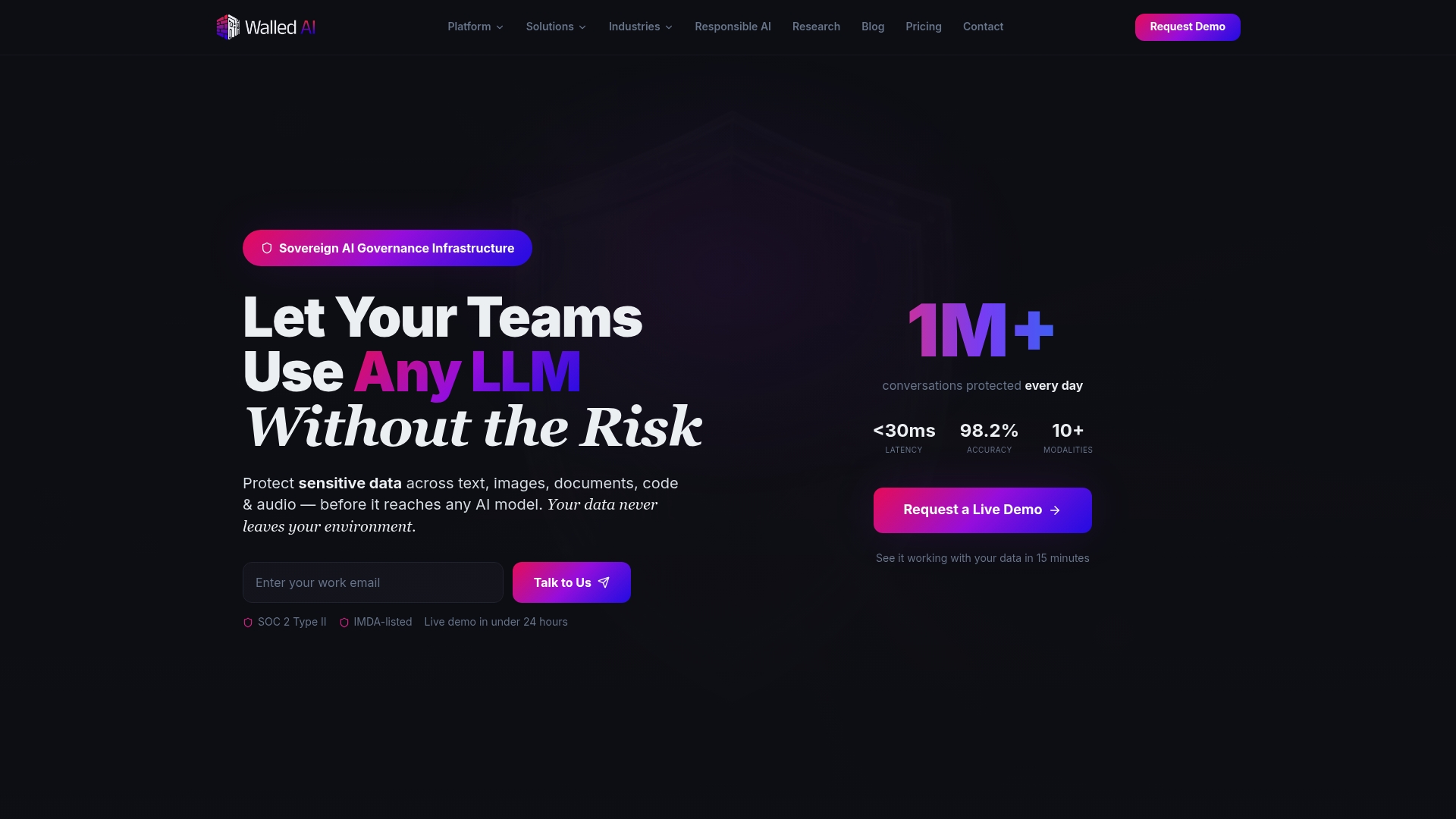
Walled's automated data classification identifies PII, PHI, financial records, IP, and credentials in real time across browser-based tools, desktop applications, and agentic workflows. For financial services teams, Walled's financial services governance layer enforces MAS TRM and PCI DSS-aligned controls without disrupting existing workflows. For organizations requiring the strictest data residency, Walled supports on-premises and air-gapped deployments that keep sensitive data entirely within customer-controlled infrastructure. Teams that need rapid deployment can get started through Walled's mid-market governance offering, which deploys in minutes.
FAQ
What types of sensitive data do AI tools most commonly expose?
The most commonly exposed categories are PII, PHI, financial records, source code, authentication credentials, and confidential business documents such as merger and acquisition files. Employees submit these categories to AI tools during routine tasks including drafting, summarizing, and debugging.
How does shadow AI increase sensitive data exposure risk?
Shadow AI refers to unsanctioned AI tool use that bypasses formal governance. Because these tools are not reviewed for data handling practices, any sensitive data submitted to them falls outside the organization's data processing agreements and compliance controls, creating direct regulatory liability.
Can AI models memorize and reproduce sensitive data submitted by users?
Yes. Stanford HAI research confirms that foundation models can memorize sensitive information from aggregated training data and regenerate it in outputs to other users. This makes exposure from AI tools qualitatively different from traditional data leakage, as remediation after model ingestion is not straightforward.
What is an AI subprocessor and why does it matter for compliance?
An AI subprocessor is a third-party AI model or service that a primary vendor uses to process data on your behalf. Because 63.6% of AI vendors do not disclose their subprocessors, data submitted to a SaaS platform may flow to an AI model that was never included in your vendor due diligence or data processing agreements.
What regulatory frameworks govern sensitive data exposure through AI tools?
The primary frameworks are GDPR for EU personal data, HIPAA for US health information, PCI DSS for payment card data, Singapore's PDPA and MAS TRM for financial institutions in Southeast Asia, and the EU AI Act for high-risk AI system deployments. Each framework imposes distinct obligations on data handling, breach notification, and vendor accountability.