

AI governance is the system of policies, roles, and controls that define responsible AI use, while AI management is the operational process that implements and enforces those policies throughout an AI system's lifecycle. Understanding the distinction between AI governance vs AI management is not optional for enterprise teams. Regulations like the EU AI Act, standards like ISO/IEC 42001, and frameworks like the NIST AI Risk Management Framework (AI RMF) each assign specific obligations to both layers. Organizations that conflate the two end up with either policies that never get enforced or controls that lack any principled rationale.
What are the main components of AI governance in enterprises?
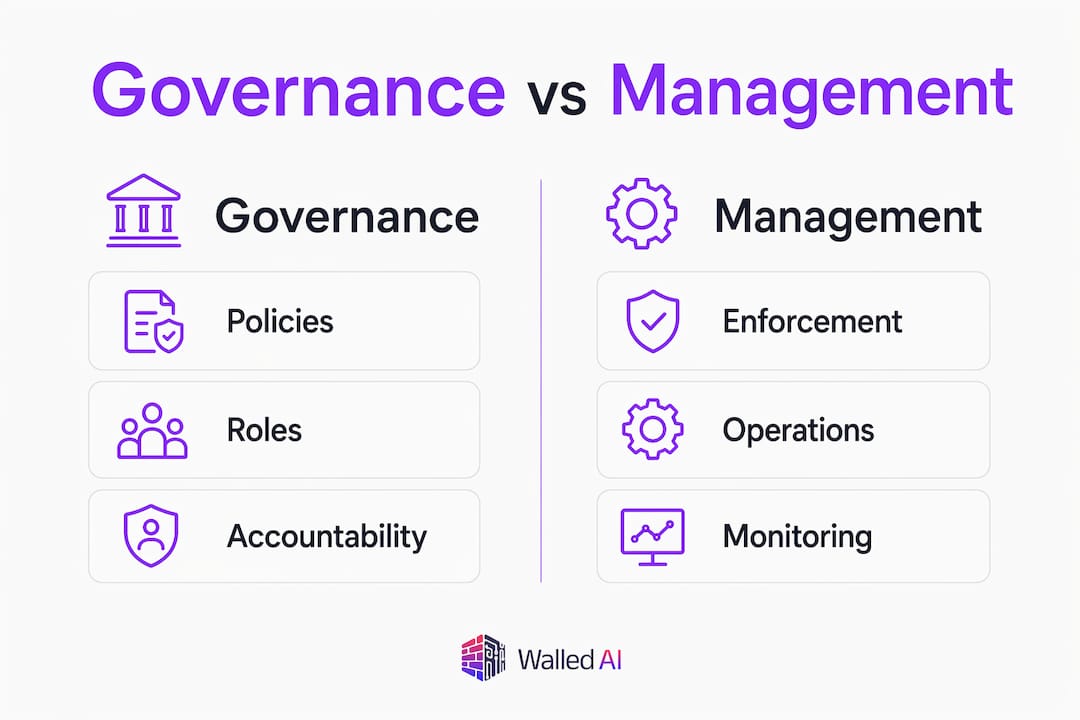
AI governance defines the rules and accountability structures that an organization applies to its AI systems. AI management then operationalizes those rules through processes such as approval workflows, risk assessments, and audit documentation. Governance sits at the strategic level. It answers the question: what are we allowed to do with AI, and who is accountable when something goes wrong?
The structural elements of an enterprise AI governance program typically include:
- Acceptable use policies that specify which AI applications are permitted, which data categories may be processed, and which use cases are prohibited outright.
- Governance roles and decision rights, including an AI oversight committee, a designated AI risk owner, and clear escalation paths for exceptions.
- Risk classification criteria aligned to regulatory thresholds. Under the EU AI Act, for example, high-risk AI classification triggers mandatory compliance obligations including risk management, data governance, and post-market monitoring.
- Accountability pillars covering transparency, fairness, and human oversight, each mapped to named roles within the organization.
- Framework alignment with recognized standards such as NIST AI RMF and ISO/IEC 42001 to give governance policies external credibility and audit defensibility.
Effective governance requires documented policies based on risk tolerance, with enforcement delivered through both automated tools and manual human oversight. That combination matters because automated controls catch high-volume, routine violations, while human oversight handles edge cases that no policy can fully anticipate.
Pro Tip: Assign a named decision authority for every governance policy category, not just a team or department. Ambiguous ownership is the single most common reason governance policies fail to translate into management action.

The CISO's responsibilities in AI governance extend beyond cybersecurity. The CISO role now covers AI-specific threat vectors including prompt injection, data exfiltration through AI interfaces, and model misuse. Governance policies must address these threats explicitly, not treat them as a subset of general information security.
How does AI management implement governance policies across the AI lifecycle?
AI management is the implementation layer. It takes the rules defined by governance and runs them through repeatable, auditable processes across every stage of an AI system's life. Without management, governance is a document. With management, governance becomes a demonstrable, enforceable program.
The core management processes in an enterprise AI program follow a defined sequence:
- Model intake and approval. Every AI model or tool entering the environment passes through a documented approval workflow. The workflow checks the model against governance risk classifications before deployment is authorized.
- Pre-deployment risk assessment. Management teams conduct structured assessments covering data sensitivity, model behavior, potential for bias, and regulatory scope. This step produces the evidence that governance policies require.
- Continuous monitoring. Post-deployment, management systems track model outputs, usage patterns, and policy adherence in real time. Changes in AI models or business processes must trigger reevaluation in management systems, not just periodic reviews.
- Incident handling. When a model produces a harmful output or a policy violation is detected, management processes define the response: containment, root cause analysis, remediation, and reporting.
- Audit evidence generation. Management closes the compliance loop by producing immutable records that demonstrate governance policies were followed. Governance defines rules, enforcement tools apply them, and evidence provides audit proof. Without that evidence, governance intent is not defensible to regulators.
The role of AI oversight in the enterprise is not limited to approving models at intake. Human oversight must remain active throughout the lifecycle, particularly for high-risk AI systems where automated monitoring cannot substitute for human judgment on consequential decisions.
Pro Tip: Build your audit evidence strategy before deployment, not after. Define which logs, decisions, and outputs constitute compliance proof, and configure your management systems to capture them automatically from day one.
Governance APIs play a specific role in management. They allow organizations to embed policy checks directly into custom AI applications and agentic workflows, so governance rules are enforced at the point of AI interaction rather than reviewed after the fact.
What regulatory frameworks define AI governance and management obligations?
Three frameworks dominate enterprise AI compliance programs in 2026. Each addresses governance and management differently, and organizations typically need all three.
| Framework | Primary focus | Governance or management? | Certification available? |
|---|---|---|---|
| EU AI Act | Risk classification and compliance obligations for AI systems | Both: governance sets classification; management executes obligations | Regulatory requirement, not voluntary |
| NIST AI RMF | Flexible risk management guidance across the AI lifecycle | Primarily governance: risk policies and organizational roles | No. Voluntary framework |
| ISO/IEC 42001 | Auditable AI management system with Plan-Do-Check-Act lifecycle | Primarily management: operational controls and system requirements | Yes. First certifiable AI management standard |
ISO/IEC 42001 is the first certifiable AI management system standard, structured around a Plan-Do-Check-Act lifecycle. NIST AI RMF is a voluntary risk management framework that organizations map to governance policies. The distinction matters because ISO/IEC 42001 certification gives external auditors a defined scope to assess, while NIST AI RMF gives internal teams a flexible process to follow.
Mapping controls across NIST AI RMF and ISO/IEC 42001 is now standard practice for organizations facing multiple stakeholder demands. NIST handles risk lifecycle guidance; ISO handles auditable management system requirements. Running them in parallel reduces documentation duplication and satisfies both internal governance committees and external certification auditors.
The EU AI Act adds a third dimension. High-risk AI classification under the EU AI Act is an upstream governance decision that drives all downstream management obligations. If a system is classified as high-risk, management must implement mandatory risk management systems, data governance controls, post-market monitoring, and registration requirements. Classification is not a management task. It is a governance decision with major management consequences.
Organizations in financial services face additional obligations under frameworks like MAS TRM, which layer sector-specific requirements on top of the general standards above. The AI governance requirements for financial services organizations therefore span multiple frameworks simultaneously, making crosswalk documentation a practical necessity rather than an optional exercise.
What are the common pitfalls in aligning AI governance with management?
Most enterprise AI programs fail at the boundary between governance and management, not within either discipline individually. The failure modes are consistent and predictable.
- Unclear accountability boundaries. Without named decision rights, management workflows cannot implement governance effectively. When a policy says "the appropriate team should review," no one reviews. Governance requires named approval and exception authorities at every decision point.
- Static governance policies. Governance documents written once and reviewed annually cannot keep pace with AI model updates, new use cases, or regulatory changes. Static policies create silent drift from acceptable risk thresholds without anyone noticing.
- Conflating governance with enforcement. Governance defines the rationale and rules. Enforcement is a management function. Organizations that assign enforcement responsibilities to the same group that writes policies lose the independence needed to catch violations objectively.
- Treating AI governance as a cybersecurity subset. AI governance vs cybersecurity is a meaningful distinction. Cybersecurity protects systems from external threats. AI governance addresses the risks that AI systems themselves create, including bias, hallucination, data leakage through model inputs, and non-compliant outputs. Both are necessary. Neither substitutes for the other.
- Skipping multidisciplinary integration. Effective AI governance and management require legal, compliance, IT, data science, and operations teams working from a shared framework. Programs built by IT alone or legal alone consistently miss the operational realities that the other disciplines understand.
The best practice that addresses all of these pitfalls is an operational loop: classify the AI system, apply the controls that classification requires, monitor those controls continuously, and feed findings back into governance for policy updates. Continuous compliance cycles incorporating classification, control enforcement, monitoring, and evaluation prevent the silent drift that static governance cannot catch.
Key Takeaways
AI governance sets the rules and accountability structures, while AI management enforces those rules through documented processes, continuous monitoring, and audit-ready evidence across the full AI lifecycle.
| Point | Details |
|---|---|
| Governance defines, management executes | Governance sets policies and risk classifications; management runs the workflows that implement them. |
| Named decision rights are non-negotiable | Every governance policy needs a named approval authority, or management workflows will stall at accountability boundaries. |
| Three frameworks, distinct roles | EU AI Act drives classification obligations; NIST AI RMF guides risk governance; ISO/IEC 42001 certifies management systems. |
| Static governance creates compliance drift | Governance policies must trigger reevaluation whenever AI models or business processes change, not just at annual review cycles. |
| Evidence closes the compliance loop | Audit-ready documentation produced by management is what makes governance intent defensible to regulators. |
Where governance theory meets operational reality
The most common mistake I see in enterprise AI programs is treating governance as a policy exercise and management as an IT project. They are not separate workstreams. They are two halves of a single compliance obligation, and the seam between them is where most audit findings originate.
Organizations that invest heavily in governance documentation but underinvest in management tooling end up with policies that exist on paper and nowhere else. Regulators reviewing EU AI Act compliance or ISO/IEC 42001 certification do not accept policy documents as evidence of compliance. They ask for logs, approval records, monitoring outputs, and incident reports. Those artifacts come from management systems, not governance committees.
The reverse failure is equally damaging. Organizations that deploy enforcement tools without a governance rationale cannot explain to auditors why specific controls were chosen, what risk they address, or who authorized the decision. Controls without rationale are not a compliance program. They are a collection of technical configurations.
What actually works is tight integration between the two layers, with governance decisions feeding directly into management system configurations and management findings feeding back into governance policy reviews. That loop requires cross-functional ownership, not just a CISO or a compliance officer working in isolation. Legal, data protection, operations, and AI engineering teams all need a seat at the table and defined responsibilities within the loop.
The organizations that will be audit-ready in 2026 are the ones that started building that loop in 2024, not the ones writing governance frameworks in response to regulatory deadlines.
— Rishabh
How Walled supports enterprise AI governance and management
Enterprise teams that need to operationalize AI governance frameworks without building compliance infrastructure from scratch have a direct path forward with Walled.
Walled provides a unified AI control plane that enforces governance policies in real time across browser-based AI tools, desktop applications, custom AI applications, and agentic workflows. The platform performs AI Data Loss Prevention before data reaches any model, produces immutable audit trails aligned with EU AI Act and ISO/IEC 42001 requirements, and supports continuous monitoring with compliance reporting built in. For organizations across sectors, Walled's enterprise AI governance platform and mid-market deployment options deliver governance and management integration without the overhead of building it internally. Government agencies requiring air-gapped deployments and financial services teams facing MAS TRM obligations each have dedicated configurations available.
FAQ
What is the core difference between AI governance and AI management?
AI governance defines the policies, roles, and accountability structures for responsible AI use. AI management implements and enforces those policies through operational processes, monitoring, and audit documentation across the AI lifecycle.
Why do enterprises need both AI governance and AI management?
Governance without management produces unenforceable policies. Management without governance produces controls with no principled rationale. Regulators under frameworks like the EU AI Act and ISO/IEC 42001 require evidence of both.
What are the main types of AI governance frameworks?
The three primary frameworks are the EU AI Act, which mandates compliance obligations based on risk classification; NIST AI RMF, a voluntary risk management framework; and ISO/IEC 42001, the first certifiable AI management system standard using a Plan-Do-Check-Act lifecycle.
How does AI governance differ from cybersecurity?
Cybersecurity protects systems from external threats. AI governance addresses risks that AI systems themselves generate, including bias, hallucination, data leakage through model inputs, and non-compliant outputs. Both disciplines are necessary and address distinct risk categories.
What is the role of governance APIs in AI management?
Governance APIs embed policy checks directly into custom AI applications and agentic workflows, enforcing governance rules at the point of AI interaction rather than reviewing compliance after the fact.