

An AI transparency requirement is the legal and governance obligation for organizations to disclose how AI systems operate, inform users when AI is involved in decisions, and maintain verifiable audit trails that regulators and auditors can inspect. The industry term for this practice is "AI transparency," and it spans three dimensions: explainability, disclosure, and accountability. EU AI Act Article 50 sets the most concrete global benchmark, with core transparency obligations taking effect on august 2, 2026. The stakes are direct: 75% of businesses report risk of customer churn from insufficient AI transparency, while 72% of consumers report reduced trust in AI compared to the prior year. For compliance officers, understanding what is AI transparency requirement means understanding both the regulatory floor and the governance infrastructure needed to meet it.
What is an AI transparency requirement?
An AI transparency requirement is a formal obligation to make AI system behavior visible, traceable, and verifiable to users, regulators, and auditors. The definition goes beyond publishing a privacy notice. It covers how decisions are made, what data was used, which policies governed the process, and who authorized the action.
Regulators do not demand access to model weights or internal neural network parameters. Transparency means showing what AI did, on what data, under what policy, and on whose authority, verified through evidence and traceability rather than model internals. That distinction matters enormously for compliance officers. It shifts the burden from solving unsolvable explainability problems to building governed, auditable processes.

The OECD and the EU AI Act both treat transparency as a foundational principle of trustworthy AI. Transparency by design means embedding explainability and accountability into the AI lifecycle from the start, not retrofitting disclosures after deployment. Organizations that treat transparency as an afterthought face far greater remediation costs when regulators come knocking.
What are the primary components of AI transparency?
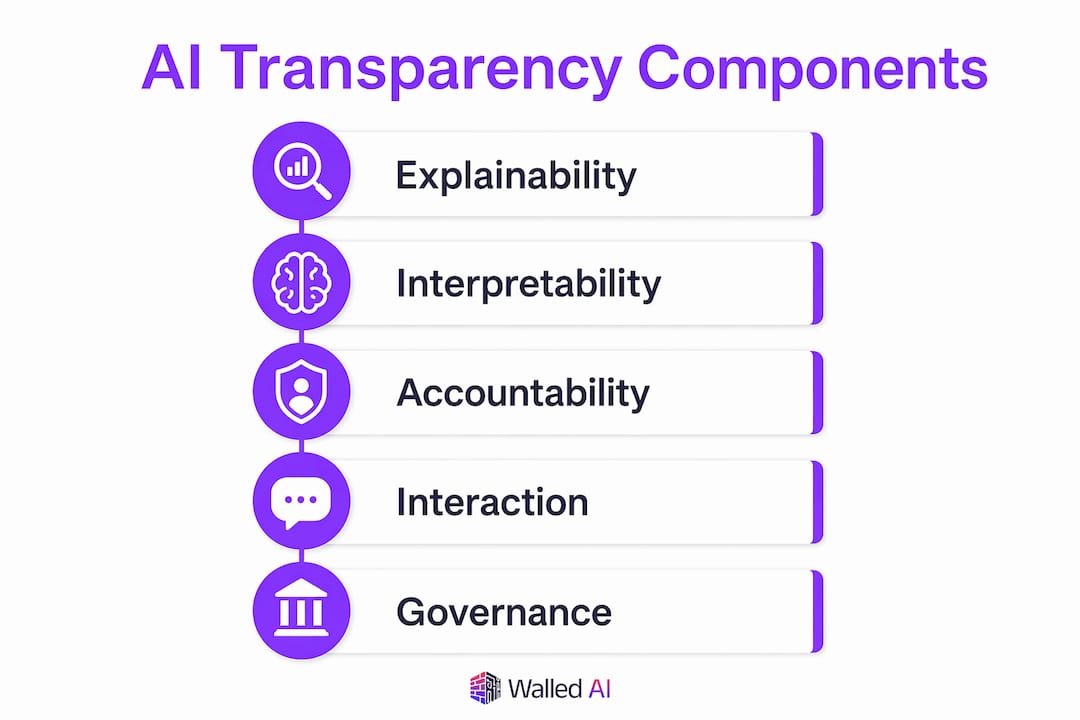
Explainability, interpretability, and accountability are the three core components of AI transparency requirements. Each operates at a different layer of the AI system and carries distinct compliance implications.
| Component | What it covers | Compliance focus |
|---|---|---|
| Explainability | How the model reaches a decision | Output documentation, rationale logging |
| Interpretability | What the model's internal logic means | Risk classification, model cards |
| Accountability | Who authorized the AI action | Human oversight records, governance policies |
Interaction transparency sits at the user-facing layer. It requires organizations to inform users, at the point of first contact, that they are interacting with an AI system. Social transparency addresses broader ethical and societal implications, including bias, fairness, and the impact of AI decisions on protected groups.
Pro Tip: Focus compliance resources on accountability and interaction transparency first. These are the layers regulators audit most frequently and where documentation gaps cause the most enforcement exposure.
Compliance officers should map each transparency component to a specific governance control. Explainability maps to model documentation and output logging. Accountability maps to human oversight protocols and policy records. Interaction transparency maps to user notification workflows and disclosure language. This mapping exercise converts abstract obligations into auditable evidence.
What are the key AI transparency obligations under the EU AI Act?
The EU AI Act creates the most detailed AI disclosure requirements currently in force globally. Article 50 transparency obligations become applicable from august 2, 2026, with requirements for marking synthetic content taking effect from december 2, 2026.
| Obligation | Scope | Deadline |
|---|---|---|
| User notification at first AI interaction | All AI systems interacting with natural persons | August 2, 2026 |
| Synthetic content labeling | AI-generated images, audio, video, and text | December 2, 2026 |
| Machine-readable marking and watermarking | Providers of general-purpose AI models | December 2, 2026 |
| Traceability and documentation | High-risk AI systems | August 2, 2026 |
| Human oversight support | High-risk AI systems | August 2, 2026 |
Mandated transparency includes notifying users when interacting with AI systems, labeling AI-generated synthetic content, and enabling human verification through interoperable technical methods. This is not a single checkbox. It requires coordinated action across product, legal, and technology teams.
The European Commission distinguishes between a Code of Practice covering technical marking and labeling, and Guidelines covering scope interpretation. Organizations operating across jurisdictions should also consult the EU AI Act compliance guide to understand how these obligations interact with GDPR and sector-specific rules. The OECD AI Principles reinforce these obligations internationally, making them relevant beyond European operations.
Providers must give clear, distinguishable transparency information at the first AI system interaction and support human verification through technical means including watermarking, metadata embedding, and logging. Each of these mechanisms requires advance technical preparation. Organizations that have not started implementation by mid-2026 face significant remediation timelines.
How can organizations implement AI transparency requirements in practice?
Effective implementation starts with governance, not technology. Organizations need written AI policies that define permitted use cases, risk classifications, and human oversight protocols before deploying any AI system. Without that policy layer, technical transparency measures have no authority to reference.
Governance controls to establish first
- Maintain a register of all AI systems in use, including third-party tools and AI copilots
- Classify each system by risk level using the EU AI Act's four-tier framework
- Assign human accountability for each AI system's decisions and outputs
- Document the data sources, training parameters, and intended use cases for each system
- Establish escalation protocols for AI decisions that affect individuals' rights or safety
Technical measures that satisfy regulators
Audit trails, governance APIs, and structured evidence are what regulators prefer over user-facing explanations alone. Mapping every AI decision to a policy and authorized use case creates the evidentiary record that survives audit scrutiny. Metadata embedding and watermarking satisfy the synthetic content marking requirements under Article 50.
Walled provides immutable audit trails and centralized policy enforcement that connect AI interactions to specific governance policies and authorized use cases. The platform's governance dashboard gives compliance officers real-time visibility into AI activity across browser-based tools, desktop applications, and agentic workflows. That visibility is the foundation of demonstrable transparency.
Pro Tip: Align your AI transparency program with your existing risk management framework. Regulators respond better to organizations that treat AI governance as an extension of established enterprise risk controls, not as a separate compliance silo.
A common pitfall is treating user-facing disclosures as the entirety of the transparency obligation. Regulators and auditors look deeper. They examine whether human oversight was genuinely possible, whether decisions were traceable to authorized policies, and whether the organization can produce evidence on demand. Organizations that invest in human oversight frameworks alongside disclosure workflows are far better positioned for regulatory scrutiny.
What are the strategic benefits and challenges of AI transparency?
Transparency is a strategic necessity. It converts AI from a liability risk into a verifiable, trustworthy tool that supports brand reputation and stakeholder confidence. The business case is direct: organizations that demonstrate transparent AI practices retain customer trust and reduce regulatory exposure simultaneously.
Business benefits of meeting AI disclosure requirements
- Reduced customer churn risk from AI-related trust deficits
- Stronger brand reputation with enterprise buyers who conduct AI due diligence
- Faster regulatory approvals for AI-enabled products in regulated industries
- Lower legal exposure from unexplained AI decisions affecting individuals
- Competitive differentiation in markets where AI governance is a procurement criterion
The challenges are real. Full model explainability is often technically impossible for large language models and deep neural networks. Organizations that chase complete internal transparency waste resources on an unachievable goal.
"Organizations should stop chasing total model explainability and instead demonstrate traceable, governed, and accountable AI activity." — Collibra AI Governance Research
The practical answer is to focus on traceable accountability rather than model internals. Governance logs, policy records, and human oversight documentation satisfy regulators. They also satisfy enterprise customers conducting vendor AI due diligence. Balancing transparency with intellectual property protection is a legitimate tension. The solution is tiered disclosure: full traceability for regulators and auditors, summary disclosures for end users, and protected model architecture for internal use only.
Compliance officers in financial services and healthcare face the highest transparency obligations because AI decisions in those sectors directly affect individuals' financial and physical wellbeing. Walled's financial services governance and healthcare compliance solutions address these sector-specific transparency demands with deployment options that keep sensitive data within customer-controlled environments.
Key Takeaways
AI transparency requirements are met through governance, traceability, and accountability controls, not through exposing model internals to regulators or users.
| Point | Details |
|---|---|
| Core definition | AI transparency requires disclosing AI involvement, decision rationale, and maintaining auditable governance records. |
| EU AI Act deadlines | Article 50 obligations apply from august 2, 2026; synthetic content marking from december 2, 2026. |
| Three components | Explainability, interpretability, and accountability each require distinct governance controls and documentation. |
| Regulator focus | Auditors want traceable evidence of policy compliance and human oversight, not access to model architecture. |
| Implementation priority | Establish AI system registers, risk classifications, and human oversight protocols before deploying technical measures. |
Transparency as a governance mandate, not a technical problem
Compliance officers often receive transparency as a technology brief. The engineering team is asked to make the model explainable, and the compliance team waits for the output. That framing is wrong, and it consistently produces programs that fail audit.
Transparency is a governance mandate. The question regulators ask is not "can you explain how the neural network works?" It is "can you show me what decision was made, under what policy, by whose authority, and with what human oversight?" Those are governance questions. They require policy documents, audit logs, accountability assignments, and escalation records.
The organizations I have seen handle AI audits well share one characteristic: they built their transparency programs around evidence production, not model documentation. They can produce a complete record of any AI decision within hours. They have named humans accountable for each AI system. Their policies are written, versioned, and linked to specific AI use cases.
The uncomfortable truth about AI transparency is that most organizations are further behind than they realize. User-facing disclosures are visible and easy to check. Governance infrastructure is invisible until a regulator asks for it. By the time the request arrives, the remediation window is closed.
Start with the governance layer. Build the audit trail infrastructure. Then layer on user disclosures and technical marking. That sequence produces durable compliance. The reverse sequence produces disclosure theater with nothing behind it.
— Rishabh
Walled's AI governance platform for transparency compliance
Compliance officers preparing for the august 2026 EU AI Act deadlines need infrastructure that produces audit-ready evidence, not just dashboards.
Walled provides a unified AI governance platform with immutable audit trails, real-time policy enforcement, and compliance reporting designed to meet GDPR, the EU AI Act, PDPA, and MAS TRM obligations. The platform maps every AI interaction to an authorized policy and generates structured evidence that satisfies regulatory audit requirements. For mid-market organizations, Walled's mid-market governance solution deploys in minutes and scales with your AI adoption. For government agencies requiring air-gapped deployments, Walled's government governance infrastructure keeps all data within sovereign environments. Explore how Walled supports your AI transparency obligations at walled.ai.
FAQ
What is an AI transparency requirement?
An AI transparency requirement is the legal obligation to disclose how AI systems make decisions, inform users of AI involvement, and maintain traceable governance records that regulators and auditors can verify.
What does the EU AI Act require for AI transparency?
Article 50 of the EU AI Act requires providers to notify users at first AI interaction and label synthetic content, with core obligations applying from august 2, 2026, and synthetic content marking from december 2, 2026.
What is the difference between AI transparency and AI explainability?
AI transparency covers governance, disclosure, and traceability of AI decisions. AI explainability is a narrower technical concept focused on interpreting model outputs. Regulators prioritize transparency over full model explainability.
How do organizations demonstrate AI transparency to regulators?
Organizations demonstrate AI transparency through immutable audit logs, policy documentation, human oversight records, and governance APIs that map each AI decision to an authorized use case and accountable individual.
Why is AI transparency important for businesses beyond compliance?
Transparency directly affects customer retention and trust. Research shows 75% of businesses face customer churn risk from insufficient AI transparency, making it a business continuity concern as well as a regulatory obligation.