

LLM output compliance checking is defined as a four-stage verification process: execution, structural and semantic validation, immutable logging, and incident reporting. For compliance officers and data protection professionals, this process is not optional. The EU AI Act, GDPR, NIST AI RMF, and frameworks like MAS TRM all require continuous runtime verification of AI-generated content, not just pre-deployment testing. Without a structured compliance verification process, organizations face incomplete incident reporting, undetected hallucinations, and regulatory exposure. This guide delivers the precise steps, tools, and governance controls needed to meet those obligations in 2026.
What tools and prerequisites do LLM output compliance checking steps require?
Effective LLM output compliance checking starts with the right architecture before a single validation runs. Three categories of prerequisites determine whether your compliance verification process will hold up under regulatory scrutiny.
Regulatory frameworks and policy baselines

Every compliance checking procedure must map to at least one binding framework. The EU AI Act Articles 55 and 73 mandate runtime output verification and structured incident reporting. NIST AI RMF provides a risk-tiered approach to AI governance. GDPR and PDPA impose data minimization and purpose limitation requirements that apply directly to AI-generated outputs containing personal data. Compliance officers must document which frameworks govern each AI system before configuring any validation layer.
Technical components required
The core technical stack for LLM output evaluation includes the following:
- Schema validation libraries: Tools like Pydantic enforce output structure contracts and reject malformed responses before they reach downstream systems.
- Semantic similarity engines: Vector-based models compute similarity scores between LLM outputs and verified reference content, enabling hallucination detection with configurable thresholds.
- PII detection pipelines: Regex-based and model-based classifiers identify personal data, credentials, and regulated information in generated text.
- Immutable logging infrastructure: Append-only log stores, such as write-once object storage or blockchain-anchored logs, preserve audit evidence that cannot be altered after the fact.
- Alerting and dashboard tooling: Monitoring systems surface compliance degradation in real time, enabling proactive governance rather than reactive incident response.
Staff roles and responsibilities
| Role | Responsibility |
|---|---|
| Compliance officer | Defines policy rules, approves validation thresholds, and signs off on incident reports |
| Data protection lead | Reviews PII detection configurations and manages data subject rights obligations |
| AI/ML engineer | Implements and maintains validation pipelines and logging infrastructure |
| Human-in-the-loop reviewer | Escalates ambiguous outputs flagged by automated guardrails for manual review |
No compliance architecture functions without clear ownership. Each role must have documented authority and escalation paths before production deployment begins.
What are the step-by-step LLM output compliance checking steps?
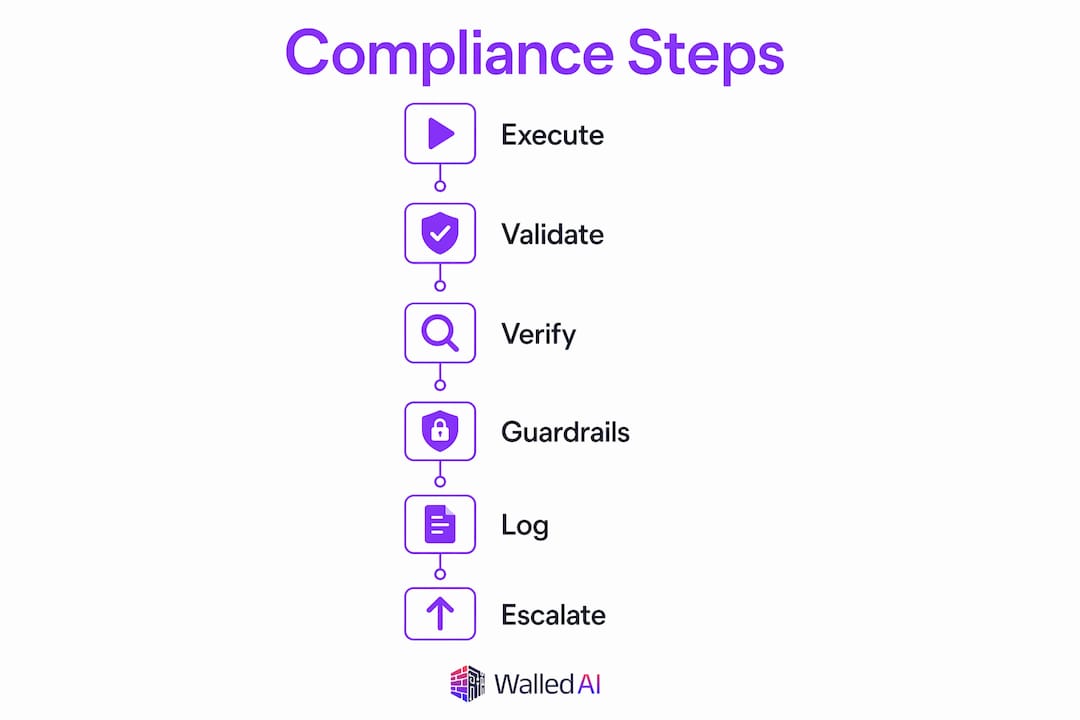
The compliance verification process follows a fixed sequence. Skipping or reordering steps creates gaps that regulators and auditors will find.
Step 1: Execute the LLM call and capture output with metadata
Every LLM call must be logged at the moment of execution. Captured metadata must include the model identity, model version, prompt hash, timestamp to the millisecond, and the raw output string. This metadata forms the foundation of the audit trail. Without it, linking a specific output to a specific model state is impossible, which makes Article 73 incident reporting incomplete by definition.
Step 2: Validate output structure and schema
Structural validation is the mandatory first step in the validation sequence. Schema parsers like Pydantic check that the output conforms to the expected format, data types, and field constraints. A response that fails structural validation must be rejected immediately. Sending a malformed output to downstream systems or end users before content checks run creates both a reliability failure and a compliance gap.
Step 3: Perform semantic validation for hallucination detection
Semantic validation compares the LLM output against verified reference content using a similarity score. Hallucination detection thresholds are typically set at 0.6 on a cosine similarity scale. Outputs scoring below the threshold trigger a correction loop: the system retries the LLM call with an evidence citation instruction, or escalates to human review if the retry also fails. This step catches factual errors that structural validation cannot detect.
Pro Tip: Set separate similarity thresholds for different content categories. A financial advice output may require a threshold of 0.8, while a general FAQ response may tolerate 0.6. Flat thresholds applied across all use cases produce too many false positives in low-risk contexts and too many false negatives in high-risk ones.
Step 4: Apply post-LLM guardrails for policy compliance
Output guardrails detect PII leaks, toxicity, format violations, and off-topic responses. They serve as the last line of defense before any content reaches a user. Implementation combines fast regex-based checks for known patterns with model-based moderation for nuanced policy violations. The order matters: run deterministic regex checks first to eliminate obvious violations without incurring model inference costs, then apply model-based checks only to outputs that pass the initial filter.
Most enterprises focus compliance controls on pre-inference prompt filtering. Post-inference output verification is the authoritative compliance gate. Prompt filtering cannot catch what the model generates in response to a compliant prompt.
Step 5: Log all validation results immutably
Every validation result must be written to an immutable log immediately after the guardrail check completes. Audit logs must connect the input prompt, the output response, the validation rules triggered, the compliance verdict, and any recovery actions taken. Simple text logs do not meet this standard. The log record must be reconstructible and tamper-evident to satisfy Article 73 of the EU AI Act.
| Log field | Required content |
|---|---|
| Timestamp | Millisecond-precision UTC timestamp |
| Model identity | Model name, version, and provider |
| Validation dimensions | Each check run and its pass/fail result |
| Compliance verdict | Final disposition: pass, flag, or block |
| Recovery action | Retry, fallback response, or human escalation |
Step 6: Execute incident reporting and human escalation
Outputs that fail validation after retry must trigger a formal incident record. The incident record captures the failure type, the affected validation dimensions, the model state at the time of failure, and the escalation path taken. Human reviewers assess whether the failure represents a systemic risk or an isolated event. Systemic failures require timely reporting to the relevant supervisory authority under the EU AI Act. Isolated failures feed back into rule tuning and threshold adjustment cycles.
What are the best practices for LLM output compliance verification?
Compliance officers who have deployed output verification pipelines in production consistently encounter the same failure patterns. Addressing them before deployment saves significant remediation effort.
- Prioritize post-inference checks. Pre-prompt filtering is a useful first layer, but it cannot substitute for output-level verification. The authoritative compliance gate is always post-inference.
- Manage guardrail latency deliberately. Guardrail performance adds 200–500ms per call. Run fast deterministic checks first and reserve model-based moderation for outputs that pass the initial filter. Asynchronous logging also reduces synchronous latency overhead.
- Maintain allowlists for known-safe patterns. False positives in PII detection and toxicity filters erode trust in the compliance system. Allowlists and confidence thresholds prevent over-blocking of legitimate outputs.
- Update rulesets on a scheduled cadence. Regulatory guidance evolves. Validation rules and thresholds must be reviewed and updated at least quarterly, or whenever a new regulatory instrument takes effect.
- Train teams on incident documentation. Automated systems generate the raw evidence. Compliance officers and data protection leads must know how to interpret validation logs, write incident narratives, and link evidence to regulatory submissions.
Compliance systems that rely entirely on automation without documented human review procedures will fail regulatory audits. Regulators expect to see evidence of human judgment in the governance chain, not just system-generated logs.
Pro Tip: Run a parallel shadow pipeline on 5–10% of production traffic before full deployment. Compare shadow validation results against your existing controls to calibrate thresholds without disrupting live users.
How should organizations monitor and audit LLM output compliance over time?
Compliance verification is not a one-time configuration. Key monitoring metrics for output compliance include hallucination rates, PII block counts, latency percentiles, and frequency of configuration changes. These metrics indicate whether the compliance posture is holding or degrading as model behavior shifts over time.
Effective ongoing oversight requires the following practices:
- Dashboard and alerting configuration: Set alert thresholds on hallucination rate increases and PII block count spikes. A sudden rise in either metric signals a model drift event or a policy gap that requires immediate investigation.
- Audit trail completeness checks: Periodically verify that log records contain all required fields. Missing fields discovered during a regulatory audit are treated as evidence of inadequate governance, not technical errors.
- Sampling and manual review cycles: Pull a random sample of flagged outputs weekly for human review. Manual review calibrates automated thresholds and surfaces edge cases that rules do not yet cover.
- Canary rollout for rule changes: Deploy updated validation rules to a small traffic segment before full rollout. Canary stages prevent a misconfigured rule from blocking compliant outputs at scale.
| Monitoring metric | Governance signal |
|---|---|
| Hallucination rate | Indicates model drift or retrieval failure in RAG pipelines |
| PII block count | Tracks data leakage risk and DLP effectiveness |
| Latency percentiles | Reveals guardrail performance impact on user experience |
| Config change frequency | Flags instability in validation rules requiring review |
Linking audit trail records to regulatory submissions is the final step in the monitoring cycle. Each Article 73 report must reference specific log records, validation verdicts, and the human review actions taken. Organizations that maintain this linkage from day one face significantly less effort when a regulatory inquiry arrives.
Key Takeaways
Effective LLM output compliance requires a structured, continuous verification pipeline that connects execution, validation, logging, and incident reporting into a single auditable chain.
| Point | Details |
|---|---|
| Four-stage pipeline is mandatory | Execution, validation, immutable logging, and incident reporting must all run continuously, not just at deployment. |
| Post-inference is the compliance gate | Pre-prompt filtering cannot catch policy violations in model outputs; post-inference guardrails are required. |
| Immutable logs must link all evidence | Audit records must connect prompts, outputs, validation verdicts, and human actions to satisfy Article 73 requirements. |
| Latency requires a hybrid check strategy | Run fast regex checks first, then model-based moderation, to keep guardrail overhead within acceptable bounds. |
| Monitoring metrics drive continuous improvement | Track hallucination rates, PII block counts, and latency percentiles to detect compliance degradation before it becomes a regulatory event. |
The compliance gap most enterprises are still ignoring
Working across enterprise AI governance programs, the pattern I see most often is organizations that have invested heavily in prompt engineering and pre-deployment red-teaming, then treated output verification as an afterthought. The assumption is that a well-designed prompt produces a safe output. That assumption is wrong, and regulators know it.
The EU AI Act does not accept pre-deployment testing as a substitute for runtime verification. Incident reporting obligations under Article 73 require evidence drawn from live production logs, not test environment results. Organizations that lack immutable, reconstructible audit trails will find themselves unable to respond to a regulatory inquiry with the specificity required.
The other gap I see consistently is the absence of cross-disciplinary ownership. Legal teams define the regulatory obligations. Technical teams build the pipelines. Compliance officers sign the reports. When these groups do not share a common understanding of what the validation pipeline actually checks, the governance documentation and the technical reality diverge. That divergence is exactly what a regulatory audit is designed to expose.
The practical answer is to treat LLM output validation as a product, not a project. It requires ongoing ownership, versioned rulesets, documented escalation paths, and a feedback loop that connects monitoring metrics back to policy decisions. Organizations that build that operating model now will be significantly better positioned as AI governance frameworks continue to tighten through 2026 and beyond.
— Rishabh
How Walled supports enterprise LLM output compliance
Walled is built specifically for organizations that need to operationalize the compliance verification process described in this guide without building every component from scratch.
Walled's AI governance platform provides built-in output verification, hallucination detection, PII masking, and immutable audit trails aligned with the EU AI Act, GDPR, PDPA, and MAS TRM. The platform deploys in minutes and integrates with existing AI pipelines through governance APIs. For regulated industries including financial services and government, Walled supports air-gapped and private cloud deployments that keep sensitive data within customer-controlled environments. Compliance officers can request a tailored demo to see how Walled maps directly to their regulatory obligations and existing AI stack.
FAQ
What are the four stages of LLM output compliance checking?
The four stages are execution, structural and semantic validation, immutable logging, and incident reporting. Each stage must run continuously at runtime, not only during pre-deployment testing.
Why is post-inference verification required instead of prompt filtering alone?
Post-inference output verification is the only method that catches policy violations and hallucinations in the actual content delivered to users. Pre-prompt filtering cannot control what the model generates in response to a compliant input.
What must an immutable audit log contain for EU AI Act compliance?
An audit log must connect the input prompt, the output response, the validation rules triggered, the compliance verdict, and any recovery actions taken. Simple text logs do not meet Article 73 requirements.
How much latency do output guardrails add to LLM calls?
Guardrail checks add approximately 200–500ms per call. Running fast deterministic regex checks before model-based moderation reduces this overhead significantly.
How often should validation rules and thresholds be updated?
Validation rules and thresholds should be reviewed at least quarterly and updated whenever a new regulatory instrument takes effect or monitoring metrics indicate compliance degradation.