

Legal sector AI compliance is defined as the set of policies, oversight protocols, and governance frameworks that ensure a law firm's use of AI tools meets applicable ethical rules, data protection laws, and professional responsibility standards. 79% of legal professionals now use AI, yet only 30% have formal AI compliance policies in place. That gap represents serious exposure. Regulations like the EU AI Act, ABA Formal Opinion 512, and U.S. state bar guidance are no longer aspirational. They carry real enforcement weight in 2026, and firms without documented governance frameworks face liability, privilege loss, and disciplinary risk.
What are the core legal and ethical regulations governing AI use in law firms?
AI governance for law firms is not a new body of law. It is the application of existing professional responsibility rules to AI tools. ABA Formal Opinion 512 serves as the primary interpretive standard, mapping Model Rules 1.1 (competence), 1.6 (confidentiality), and 5.3 (supervision of non-lawyers) directly to AI use. Firms that deploy AI without understanding these mappings are already in violation, even if no incident has occurred.
The key obligations under these rules include:
- Rule 1.1 (Competence): Attorneys must understand the capabilities and limitations of any AI tool they use. Claiming ignorance of how a tool processes data is not a defense.
- Rule 1.6 (Confidentiality): Client data cannot be entered into an AI system without adequate safeguards. This includes understanding where data is stored, who can access it, and whether the vendor trains models on user inputs.
- Rule 5.3 (Supervision): Partners and supervising attorneys are responsible for AI outputs produced by associates or staff. Supervision extends to the AI tool itself.
On the regulatory side, more than 14 U.S. states have issued formal AI guidance for attorneys, most reinforcing the ABA framework. Firms operating across multiple jurisdictions must track each state's specific requirements, which vary in disclosure obligations and consent standards.
The EU AI Act adds a harder deadline. Legal AI tools classified as high-risk face mandatory conformity assessments and data processing registries, with enforcement beginning august 2, 2026. Firms serving EU clients or operating in EU jurisdictions must complete these assessments before that date. Missing the deadline is not a technical violation. It is a legal one.

Which policies and organizational frameworks are essential for AI compliance?
A governance framework for AI in legal practice requires three distinct layers: approved tools, permitted tools, and prohibited tools. This three-tier model gives compliance officers a clear structure for managing AI adoption without blocking productivity.
- Approved tools are fully vetted, documented, and authorized for use with client data. Vendor data processing agreements must confirm no model training on firm inputs, data residency controls, and breach notification timelines.
- Permitted tools are authorized for internal, non-client-facing tasks only. Research summarization, internal drafting, and scheduling fall here. Client data never enters these systems.
- Prohibited tools are explicitly banned. Consumer-grade AI tools with no enterprise data agreements belong in this category.
Building an approved-tools list requires vendor risk management. Every vendor assessment should document the tool's data processing location, retention policies, subprocessor relationships, and AI-specific processes including inference and fine-tuning. Data processing agreements must cover AI-specific processes like these explicitly, not just standard data handling terms.
Human oversight protocols must be written into policy, not assumed. Every AI-generated work product requires attorney review before delivery to a client or filing with a court. The policy should specify who reviews, what the review must cover, and how the review is documented.
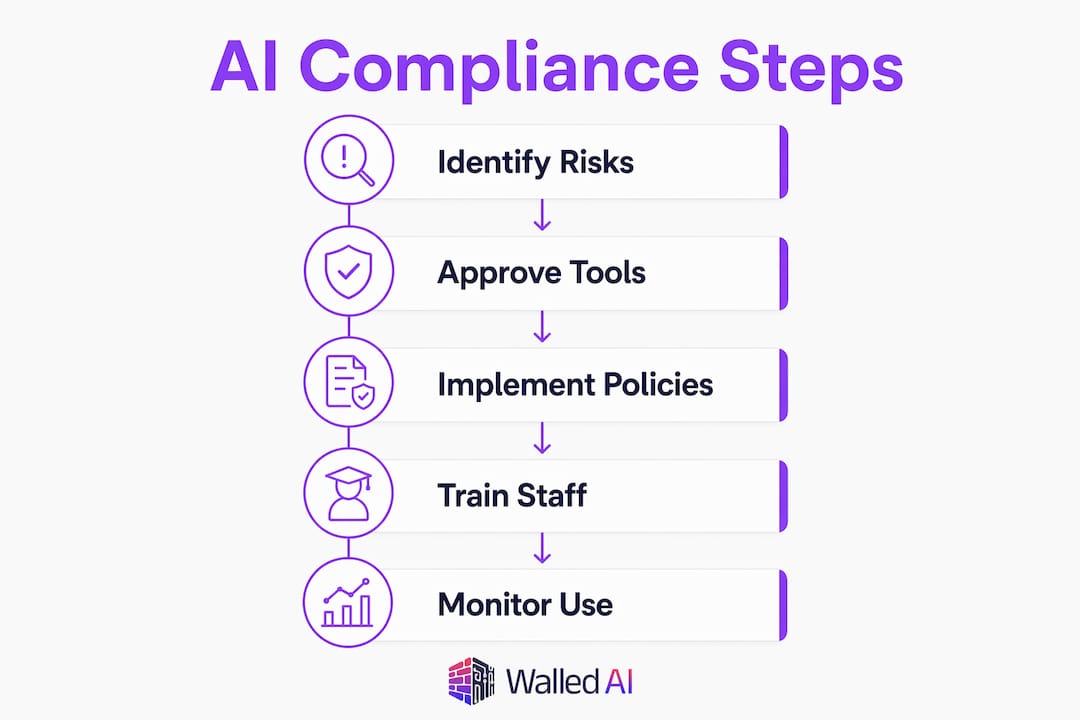
Pro Tip: A basic firm AI policy covering tool categories, oversight requirements, and prohibited uses can be drafted in approximately two hours using a structured template. Starting with a simple, enforceable policy is far better than waiting for a perfect one.
| Policy element | Minimum requirement |
|---|---|
| Approved-tools list | Updated quarterly with vendor risk scores |
| Human oversight protocol | Named reviewer for each AI output category |
| Training requirements | Annual AI literacy training for all fee earners |
| Audit logging | Immutable logs of AI interactions retained for 3 years |
| Incident response plan | Defined escalation path for AI-related data incidents |
Incident response plans must address AI-specific scenarios. A prompt injection attack that exposes client data is not the same as a phishing breach. The response plan should name the AI tool involved, the data categories at risk, and the notification obligations triggered under applicable law.
How can legal teams conduct risk assessments and compliance checks for AI tools?
Effective AI risk management in law starts with three output standards: confidence, legibility, and defensibility. AI outputs must meet confidence, legibility, and defensibility standards before supervising attorneys can rely on them. Confidence means the output is accurate enough to act on. Legibility means the reasoning is traceable. Defensibility means the process can be explained to a court, regulator, or client.
A practical compliance check for any AI tool follows four steps:
- Vendor documentation review. Obtain and review the vendor's data processing agreement, privacy policy, and AI-specific terms. Confirm no-training commitments in writing.
- Sample audit review. Run 20–30 representative tasks through the tool and evaluate outputs against the confidence, legibility, and defensibility standards. Document the results.
- Privilege and confidentiality assessment. Determine which data categories the tool will process. Map those categories to applicable privilege rules and data protection obligations.
- Client disclosure and consent protocol. Establish when disclosure is required and what informed consent looks like for each use case.
Routine AI use for non-client tasks may not require client disclosure. However, informed consent is mandatory whenever confidential client information enters an AI system. Failing to obtain that consent risks privilege waiver and ethics violations.
The human oversight requirements embedded in both ABA guidance and the EU AI Act reinforce this point. Oversight is not optional. It is a documented, auditable obligation.
What are common compliance pitfalls when adopting AI in the legal sector?
Selecting AI technology before building a compliance framework is the most common failure in legal AI deployments. Firms that choose a tool first and build policy around it end up with governance shaped by vendor limitations rather than professional obligations. The compliance framework must come first.
Other pitfalls that legal teams consistently encounter include:
- Liability misconceptions. Liability for client data leaks rests with the law firm, not the AI vendor. Signing a vendor agreement does not transfer professional responsibility. Firms remain accountable for every unauthorized disclosure caused by an AI tool they selected and deployed.
- Black-box AI reliance. Deploying AI models that cannot explain their reasoning creates defensibility failures. If an attorney cannot describe how an AI reached a conclusion, that conclusion cannot be defended in court or before a regulator.
- Cybersecurity gaps. AI compliance requires integration with cybersecurity to address credential risks and attacker impersonation. A firm with strong AI policies but weak credential management is still exposed. AI governance without cybersecurity fundamentals is incomplete.
Pro Tip: Before approving any AI tool, require the vendor to provide a written answer to this question: "Does your system use client inputs to train or fine-tune any model?" A vendor that cannot answer clearly is a vendor that should not be approved.
The compliance challenges in AI adoption that derail most firms are not technical. They are organizational. Firms that treat AI compliance as an IT project rather than a governance obligation consistently underestimate the policy, training, and oversight work required.
Step-by-step roadmap for integrating AI compliance into legal workflows
A 12-month implementation roadmap gives legal teams a structured path from policy design to full deployment. The phases below reflect the compliance-first approach that regulators and ethics bodies expect.
- Months 1–3: Use case selection and framework design. Identify the specific tasks AI will support. Define confidence, legibility, and defensibility criteria for each use case. Draft the three-tier tool policy and assign a compliance owner.
- Months 4–6: Policy drafting, training, and pilot testing. Finalize the approved-tools list. Deliver AI literacy training to all fee earners. Run a controlled pilot with one approved tool on low-risk, non-client tasks. Document all outputs and review findings.
- Months 7–9: Vendor reviews and monitoring protocols. Complete vendor risk assessments for all tools in the approved and permitted tiers. Establish audit logging and set up monitoring dashboards. Review the EU AI Act compliance requirements relevant to your practice areas.
- Months 10–12: Full deployment, auditing, and ROI measurement. Expand approved AI use to client-facing tasks where consent and oversight protocols are confirmed. Conduct the first full compliance audit. Measure time savings, error rates, and policy adherence.
| Phase | Key deliverable | Compliance milestone |
|---|---|---|
| Months 1–3 | Governance framework document | Use cases defined, criteria set |
| Months 4–6 | Approved-tools list and training records | Pilot completed and documented |
| Months 7–9 | Vendor risk assessments and audit logs | Monitoring protocols active |
| Months 10–12 | Full audit report and ROI analysis | Compliance posture validated |
The roadmap is not a one-time project. After month 12, the governance cycle repeats. Regulations change, vendors update their systems, and new AI capabilities create new risk categories. Firms that treat the roadmap as a living program rather than a checklist maintain compliance over time.
Key Takeaways
Legal sector AI compliance requires a documented governance framework, defined output standards, and continuous human oversight to meet ABA, EU AI Act, and state bar obligations.
| Point | Details |
|---|---|
| Compliance gap is real | 79% of legal professionals use AI, but only 30% have formal policies in place. |
| Framework before technology | Define use cases and compliance criteria before selecting any AI tool. |
| Firm liability is absolute | Law firms bear full responsibility for data breaches caused by AI tools they deploy. |
| Output standards matter | Every AI output must meet confidence, legibility, and defensibility standards before use. |
| Compliance is a cycle | The 12-month roadmap repeats annually as regulations and AI capabilities evolve. |
AI compliance is a culture problem, not a technology problem
Working with legal teams on AI governance has made one thing clear: the firms that struggle most are not the ones with the wrong tools. They are the ones that treat compliance as a project with an end date.
The ABA Model Rules have always required competence, confidentiality, and supervision. AI does not change those obligations. It intensifies them. Every time an attorney pastes a client memo into an unapproved AI tool, they are not making a technology mistake. They are making a professional responsibility decision, often without realizing it.
The firms that get this right build compliance into their culture before they build it into their systems. That means training that goes beyond a one-hour annual session. It means partners who ask about AI use in file reviews the same way they ask about billing entries. It means compliance officers who sit in on technology evaluations, not just legal reviews.
Cybersecurity integration is the piece most firms underestimate. AI governance without strong credential management and access controls is a policy document with no enforcement mechanism. The two disciplines must develop together, not in sequence.
The uncomfortable truth is that most legal AI compliance failures will not look like a data breach. They will look like an attorney who relied on an AI-generated case summary that cited a nonexistent ruling, filed it, and could not explain the process to the court. Defensibility is not a technical standard. It is a professional one.
— Rishabh
How Walled supports legal sector AI governance
Legal teams that have completed their compliance framework design often find the same gap: policy documents exist, but enforcement and monitoring do not.
Walled provides a unified AI governance platform built for regulated industries. The platform performs real-time AI Data Loss Prevention before any data reaches an AI model, detecting and masking client information, credentials, and privileged content. Walled's prompt injection defense protects AI workflows from adversarial attacks that could expose confidential data. The governance dashboard delivers immutable audit trails and compliance reporting aligned with GDPR, the EU AI Act, and other frameworks. For firms seeking fast deployment, Walled's mid-market governance solution is designed to move from policy to enforcement in days, not months.
FAQ
What is legal sector AI compliance?
Legal sector AI compliance is the practice of governing AI tool use within law firms to meet professional responsibility rules, data protection laws, and ethical standards. It covers policy design, vendor oversight, human review protocols, and audit documentation.
Which regulations apply to AI use in law firms?
ABA Formal Opinion 512, ABA Model Rules 1.1, 1.6, and 5.3, more than 14 U.S. state bar guidelines, and the EU AI Act all apply depending on jurisdiction. EU enforcement for high-risk legal AI tools begins august 2, 2026.
Who is liable if an AI tool causes a client data breach?
The law firm is liable, not the AI vendor. Under ABA Formal Opinion 512, professional responsibility for unauthorized data disclosure rests with the firm that selected and deployed the tool.
Does using AI require client disclosure?
Routine AI use on non-client tasks generally does not require disclosure. Informed client consent is required whenever confidential client information enters an AI system, as failure to obtain it risks privilege waiver and ethics violations.
How long does it take to build a basic AI compliance policy?
A foundational AI policy covering tool categories, oversight requirements, and prohibited uses can be drafted in approximately two hours using a structured template. Full governance framework implementation typically follows a 12-month roadmap.