

LLM output validation is defined as the process of verifying that responses from large language models are accurate, structurally correct, semantically sound, and compliant with business and regulatory requirements before those responses reach any decision-critical system. Without validation, enterprises expose themselves to hallucinated facts, biased reasoning, and security vulnerabilities that no amount of prompt engineering can reliably prevent. Industry bodies including OWASP have formally classified unvalidated LLM output as a top-tier production risk. The consequences range from corrupted data pipelines to regulatory breaches under frameworks such as GDPR and the EU AI Act.
Why LLM outputs need validation: the core case
LLM output validation is not optional for enterprise deployments. It is the control layer that separates experimental AI from production-grade AI. Large language models are probabilistic systems. They do not retrieve facts from a verified database. They generate statistically likely text, which means every response carries some probability of being wrong, even when it reads as authoritative.
The most dangerous failure mode is overconfidence. Models learn that hedging lowers output quality ratings during training, so they develop a systematic bias toward confident but sometimes incorrect statements. A financial analyst relying on an unvalidated LLM summary of regulatory filings may act on fabricated figures that sound entirely plausible.

Structural failures compound the problem. Without schema enforcement, formatting failures affect roughly 8% of production LLM calls. That rate is high enough to break downstream data pipelines, corrupt automated workflows, and generate runtime exceptions in customer-facing applications. Validation is the mechanism that catches these failures before they propagate.
What common problems arise from unvalidated LLM outputs?
Unvalidated outputs produce four distinct categories of failure, each with different risk profiles for enterprise teams.
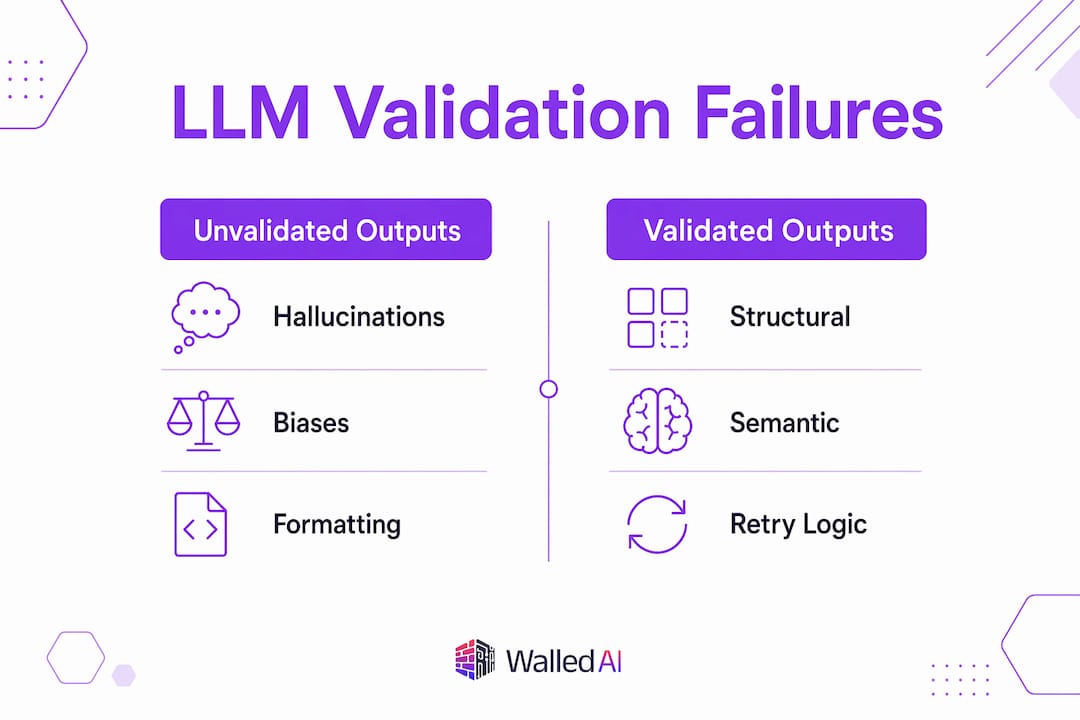
Hallucinations are the most discussed failure. An LLM may cite a nonexistent court case, invent a product specification, or attribute a quote to the wrong person. These errors are particularly dangerous because the model presents them with the same confident tone it uses for accurate information.
Systematic biases are less visible but equally damaging. Research characterizing 27 distinct validation approaches identifies position bias, egocentric bias, and style bias as persistent problems in LLM outputs. Position bias means the model favors information that appeared earlier in its context window. Egocentric bias means it rates its own prior outputs as more correct. Style bias means it favors outputs that match certain writing patterns regardless of factual accuracy.
Structural failures include malformed JSON, schema violations, and missing required fields. These failures break automated pipelines silently or noisily, depending on how downstream systems handle exceptions.
Security vulnerabilities are the most acute risk. Unvalidated output strings can trigger cross-site scripting (XSS) attacks and unhandled runtime errors, placing unvalidated LLM output among OWASP's top-10 LLM risks. This risk is especially relevant when LLM outputs are rendered directly in web interfaces or passed to agentic systems that execute code.
"Evaluating LLM outputs is a learned professional skill that pays for itself by reducing operational risk and misinformation in business workflows. Structured evaluation across accuracy, relevance, consistency, and tone is not optional for production systems."
The combination of these failure modes means that enterprise AI risk is not theoretical. It is measurable, recurring, and preventable with the right validation architecture.
How do technical validation methods ensure LLM output quality?
Technical validation operates across three layers: structural, semantic, and retry logic. Each layer catches a different class of error.
Schema validation and constrained decoding
Schema validation checks whether an LLM output conforms to a predefined structure, such as a valid JSON object with required fields and correct data types. This is the fastest and cheapest validation layer. Automated schema validation followed by a single automatic retry reduces formatting failures from approximately 8% to under 0.5% in production systems. That improvement alone justifies the implementation cost for any team running structured output pipelines.
Constrained decoding takes schema enforcement further by restricting the model's token generation to only produce schema-compliant output. The trade-off is significant. Constrained decoding can degrade reasoning quality by 3–9 percentage points, with math benchmark performance dropping by as much as 12.7 points. Teams must weigh format compliance against output accuracy for each use case.
Semantic validation layers
Schema validation cannot catch business logic errors. A JSON object can be perfectly structured and still contain a date range where the end date precedes the start date, a price that violates contractual limits, or a medical dosage that exceeds safe thresholds. Semantic errors occur in approximately 16.83% of frontier model API calls despite structural correctness. That figure means roughly one in six API calls passes schema checks but fails on business logic. Semantic validation layers apply domain-specific rules, cross-field consistency checks, and business constraint enforcement to catch these errors.
Validation threshold tuning
Validation rejection rates require active tuning. A properly tuned validator stabilizes rejection rates at 3–5%. Rejection rates above 20% signal either overly strict validation rules or underlying issues with the generation prompt itself. High rejection rates do not mean the validator is working well. They often mean the system is misconfigured.
Pro Tip: Start with a permissive validator in staging, log all rejections, and tighten rules incrementally based on observed failure patterns rather than theoretical risk.
| Validation layer | What it catches | Key trade-off |
|---|---|---|
| Schema validation | Malformed structure, missing fields | Fast but blind to logic errors |
| Constrained decoding | Format non-compliance at generation | Can reduce reasoning quality by 3–9 points |
| Semantic validation | Business logic errors, constraint violations | Requires domain-specific rule authoring |
| Retry logic | Transient formatting failures | Adds latency; diminishing returns after two retries |
Why is human oversight critical alongside automated validation?
Automated validation catches structural and rule-based errors reliably. It does not catch nuanced semantic errors, contextual misinterpretations, or outputs that are technically correct but strategically wrong for a given business situation.
The core problem is that LLMs cannot reliably express uncertainty. Training incentives reward authoritative tone, so a model hedging on a medical diagnosis and a model confidently stating a fabricated drug interaction read identically to a downstream automated system. Human reviewers recognize contextual signals that automated filters miss.
Effective human oversight in LLM workflows follows a structured process:
- Define evaluation criteria before deployment. Specify what "correct," "faithful," and "safe" mean for each use case. Vague criteria produce inconsistent human reviews.
- Assign domain experts to high-stakes outputs. A legal team should review contract summaries. A clinical team should review medical content. Generic reviewers miss domain-specific errors.
- Log all human corrections as training signal. Every correction is a data point that can improve prompts, fine-tuning, or validation rules over time.
- Set escalation thresholds. Define which output categories always require human review versus which can be released after automated checks pass.
- Review validation metrics continuously. Multi-dimensional evaluation across correctness, faithfulness, and safety replaces deterministic pass/fail testing for probabilistic models.
Pro Tip: Build a "golden set" of 200–500 verified outputs per use case and run automated validators against it weekly. Drift in pass rates signals model or prompt degradation before users notice.
Human oversight is not a substitute for automation. It is the layer that handles exceptions, ambiguous cases, and the outputs that automated systems cannot confidently classify. The two layers are complementary, not competing.
How to integrate output validation into enterprise AI governance
Validation architecture belongs in the system design phase, not as an afterthought after deployment. Enterprises that bolt on validation post-launch face higher remediation costs and more complex audit trails.
A production-grade validation architecture includes:
- Input preprocessing: Inspect and sanitize prompts before they reach the model to reduce the probability of generating problematic outputs. Walled performs real-time AI Data Loss Prevention at this layer, masking sensitive data before it enters any model.
- Structural validation at output: Apply schema checks immediately after generation. Trigger automatic retries for formatting failures.
- Semantic validation: Apply domain-specific business rules, cross-field consistency checks, and safety filters before outputs reach any downstream system or user interface.
- Human review queues: Route low-confidence or high-stakes outputs to expert reviewers. Log all decisions with timestamps and reviewer identifiers for audit purposes.
- Continuous monitoring: Track accuracy, faithfulness, consistency, and safety metrics across all production outputs. Structured evaluation across these dimensions reduces operational risk and misinformation in business workflows.
- Immutable audit trails: Record every validation decision, retry, and human override. Compliance frameworks including GDPR, the EU AI Act, and MAS TRM require traceability for AI-assisted decisions.
Governance frameworks must also address agentic AI workflows, where unvalidated LLM outputs are passed directly to tools, APIs, or other agents. In agentic systems, a single hallucinated output can trigger a cascade of incorrect downstream actions. Validation at every agent handoff point is not optional in these architectures.
Walled provides a unified AI control plane that enforces validation policies across browser-based tools, desktop applications, custom AI applications, and agentic workflows. The platform continuously validates AI-generated responses for factual accuracy, hallucinations, and policy compliance, generating immutable audit trails that satisfy regulatory reporting requirements.
Key Takeaways
Validating LLM outputs is the single most effective control an enterprise can implement to reduce AI-driven operational risk, prevent regulatory exposure, and build durable trust in AI-assisted decision-making.
| Point | Details |
|---|---|
| Schema validation reduces failures | A single automatic retry cuts formatting failure rates from ~8% to under 0.5%. |
| Semantic errors are common | Roughly 16.83% of structurally correct API calls contain business logic errors that only semantic validation catches. |
| Overconfidence is a training artifact | Models systematically favor confident tone, making external validation the only reliable error check. |
| Tuning rejection rates matters | A well-configured validator holds rejection rates at 3–5%; rates above 20% signal a misconfigured system. |
| Human oversight is irreplaceable | Expert reviewers catch contextual and domain-specific errors that automated filters cannot classify. |
The case for treating validation as infrastructure, not afterthought
I have worked with enterprise teams that treat LLM validation as a quality assurance step they will "add later." They rarely do. By the time a hallucinated output causes a compliance incident or a malformed JSON payload corrupts a production database, the cost of retrofitting validation is an order of magnitude higher than building it in from the start.
The deeper issue is a category error. Teams that skip validation are treating LLMs as deterministic software. They are not. Every output is a probability distribution, and some portion of that distribution is wrong. The question is never "will this model make mistakes?" It is "how will we catch and contain those mistakes before they reach a decision?"
I have also seen the opposite failure: validation systems so strict that rejection rates climb above 20%, users lose confidence in the AI tool, and adoption collapses. Validation strictness must be calibrated to the risk profile of each use case. A customer service chatbot and a clinical decision support system require fundamentally different thresholds.
The teams that get this right build validation as infrastructure. They define evaluation criteria before deployment, assign domain experts to review queues, and treat every human correction as a signal to improve the system. They also recognize that hallucination detection is a continuous process, not a one-time configuration. The models change. The prompts change. The business rules change. Validation must change with them.
— Rishabh
How Walled supports enterprise LLM output validation
Enterprises deploying generative AI at scale need validation built into their governance infrastructure, not layered on as a separate tool.
Walled provides continuous validation of AI-generated responses for factual accuracy, hallucinations, and policy compliance across every deployment environment, including on-premises, private cloud, and air-gapped configurations. The platform enforces schema and semantic checks, generates immutable audit trails, and routes flagged outputs to human review queues. For regulated industries and mid-market enterprises that need governance deployed quickly without compromising security, Walled delivers a unified control plane that covers every AI interaction from prompt to output. Organizations in financial services, healthcare, and government can meet GDPR, EU AI Act, and MAS TRM obligations with full traceability built in.
FAQ
What is LLM output validation?
LLM output validation is the process of verifying that a model's response is accurate, structurally correct, semantically sound, and compliant with business rules before it reaches any downstream system or user. It combines schema checks, semantic rules, and human review to catch errors that models cannot self-correct.
Why do LLMs produce inaccurate outputs even with good prompts?
LLMs are probabilistic systems that generate statistically likely text rather than retrieving verified facts. Training incentives reward confident tone, so models produce authoritative-sounding responses even when the underlying content is incorrect.
How often do semantic errors occur in LLM outputs?
Semantic errors occur in approximately 16.83% of frontier model API calls that pass structural validation. This means business logic errors are common enough to require a dedicated semantic validation layer in any production system.
What rejection rate indicates a well-tuned validator?
A properly tuned output validator stabilizes rejection rates at 3–5%. Rates above 20% indicate overly strict rules or underlying prompt issues that need to be addressed at the generation stage.
Which compliance frameworks require LLM output validation?
GDPR, the EU AI Act, and MAS TRM all require traceability and auditability for AI-assisted decisions. Immutable audit trails of validation decisions, retries, and human overrides are the standard mechanism for demonstrating compliance under these frameworks.