

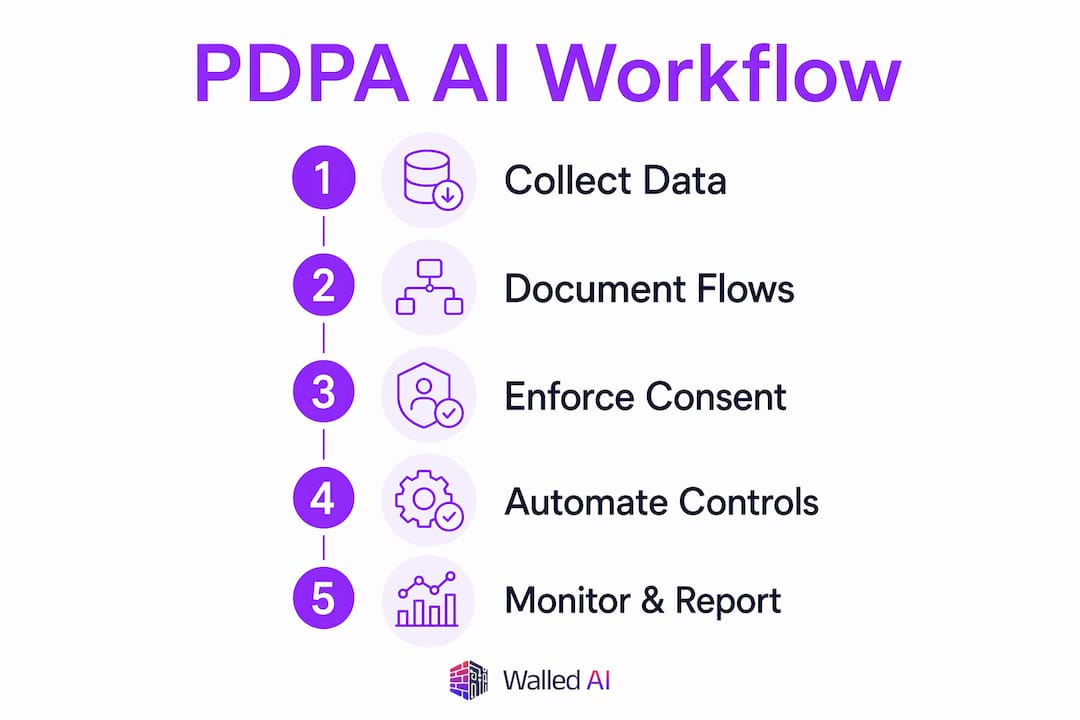
A PDPA AI data handling workflow is a structured process that governs how organizations collect, process, store, and delete personal data within AI systems while meeting legal obligations under Singapore's and Malaysia's Personal Data Protection Acts. Compliance officers in regulated industries face a compounding risk: AI systems process personal data at scale and speed, creating exposure points that manual controls cannot cover. Malaysia's PDPA sets penalties up to RM1 million or three years imprisonment for non-compliance. Singapore's PDPC issued AI-specific advisory guidelines in 2024 that set operational standards for data minimization, transparency, and consent within AI workflows. Getting this right requires more than policy documents. It requires an operational framework embedded directly into how AI systems run.

What are the core PDPA principles governing AI data handling workflows?
Seven PDPA principles directly shape how organizations must design AI data handling processes. Each principle translates into a specific workflow control.
- Consent: Obtain clear, informed consent before using personal data in AI training or inference. AI-specific PDPA notices must disclose AI model functions and data types, including whether data feeds model development and how individuals can withdraw consent.
- Purpose limitation: Process personal data only for the purpose stated at collection. Repurposing data for AI model training without fresh consent violates this principle.
- Data minimization: Collect only the data necessary for the defined AI function. Apply minimization at the prompt level, not just at intake.
- Accuracy: Maintain accurate personal data records. AI systems that generate outputs based on stale or incorrect personal data create both compliance and liability risks.
- Retention limitation: Delete personal data once the processing purpose is fulfilled. Define and enforce retention schedules within AI pipelines.
- Security: Protect personal data against unauthorized access, loss, or disclosure throughout the AI workflow.
- Breach notification: Malaysia requires notification within 72 hours of a qualifying breach. Singapore's PDPC requires notification within three days. Both timelines demand automated detection, not manual review.
The 2024 PDPC AI guidelines add a layer specific to generative AI: organizations must provide individuals with a mechanism to withdraw consent from AI-driven processing at any time. This withdrawal right must be embedded in the workflow, not handled as a one-off request.
How to map and document AI data flows for PDPA compliance
Data flow mapping is the foundation of any compliant AI data handling process. Without a clear map, organizations cannot demonstrate lawful basis, enforce retention, or respond to subject access requests.
- Identify all data collection points. List every input channel feeding personal data into AI systems: web forms, APIs, CRM integrations, uploaded documents, and real-time data streams.
- Categorize data by sensitivity. Classify personal data into tiers: general personal data, sensitive personal data (health, financial, biometric), and special categories requiring heightened protection.
- Trace data flows within AI systems. Document how data moves from ingestion through preprocessing, model inference, output generation, and storage. Include every internal system and third-party processor that touches the data.
- Record the lawful basis for each processing activity. Consent, legitimate interest, or contractual necessity must be documented against each data flow.
- Build and maintain a Records of Processing Activities (ROPA). The ROPA is the audit-ready document that regulators expect to see. It must reflect the current state of AI data flows, not a snapshot from the last annual review.
The table below shows the minimum fields a ROPA entry for an AI workflow should contain.
| ROPA Field | Required Detail |
|---|---|
| Processing activity name | Specific AI function (e.g., customer churn prediction) |
| Data categories processed | Personal identifiers, behavioral data, financial records |
| Lawful basis | Consent, contract, or legitimate interest |
| Retention period | Defined schedule with deletion trigger |
| Third-party processors | Named vendors with DPA reference |
| Cross-border transfers | Destination country and transfer mechanism |
PDPA compliance requires that individuals can request access, correction, and consent withdrawal at any time. The ROPA must link directly to the systems where these rights can be exercised, so requests do not stall in manual queues.
What are the best practices for AI vendor due diligence under PDPA?
Every AI vendor that processes personal data on your behalf is a data processor under PDPA. A missing or incomplete Data Processing Agreement (DPA) transfers liability to your organization.
A compliant vendor DPA must cover the following:
- Sub-processor disclosure: The vendor must list all sub-processors and notify you before adding new ones. You retain the right to object.
- Breach notification SLA: Vendor DPAs should require notification within 48 hours or less to give your organization time to meet the 72-hour regulatory deadline.
- Data residency and cross-border transfer mechanisms: Confirm where data is stored and processed. For cross-border transfers, document the legal mechanism: adequacy decision, standard contractual clauses, or binding corporate rules.
- Retention schedules and deletion SLAs: Define when data is deleted after contract termination and require written confirmation of deletion.
- Prohibition on unauthorized model training: The DPA must explicitly prohibit the vendor from using your organization's personal data to train or improve their AI models without separate consent.
Conduct a Transfer Impact Assessment for any vendor processing personal data outside Singapore or Malaysia. This assessment evaluates whether the destination country's legal framework provides equivalent protection.
Pro Tip: Schedule annual DPA reviews and calendar reminders for sub-processor change notifications. Vendors update their sub-processor lists quietly. Missing a change means your ROPA is inaccurate and your transfer mechanisms may be invalid.
For organizations in financial services, AI governance frameworks must also align vendor controls with MAS TRM requirements, which add a further layer of third-party risk assessment.
How to automate PDPA compliance controls in AI data workflows
Manual compliance controls fail at AI scale. Automated controls embedded in the workflow are the only reliable way to meet PDPA obligations consistently.
The most effective automation controls for AI data handling processes include:
- Automated data classification: Classify personal data by sensitivity at ingestion. Tools that apply classification labels in real time allow downstream controls to trigger automatically based on data type.
- Prompt-level data minimization: Inspect and redact personal data from AI prompts before they reach a model. This prevents unnecessary personal data from entering AI processing at all.
- Session logging with immutable audit trails: Log every AI interaction involving personal data. Logs must be tamper-proof to serve as evidence in regulatory investigations.
- Continuous breach monitoring: Automated log analysis triggers immediate alerts, addressing the problem that manual assessment windows are too narrow for PDPA's breach notification deadlines.
Pro Tip: Do not rely on the Data Protection Officer alone to catch compliance gaps. Embedding automated privacy controls within engineering teams outperforms sole DPO accountability. Automated data masking in LLM prompts, for example, removes personal data before it reaches the model without requiring a compliance review for each interaction.
Governance must shift from a centralized compliance function to a distributed model. Decentralizing privacy controls to product and engineering teams reduces bottlenecks and improves AI deployment speed. Compliance officers set the policy; engineers implement the controls in code. Walled supports this model by providing a unified AI control plane that enforces data classification, prompt inspection, and policy controls across all AI interactions without requiring manual intervention per session.
Automated sensitivity detection is the technical foundation for this approach. When classification runs continuously and automatically, every downstream control, including retention enforcement, access controls, and breach alerting, operates on accurate, current data labels.
What steps create a PDPA-compliant breach response workflow for AI incidents?
A structured breach response workflow is not optional under PDPA. The notification deadlines are tight, and the penalties for missing them are significant. Failing to notify the PDPC of a qualifying breach in Malaysia carries fines up to RM250,000 and up to two years imprisonment.
- Detect and log the incident. Automated monitoring systems should flag anomalies in real time. Every potential breach must be logged with a timestamp, affected data categories, and estimated number of individuals affected.
- Assess harm and qualifying status. Determine whether the breach meets the threshold for mandatory notification: significant harm to individuals or a significant scale of exposure. Document the assessment rationale.
- Escalate internally. Notify the DPO, legal counsel, and senior management within a defined internal window, typically within 24 hours of detection, to allow time for regulatory notification preparation.
- Notify the regulator. Malaysia requires notification within 72 hours. Singapore requires notification within three days. Submit the required details: nature of the breach, data categories affected, estimated number of individuals, and remediation steps taken.
- Notify affected individuals. Where the breach is likely to cause significant harm, notify individuals directly with clear information on what happened and what they should do.
- Document and remediate. Record all actions taken, decisions made, and communications sent. Update the ROPA and review the controls that failed to prevent the breach.
A breach response workflow that depends on manual detection and email chains will not meet a 72-hour notification deadline for an AI system processing thousands of records per hour. Automated detection, pre-approved escalation paths, and templated regulatory notifications are the minimum viable controls for PDPA compliance in AI environments.
For cross-border AI deployments, cross-border data compliance requirements add additional notification obligations depending on where data is stored and processed at the time of the breach.
Key Takeaways
A compliant PDPA AI data handling workflow requires automated controls, documented data flows, and breach response procedures that meet regulatory deadlines without relying on manual processes.
| Point | Details |
|---|---|
| PDPA principles govern AI workflows | Seven principles including consent, minimization, and breach notification apply directly to AI data processing. |
| ROPA is the audit foundation | Maintain current Records of Processing Activities linking every AI data flow to its lawful basis and retention schedule. |
| Vendor DPAs must be complete | Require sub-processor disclosure, deletion SLAs, and breach notification within 48 hours from every AI vendor. |
| Automate classification and monitoring | Automated sensitivity detection and continuous log analysis are the only reliable way to meet tight PDPA notification windows. |
| Breach response needs structure | A documented escalation chain and pre-approved notification templates are required to meet 72-hour and 3-day deadlines. |
Why compliance teams need to own less and govern more
The most persistent mistake I see in PDPA AI compliance programs is treating this as a compliance team problem. The DPO writes a policy, legal reviews the vendor contracts, and engineering ships the AI feature. Three months later, the feature has changed, the data flows have changed, and the policy is already out of date.
The organizations that handle this well have made a different choice. They treat PDPA obligations as engineering requirements, not compliance documents. Consent withdrawal is a feature ticket. Data minimization is a code review checklist item. Breach alerting is a monitoring configuration. When controls live in the system rather than in a policy document, they stay current automatically.
Synthetic data is another area where I see overconfidence. Teams assume that synthetic datasets are outside PDPA scope. They are not automatically exempt. Organizations must prove statistical representativeness and maintain provenance records for any synthetic data used in AI training. Without that documentation, a regulator can treat the dataset as personal data.
The compliance officer's role in this model is to set the governance framework, define the policies, and verify that engineering has implemented them correctly. That is a more demanding role than writing policies. It requires technical literacy and ongoing engagement with product teams. The organizations that build this capability now will have a significant advantage as PDPA enforcement of AI systems intensifies through 2026 and beyond.
— Rishabh
How Walled supports PDPA AI data handling workflows
Walled is built for compliance officers who need AI governance controls that work at the speed of AI deployment. The platform performs real-time data classification and prompt inspection before personal data reaches any AI model, enforcing data minimization automatically. Continuous monitoring and immutable audit trails support both breach detection and regulatory reporting within PDPA's notification windows. For regulated industries, Walled's mid-market AI governance solution deploys quickly and integrates with existing AI tools, custom applications, and agentic workflows. Organizations in financial services, government, and healthcare can align PDPA obligations with sector-specific frameworks including MAS TRM and GDPR through a single governance control plane.
FAQ
What is a PDPA AI data handling workflow?
A PDPA AI data handling workflow is a structured set of processes and controls that govern how personal data is collected, processed, stored, and deleted within AI systems to meet obligations under Singapore's or Malaysia's Personal Data Protection Act.
What must an AI-specific PDPA notice include?
AI-specific PDPA notices must disclose the AI model's functions, the types of personal data used, whether data is used in model training, and how individuals can withdraw consent.
How long does an organization have to report a data breach under PDPA?
Malaysia requires breach notification within 72 hours. Singapore requires notification within three days. Both deadlines apply from the point the organization becomes aware of a qualifying breach.
Does synthetic data require PDPA compliance documentation?
Synthetic data is not automatically exempt from PDPA. Organizations must maintain provenance records and demonstrate statistical representativeness to justify any compliance exception for synthetic datasets used in AI training.
How should organizations manage AI vendor compliance under PDPA?
Organizations must require vendors to sign a Data Processing Agreement that covers sub-processor lists, breach notification within 48 hours, data residency, deletion SLAs, and a prohibition on unauthorized model training using your data.