

Regulated data AI processing controls are the technical and organizational safeguards that govern how AI systems collect, process, store, and transmit sensitive or legally protected information. Without these controls, organizations expose themselves to regulatory penalties under frameworks including GDPR, the EU AI Act, and U.S. state privacy laws, where fines can reach €35 million or 7% of global turnover. The stakes extend beyond financial penalties. Inadequate controls damage institutional trust, compromise data subjects' rights, and create audit failures that regulators treat as systemic governance breakdowns. This guide gives compliance and data governance professionals a practical framework for building, deploying, and maintaining effective controls across the full AI data lifecycle.
What is the regulatory landscape for AI data processing controls?
The compliance environment for AI data processing has grown significantly more complex. 144 countries and over 20 U.S. states have enacted active data privacy laws as of 2026. That volume of overlapping obligations means no single framework covers every jurisdiction where an enterprise AI system may operate.
The EU AI Act introduces phased enforcement for high-risk systems, with key compliance deadlines on December 2, 2027, and August 2, 2028. Organizations deploying AI in healthcare, finance, hiring, or critical infrastructure must treat these dates as hard deadlines for control implementation, not aspirational targets.
At the U.S. state level, more than 15 states now require documented data protection risk assessments for high-risk AI processing activities. California, Colorado, and Texas are among the states with the broadest mandates. Organizations operating across multiple states face duplicated assessment obligations unless they build harmonized workflows from the start.
| Regulation | Jurisdiction | Key control requirements | Enforcement timeline |
|---|---|---|---|
| GDPR | EU/EEA | Data minimization, consent, audit trails, DPIAs | Active |
| EU AI Act (high-risk) | EU/EEA | Transparency, human oversight, explainability logs | Dec 2027 / Aug 2028 |
| PDPA | Singapore | Purpose limitation, data protection officers, breach notification | Active |
| MAS TRM | Singapore (financial) | Model risk governance, access controls, audit documentation | Active |
| U.S. state laws (15+) | Multi-state | Risk assessments, opt-out rights, sensitive data protections | Varies by state |
Sector-specific rules add another layer. Financial services organizations subject to MAS TRM must document model risk governance alongside standard data protection obligations. Healthcare organizations processing protected health information face HIPAA requirements that interact directly with AI transparency mandates. Compliance professionals must map each AI system's data flows against every applicable jurisdiction before selecting controls.
Technical and organizational controls for regulated AI data
Access management is the first line of defense for regulated data in AI pipelines. Role-based access control (RBAC) limits which personnel and systems can query sensitive datasets, while attribute-based access control (ABAC) applies dynamic rules based on data classification, user context, and processing purpose. Both approaches reduce the attack surface for unauthorized data exposure.
Data security measures form the second layer. The core techniques include:
- Encryption at rest and in transit: Protects regulated data from interception and unauthorized storage access.
- Tokenization: Replaces sensitive values with non-sensitive tokens, allowing AI models to process data without exposing the underlying regulated content.
- Dynamic data masking: Redacts or obscures sensitive fields in real time before data reaches model inference layers.
Audit logging and chain-of-custody documentation are non-negotiable for regulatory defensibility. Data Security Posture Management (DSPM) provides continuous classification and tracking of sensitive data, including personal health information, personally identifiable information, and financial records, through every stage of an AI processing pipeline. DSPM gives auditors a verifiable record of where regulated data traveled and what controls applied at each point.
High-risk AI systems require additional transparency controls. Explainability traces log the full chain of model reasoning and source data references for each AI output, allowing auditors to reconstruct decisions under the EU AI Act and comparable frameworks. This goes well beyond a static sign-off. Every inference that affects a regulated outcome needs a documented reasoning trail.

Pro Tip: Configure explainability logging at the model serving layer, not as a post-processing step. Logging after inference risks gaps in the reasoning chain that auditors will flag.
Organizational controls complement technical measures. Approval gates require human sign-off before AI outputs trigger regulated actions. Monitoring automation flags anomalous model behavior, data access patterns, and policy violations in real time. Operational controls like these are consistently more effective than broad AI bans, which drive shadow AI use and eliminate the audit trail entirely.
How to implement AI processing controls step by step
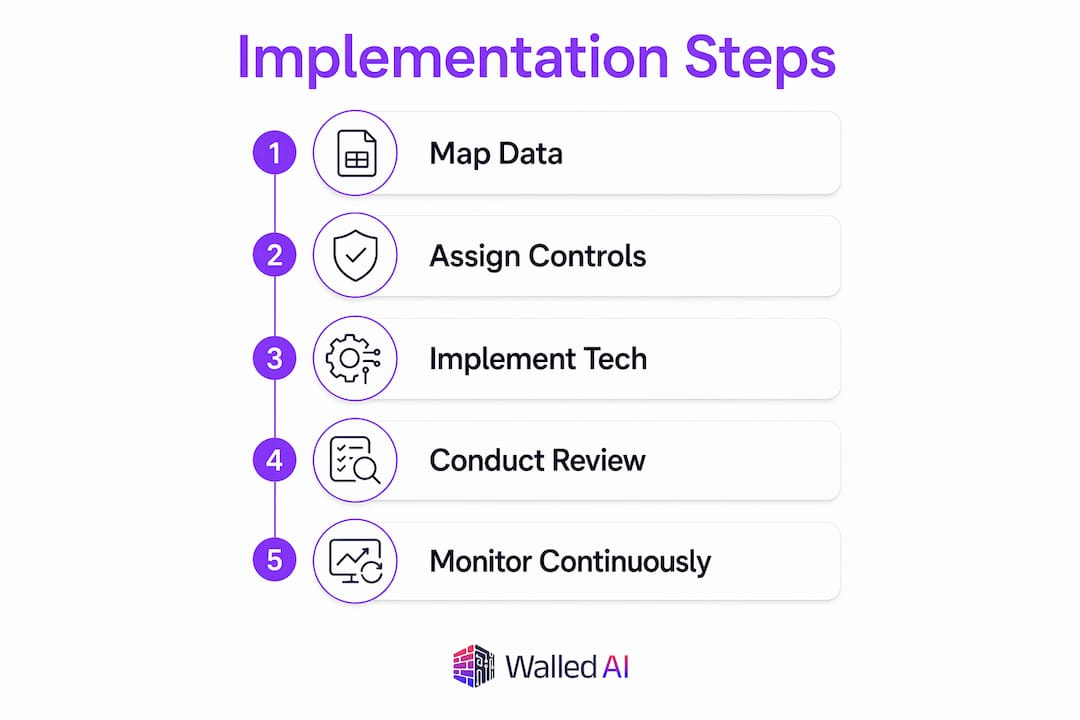
A structured implementation sequence prevents the gaps that create compliance exposure. The following stages apply to any enterprise AI system processing regulated data.
-
Identify and classify regulated data. Catalog every data source feeding AI workflows. Tag fields containing personal data, financial records, health information, or intellectual property. Use automated data classification tools to maintain accuracy as data volumes grow.
-
Conduct a documented risk assessment. Map each AI use case against applicable regulations. For U.S. deployments, align assessments with state-specific mandates. For EU deployments, complete a Data Protection Impact Assessment (DPIA) under GDPR and a conformity assessment under the EU AI Act for high-risk systems. The enterprise AI risk assessment process should produce a written record that satisfies regulatory inquiry.
-
Develop governance policies aligned to recognized frameworks. The NIST AI Risk Management Framework (NIST AI RMF) and ISO 42001 provide structured templates for AI governance policies. Map your internal policies to these frameworks so that external auditors can verify alignment without requiring custom documentation for each regulatory body.
-
Configure and deploy technical controls. Implement RBAC and ABAC for data access. Apply encryption, tokenization, and masking at the appropriate pipeline stages. Deploy DSPM to maintain continuous chain-of-custody records. Activate explainability logging for all high-risk AI outputs.
-
Integrate continuous monitoring. AI compliance is a continuous lifecycle process, not a periodic audit event. Automated monitoring must track model drift, bias indicators, data access anomalies, and policy violations on an ongoing basis. Set alert thresholds that trigger human review before a compliance breach occurs.
-
Establish regular audit and update cycles. Schedule quarterly control reviews and align update cycles with regulatory enforcement dates. When regulations change, update policies, retrain relevant models, and re-document risk assessments before the new requirements take effect.
Pro Tip: Build a single master data map that links each regulated data field to its applicable regulations, assigned controls, and audit evidence location. This single artifact cuts audit preparation time significantly and prevents duplicated effort across teams.
| Control approach | Best for | Key limitation |
|---|---|---|
| Manual review gates | Low-volume, high-stakes decisions | Does not scale to high-throughput AI pipelines |
| Automated policy enforcement | High-volume data processing | Requires accurate data classification to function correctly |
| Continuous DSPM monitoring | Multi-jurisdiction regulated data | Needs integration with AI pipeline events, not just storage |
| Explainability trace logging | High-risk AI under EU AI Act | Adds latency; must be architected into model serving layer |
Common challenges in maintaining AI data processing controls
Regulatory fragmentation is the most persistent operational challenge. Organizations subject to GDPR, PDPA, MAS TRM, and multiple U.S. state laws face overlapping but non-identical requirements. Harmonizing multi-state privacy law triggers into repeatable assessment workflows reduces duplication and prevents teams from running parallel processes that produce inconsistent documentation.
Common pitfalls and their solutions include:
- Fragmented team ownership: Legal, data science, IT, and business units each own a piece of AI compliance but rarely share tooling. Compliance requires joint ownership across all four functions with shared platforms and defined accountability.
- Shadow AI proliferation: Broad AI bans push employees toward unmonitored tools, eliminating the audit trail. Operational controls with clear usage policies are more effective than prohibition.
- Model drift and bias accumulation: Pre-deployment audits do not catch risks that emerge in production. Continuous bias testing and production monitoring are required to maintain compliance after launch.
- Explainability gaps: Teams often log model outputs without capturing the reasoning chain. Auditors under the EU AI Act require the full trace, not just the result.
- Disconnected tooling: Failure points in AI compliance most often stem from fragmented tools and disconnected teams. A unified platform embedding controls directly into AI workflows closes these gaps.
Pro Tip: When selecting monitoring tools, prioritize platforms that integrate directly with your AI serving infrastructure rather than those that operate as separate audit layers. Post-hoc monitoring misses real-time violations and creates gaps in the audit record.
For cross-border AI data compliance, the practical solution is a tiered control architecture that applies the strictest applicable standard across all jurisdictions. This approach avoids the need to maintain separate control sets for each regulatory regime and simplifies audit documentation considerably.
Key Takeaways
Effective regulated data AI processing controls require integrating legal compliance, technical safeguards, continuous monitoring, and cross-functional governance into a single, auditable framework.
| Point | Details |
|---|---|
| Regulatory complexity is high | 144 countries and 20+ U.S. states have active data privacy laws requiring tailored AI controls. |
| Technical controls must layer | Combine RBAC, encryption, tokenization, masking, and DSPM to protect regulated data at every pipeline stage. |
| Explainability is legally required | High-risk AI systems under the EU AI Act must log full reasoning traces, not just outputs. |
| Compliance is continuous | Automated monitoring for model drift, bias, and policy violations must run in production, not only at deployment. |
| Cross-functional ownership is mandatory | Legal, IT, data science, and business teams must share tools and accountability to prevent governance gaps. |
Why compliance must be built in, not bolted on
Working directly with enterprise compliance programs reveals a consistent pattern: organizations that treat AI governance as an audit preparation exercise consistently underperform those that embed controls into daily workflows. The difference is not the quality of their policies. It is the point at which controls enter the process.
When data classification, access management, and explainability logging are configured before a model goes to production, the compliance record builds itself. When those controls are added after deployment, teams spend months reconstructing audit evidence that should have been captured automatically. The human oversight requirements in the EU AI Act and comparable frameworks are not bureaucratic additions. They reflect a genuine recognition that AI systems operating on regulated data require human accountability at defined decision points.
The other pattern worth noting is the cost of regulatory fragmentation on team morale. Compliance professionals managing overlapping obligations across GDPR, PDPA, and U.S. state laws often describe the work as endless duplication. The organizations that solve this problem do so by building a single control architecture calibrated to the strictest applicable standard, then documenting how that architecture satisfies each jurisdiction's specific requirements. That approach requires upfront investment but eliminates the ongoing cost of parallel compliance tracks.
The technology is not the hard part. The hard part is getting legal, data science, IT, and business leadership to agree on shared accountability before a regulatory inquiry forces the conversation.
— Rishabh
How Walled supports regulated AI data governance
Enterprise AI adoption creates real compliance exposure when sensitive data reaches AI models without inspection, classification, or policy enforcement. Walled addresses this directly through a unified AI control plane that governs AI interactions across browser-based tools, desktop applications, custom AI applications, and agentic workflows.
Before any data reaches a model, Walled performs real-time AI Data Loss Prevention (AI-DLP), detecting and masking regulated information including personal data, financial records, source code, and credentials. The platform maintains immutable audit trails and compliance reporting aligned to GDPR, the EU AI Act, PDPA, and MAS TRM. For organizations in financial services, Walled's AI governance for financial services capabilities address model risk documentation and data traceability requirements directly. For technology organizations managing regulated data at scale, the AI governance platform supports on-premises, private cloud, and air-gapped deployments, keeping sensitive data within customer-controlled environments throughout the AI lifecycle.
FAQ
What are regulated data AI processing controls?
Regulated data AI processing controls are the technical and organizational safeguards that govern how AI systems handle legally protected information, including personal data, financial records, and health information. They include access management, encryption, audit logging, explainability traces, and human oversight mechanisms required by frameworks such as GDPR and the EU AI Act.
How do I ensure AI compliance across multiple jurisdictions?
Build a tiered control architecture calibrated to the strictest applicable standard, then document how each control satisfies jurisdiction-specific requirements. Harmonizing multi-state and international obligations into repeatable assessment workflows reduces duplication and produces consistent audit evidence across GDPR, PDPA, and U.S. state privacy laws.
What is the EU AI Act enforcement timeline for high-risk systems?
The EU AI Act enforces compliance for high-risk AI systems in two phases, with key dates on December 2, 2027, and August 2, 2028. Organizations deploying AI in regulated sectors including healthcare, finance, and critical infrastructure must complete conformity assessments and implement required controls before these deadlines.
Why are explainability traces required for AI compliance?
Explainability traces log the full chain of model reasoning and source data references for each AI output, allowing auditors to reconstruct decisions under the EU AI Act and comparable frameworks. A static output record does not satisfy high-risk AI transparency requirements. The complete reasoning chain must be captured at the model serving layer.
What is the risk of not implementing AI data processing controls?
Non-compliance with GDPR and the EU AI Act carries fines up to €35 million or 7% of global annual turnover. Beyond financial penalties, inadequate controls create audit failures, reputational damage, and loss of regulatory authorization to operate AI systems in regulated markets.