
Managing AI security, policy enforcement, and regulatory compliance across diverse models and deployments is time-consuming and exposes organizations to operational risk. Most existing tools restrict deployment to cloud or SaaS, lack real-time audit trails, or require vendor lock-in, limiting flexibility and governance coverage. Security, compliance, and AI governance teams can compare deployment modes, audit features, and policy controls across six alternatives to match one to their environment and governance needs.
Table of Contents
- WalledAI
- Prompt Security
- AlertAI
- Trust3 AI
- Grafyn AI Security Platform
- LangProtect
- Comparison of alternatives
WalledAI
At a Glance
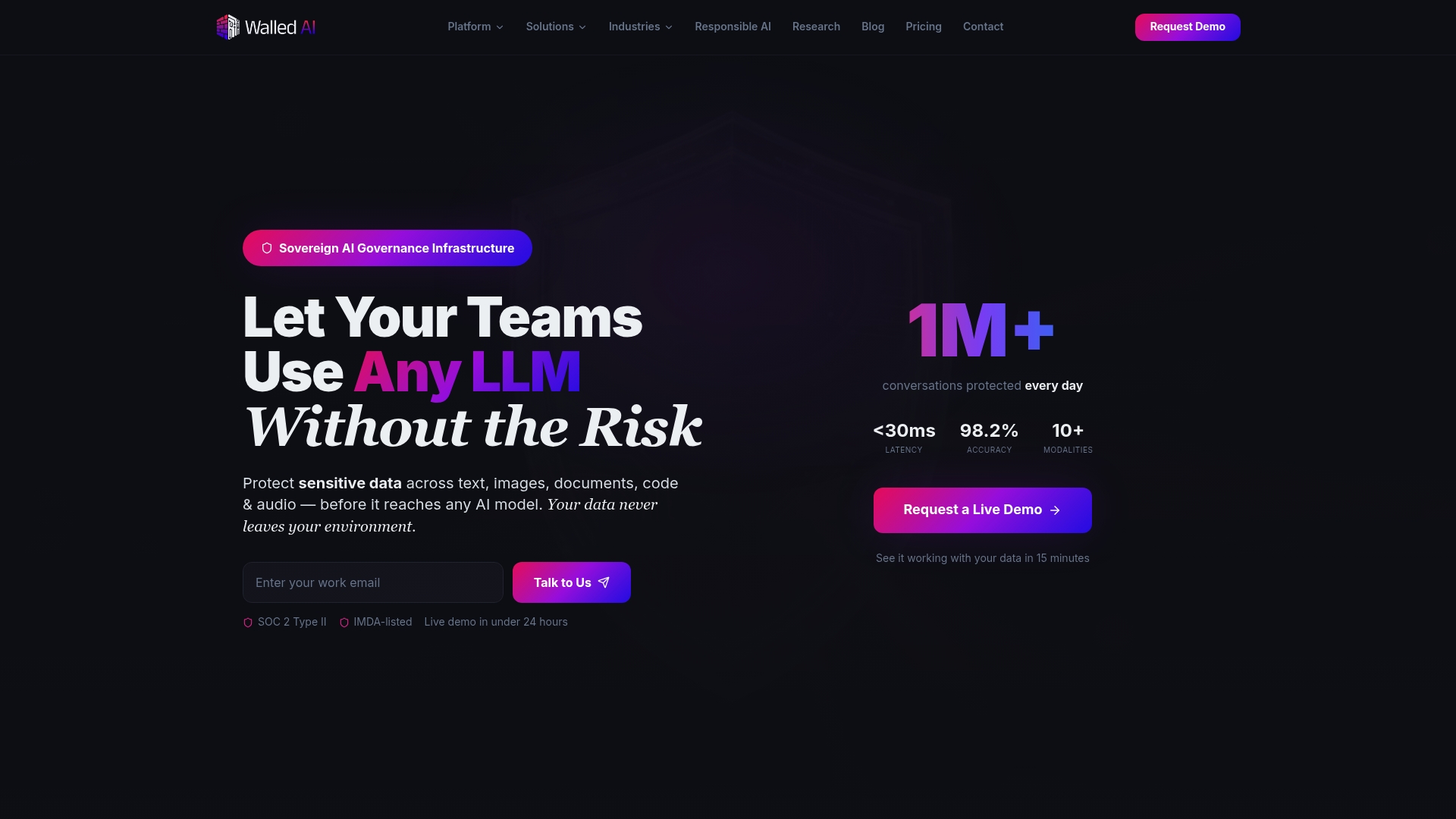
WalledAI supports on premise, private cloud, and air gapped deployments to keep sensitive data inside customer controlled infrastructure. It masks sensitive fields in real time before any LLM call and blocks prompt injection attempts. The platform logs full interaction lineage for audit and regulatory reporting.
Core Features
WalledAI intercepts and masks sensitive data in real time, applying AI data loss prevention before any model sees the input. Runtime guardrails operate at runtime with Redact, Protect, and Correct actions while role based access control limits actions by department, team, and user. The solution logs every interaction for audit, validates model outputs against ground truth, and governs any LLM vendor neutrally.
Key Differentiator
Support for on premise, private cloud, and air gapped deployment modes combined with vendor neutral LLM governance. That deployment flexibility lets organizations keep data on their infrastructure while applying consistent policies across GPT 4, Claude, Gemini, Llama, and other models. This design targets regulatory and sovereignty requirements directly.
Pros
Supports on premise deployment and keeps data within customer control. That alignment simplifies meeting requirements under EU AI Act, MAS TRM, and PDPA. Model agnostic governance applies the same runtime guardrails across multiple LLM vendors while logging full lineage for audits. WalledAI reports low latency under 30ms. That latency claim supports real time enterprise workflows.
Cons
- Requires dedicated deployment and ongoing management, which increases operational complexity and total cost of ownership for some organizations.
Who It's For
Enterprise security, compliance, and AI governance teams operating in regulated sectors such as banking, healthcare, and government. Organizations that require data sovereignty and want LLM governance without sending data to third party infrastructure. Teams prepared to allocate engineering resources for on premise or air gapped deployments will extract the most value.
Unique Value Proposition
Per call AI data loss prevention inspects and masks sensitive fields before any external model receives input. That capability cuts the need to rewrite internal workflows or remove whole data classes before model use. For organizations with strict data residency rules, this reduces legal and operational friction while keeping existing AI tooling in place.
Real World Use Case
A multinational bank deploys WalledAI across regional datacenters to mask client identifiers before model calls. The platform logs interactions with lineage for regulator audits and applies correction checks to reduce hallucinations in automated responses. Compliance teams receive audit ready reports for each regional regulator.
Pricing
Pricing is not listed publicly. Enterprise deployment and commercial terms are tailored per organization and depend on deployment model and support needs. Purchasers must contact the vendor for a custom quote and implementation plan.
Website: https://walled.ai
Prompt Security
At a Glance
Includes the open source tool Prompt Fuzzer for automated vulnerability testing of prompts and agent workflows. The platform emphasizes runtime protection and full audit logging to track AI interactions across environments. That visibility targets prompt injection, data leakage, and unsafe agent behavior at deployment time.
Core Features
Risk assessment tools scan AI applications and report vulnerability findings before deployment, while runtime protections enforce allow or block decisions during execution. The platform monitors machine control points and agentic interactions in real time and records immutable audit logs for incident review and compliance. Deployment options include cloud and self-hosted installs to match enterprise security policies.
Key Differentiator
Deep integration with machine control points and agentic AI systems enables enforcement at the machine level rather than only at the API gate. That machine-level control lets policies act on agent behaviors and low-level control flows. For organizations running autonomous agents, this narrow focus reduces the blind spots common in generic API-only safeguards.
Pros
Prompt Security offers endpoint-level enforcement and targeted protections for homegrown AI applications and code assistants, which benefits organizations that embed models inside developer workflows. Prompt Security includes the open source tool Prompt Fuzzer for automated vulnerability testing of prompts and agent workflows. The platform supports cloud and self-hosted deployments and records full audit trails, giving security teams the telemetry needed for investigations and policy evidence.
Cons
-
Specific third-party feedback on limitations or user experience challenges was not available, making it hard to anticipate operational friction.
-
The platform may require dedicated security or DevOps expertise to configure enforcement points and manage runtime rules effectively.
-
Pricing details are not published, and premium security controls could raise total cost of ownership for some teams.
Who It's For
Security, DevOps, and AI teams in enterprises that deploy models inside internal applications and agentic systems will find the product most relevant. The platform fits organizations that require machine-level enforcement, auditability, and options for on-premise hosting. It suits teams that can allocate engineering resources to integrate enforcement hooks and manage runtime policies.
Real World Use Case
A multinational firm deployed the platform to monitor internal code assistants and autonomous agents used across development and automation pipelines. Security teams used audit logs and runtime blocks to stop prompt injection attempts and to trace potential data leakage incidents. That deployment preserved sensitive IP while allowing internal AI tooling to remain operational.
Pricing
Not specified publicly; likely customized based on deployment scope and enterprise needs. Pricing typically varies with the number of enforcement points, deployment model, and support SLAs, so procurement will require a vendor quote.
Website: https://prompt.security
AlertAI
At a Glance
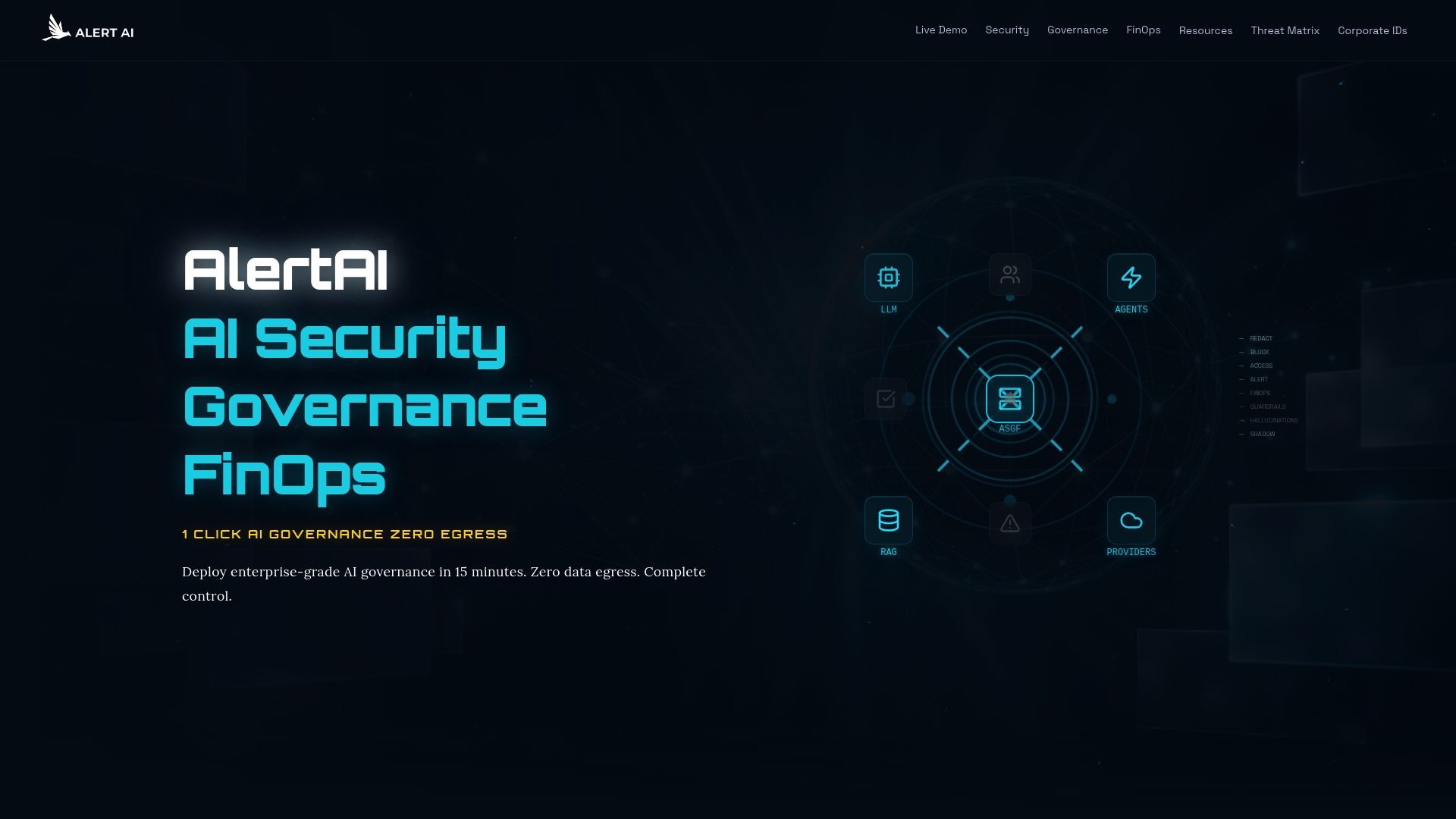
AlertAI runs a zero egress enclave inside client infrastructure that prevents data from leaving the organization. The vendor advertises over 1,000 automated guardrails for policy enforcement. It also adds cost controls and immutable audit trails for forensic analysis.
Core Features
AlertAI provides one click deployment of governance, security, and FinOps components as a stateless inline proxy inside the client perimeter. Policy enforcement runs in real time with threat detection and interception for prompt injection, model extraction, hallucinations, deepfakes, and adversarial attacks. Cost features cover token level attribution, hardware resource monitoring, and automated spending limits alongside immutable provenance for audits.
Key Differentiator
The defining capability is the zero egress enclave that executes inspection and policy enforcement without routing data through a third party. That design gives security teams direct custody of model telemetry, logs, and decision provenance inside their infrastructure. For regulated environments this reduces external exposure while keeping compliance controls and forensic trails under internal governance.
Pros
The stateless inline proxy reduces data spillage risk by intercepting malicious inputs before they reach models. Unified governance automates policy application across EU AI Act, NIST, ISO, and DORA and centralizes immutable audit trails for forensics. Running inside the client perimeter gives teams direct control over security, telemetry, and cost signals for model operations.
Cons
-
Little independent review coverage exists. No user reviews were identified on major platforms.
-
Technical complexity means deployment and ongoing management may require dedicated AI security engineers.
-
Pricing and commercial terms are not published and require marketplace procurement or enterprise quotes.
-
Not suitable for teams seeking a pure SaaS option or for small organizations without on premise infrastructure.
When It May Not Fit
AlertAI may not fit teams without dedicated AI security expertise due to deployment complexity. Organizations that prefer a tenant based cloud SaaS model will find the client perimeter requirement restrictive. Small firms or early stage projects with limited infrastructure will likely find the offering overbuilt.
Who It's For
Security teams, compliance officers, and AI infrastructure managers at large enterprises are the primary audience. The product matches organizations that require on premise control, strict data residency, and internal forensic capability. Finance, healthcare, and regulated sectors running LLMs or autonomous agents will derive the most operational value.
Real World Use Case
A financial institution deployed LLM based customer service inside its data center and used AlertAI to enforce security policies automatically. The platform blocked prompt injections, recorded immutable provenance for model outputs, and prevented data egress to external APIs. Token level attribution and automated spending limits helped the team control model cost signals during peaks.
Pricing
Pricing is not published publicly. Sales and procurement occur via AWS and Azure marketplaces or through custom enterprise quotes. Expect enterprise licensing or marketplace procurement workflows rather than self serve monthly plans.
Website: https://alertai.com
Trust3 AI
At a Glance
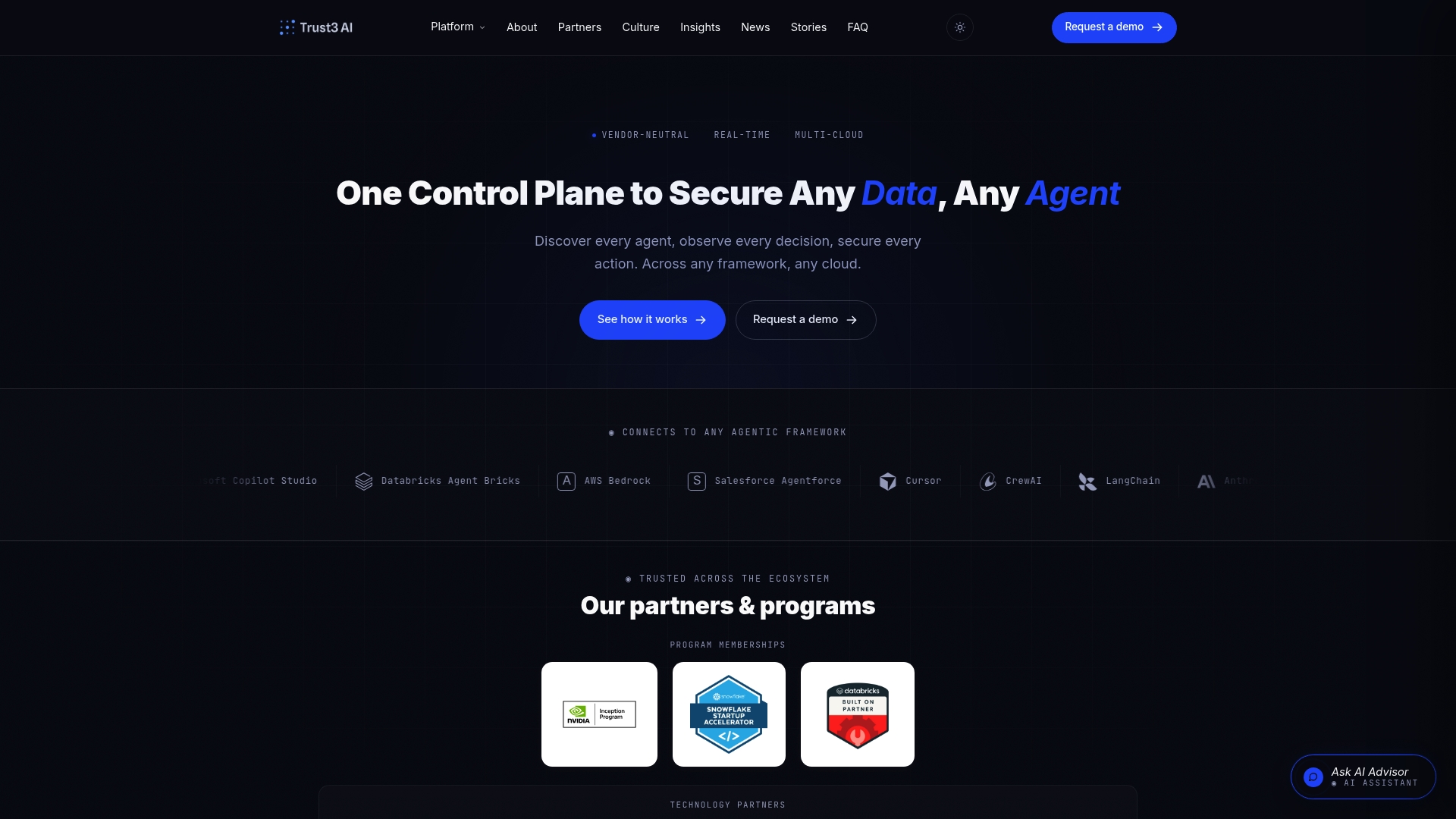
Trust3 AI reports automated discovery of AI agents across frameworks and clouds as a core capability. The vendor states it traces prompts, tool calls, and decisions to support tamper evident audit trails. Organizations get continuous risk assessment and a monitored Trust Score for agents and data sources.
Core Features
Trust3 AI discovers agent instances across heterogeneous environments and maps their metadata and context for governance. It records prompts, tool calls, and decisions so security and compliance teams can reconstruct agent behavior for audits. Purpose based access controls operate in real time and the platform assesses protocol security for agent to agent and agent to data interactions.
Key Differentiator
Trust3 AI is built on industry standards such as Apache Ranger and Atlas, which the vendor highlights as the foundation for interoperability. That choice makes it easier to integrate with existing data governance tooling and to scale governance policies across multi cloud estates. The standards based approach supports enterprises that already use Ranger or Atlas for access control and lineage.
Pros
The platform provides a unified inventory view that consolidates agent discovery, actions, and metadata across clouds and frameworks. Real time policy enforcement lets teams block or alter agent behavior before sensitive data leaves a controlled environment. Built in support for EU AI Act, HIPAA, and GDPR frameworks is advertised, and the observability stack produces tamper evident logs useful for regulatory readiness.
Cons
- Limited independent reviews exist, so external validation of operational experience is scarce.
- Deployment complexity may be high for teams unfamiliar with multi cloud governance architecture.
- Pricing is customized and requires direct consultation, with no public trial or standard tier published.
When It May Not Fit
Trust3 AI may not suit small teams or single cloud deployments that lack the governance staff to manage a standards based stack. Organizations seeking out of the box, self service pricing or a free trial will find the commercial model a poor match. Teams without Ranger or Atlas experience could face steep onboarding overhead.
Notable Integrations
Trust3 AI integrates with major cloud and data platforms including Snowflake, Databricks, AWS Bedrock, Google Cloud, and provider models such as Anthropic, OpenAI, Meta Llama, and NVIDIA. These connectors support telemetry ingestion, model provenance, and policy enforcement across compute and data layers.
Who It's For
Security, compliance, and data governance teams at enterprises that manage large agent ecosystems across multiple clouds will benefit most. The platform targets organizations that already run or plan to adopt Ranger or Atlas and that require audit ready controls and continuous risk monitoring.
Real World Use Case
A multinational deployed Trust3 AI to locate both sanctioned and shadow agents across AWS and Google Cloud. The team used the audit trails to demonstrate GDPR policy adherence during an internal compliance review and adjusted purpose based access controls to block an agent from accessing customer PII.
Pricing
Most engagements begin with a tailored assessment and the vendor customizes pricing to environment scale and scope. The company does not publish standard tiers or a free trial and asks prospects to consult for a quote. Procurement should plan for an assessment phase and implementation work.
Website: https://trust3.ai
Grafyn AI Security Platform
At a Glance
Grafyn is built on a proprietary framework called AI-TRUST, which applies discovery, blast radius minimization, and red teaming across AI estates. The platform focuses on continuous visibility for models, pipelines, and shadow AI to reduce undetected risk. Grafyn targets enterprise security teams responsible for governing large, distributed AI deployments.
Core Features
Grafyn combines asset discovery and observability with threat detection and automated response so security teams can see and act on AI risks. Discovery maps AI assets across cloud, code, and SaaS while blast radius detection traces risk spread and impact. Governance controls, policy enforcement, and continuous monitoring validate model behavior and detect anomalies in data flows and integrations.
Key Differentiator
The platform’s defining element is AI-TRUST, a structured AI security framework that ties discovery to response workflows and red teaming. That linkage moves organizations from one-off checks to an ongoing security fabric that maps dependencies and closes the loop from detection to remediation. The framework orients Grafyn toward organizations needing governed, repeatable testing of AI defenses.
Pros
Grafyn provides continuous monitoring that detects anomalies across models, data flows, and integrations, and it links findings to automated remediation paths. The platform finds shadow AI and maps dependencies so teams can reduce the potential attack surface. Grafyn's built-in red teaming and attack simulation provide practical validation of defenses before deployment.
Cons
- No substantive third party user reviews are publicly documented, so community feedback is limited.
- Implementation may be complex for organizations without mature AI governance processes, increasing initial project scope and resource needs.
- Public resources do not detail specific integration or deployment limits, which makes technical fit harder to assess in advance.
Who It's For
Large enterprise security teams, AI governance officers, data engineers, and risk managers responsible for securing and managing AI ecosystems will find Grafyn relevant. The platform fits organizations that must discover hidden AI assets and enforce centralized policies across multi cloud and hybrid estates. Grafyn suits teams prepared to invest in governance process and integration work.
Real World Use Case
A multinational corporation used Grafyn to locate AI models and autonomous agents across cloud and on premise environments. The platform mapped dependencies to reveal blast radius exposure, enforced security policies, and ran red team exercises to validate mitigations prior to rollout. Continuous observability helped the team detect prompt injection attempts and anomalous model behavior.
Pricing
Grafyn’s pricing is not specified publicly and appears enterprise oriented. The vendor targets large organizations and likely sells via custom enterprise contracts rather than self service plans. Prospective buyers should request a tailored quote and deployment sizing from the vendor.
Website: https://grafyn.ai
LangProtect
At a Glance
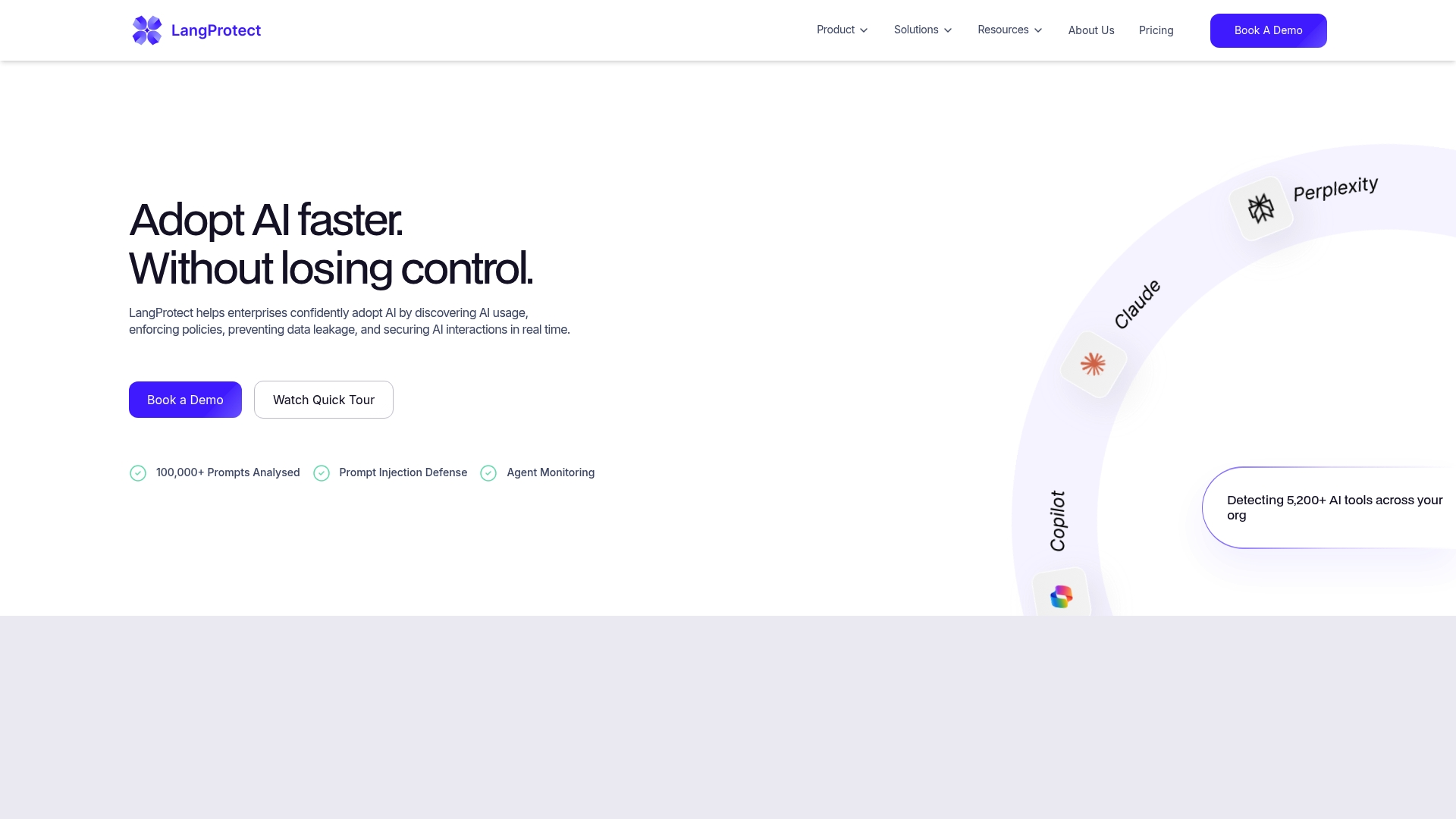
Active AI attack simulation with red teaming tools is part of the offering. The vendor advertises compliance with GDPR, HIPAA, and SOC 2. That combination targets regulated environments that need both discovery and adversarial testing.
Core Features
LangProtect performs real-time AI tool discovery and ongoing monitoring to reveal shadow deployments and agentic workflows across an enterprise. It applies prompt injection defense and prompt sanitization while performing sensitive data redaction and anonymization before data reaches models. Automated policy enforcement and active attack simulation complete a defensive stack that produces alerts and blocks risky AI interactions.
Key Differentiator
The primary differentiator is integrated discovery plus simulated adversarial testing delivered in real time. LangProtect merges shadow AI visibility with red teaming tools to validate defenses under realistic attack scenarios. This focus positions it as a toolset for security teams that need to test detection and prevention on live AI traffic.
Pros
LangProtect gives teams clearer visibility into AI adoption by finding unmanaged tools and agent workflows across departments, which reduces blind spots. It enforces policies at scale with automated controls and risk mitigation, freeing security teams from repeated manual checks. The platform also supports cloud and on premises deployment, which helps organizations that require data residency or network segmentation.
Cons
- Public documentation gaps and some broken web pages limit the ability to evaluate deployment details or admin workflows.
- No listed third party user reviews means there is little independent evidence of long term effectiveness.
- The vendor does not publish a detailed integrations list, which makes compatibility with particular enterprise stacks unclear.
When It May Not Fit
Organizations that require a fully documented partner ecosystem may find LangProtect missing the integration detail they need. Small teams without dedicated security staff will likely find the platform more complex than required. Buyers needing transparent customer testimonials or community support will encounter limited public resources.
Who It's For
Security and compliance teams at large enterprises deploying AI across regulated functions will find the product aligned with their needs. Organizations that must enforce policies centrally and run internal adversarial tests against models benefit most. Teams requiring cloud and on premises options will value the deployment flexibility.
Real World Use Case
A global financial services firm uses LangProtect to discover shadow AI tools in trader desks and client support teams. The firm runs red team simulations against those workflows to validate prompt injection and jailbreak defenses. LangProtect then enforces policies that redact regulated customer data before it reaches third party models.
Pricing
Pricing is not specified and appears to follow enterprise custom pricing. Prospective buyers should contact sales for a tailored quote and deployment options.
Website: https://langprotect.com
Comparison of alternatives
Enterprises evaluating AI security platforms often balance deployment flexibility against operational control requirements. Understanding the unique strengths and tradeoffs among available options can guide informed decisions for teams prioritizing regulatory compliance and data control.
Deployment Versatility
WalledAI stands out with its support for on-premise, private cloud, and air-gapped modes, ensuring sensitive data remains within customer-controlled infrastructure. This versatility directly addresses concerns related to sovereignty and compliance, notably under frameworks like the EU AI Act and PDPA. Comparatively, AlertAI provides zero egress enclave functionality for strict perimeter control but mandates client-side hosting, potentially limiting scalability. Prompt Security offers flexible hosting options but lacks the depth of sovereignty alignment evident in WalledAI's real-time governance capabilities.
Integration Support
Trust3 AI excels in interoperability through reliance on industry standards such as Apache Ranger and Atlas, allowing integration with established governance architectures across diverse environments. Its design simplifies the extension of policies to existing multi-cloud setups, aiding enterprises in maintaining consistent operational governance. Meanwhile, Grafyn AI's proprietary AI-TRUST framework focuses on asset discovery and remediation workflows, beneficial for organizations mapping shadow AI assets but demanding greater upfront investment compared to the standards-driven approach of Trust3 AI.
Best fit
- Enterprises requiring adaptable deployments encompassing on-premise and air-gapped setups while prioritizing real-time data masking will find WalledAI uniquely capable.
- Organizations seeking machine-level enforcement for autonomous agents should consider Prompt Security for its endpoint-focused security measures.
- Multi-cloud governance teams managing distributed AI ecosystems will benefit from Trust3 AI's use of standard frameworks ensuring systemic integration.
- Enterprises needing unified visibility and attack simulations to evaluate AI dependencies across environments may derive significant value from Grafyn AI Security Platform.
Our pick
WalledAI is the preferred choice for enterprises emphasizing data sovereignty while maintaining flexible governance across varied deployment environments. Its ability to mask sensitive data in real time and ensure vendor-neutral governance makes it ideal for regulated industries such as finance, healthcare, and government. However, organizations focused on compatibility with existing governance systems might prioritize Trust3 AI for its use of industry standards.
For teams prioritizing enterprise-grade governance, extensive deployment flexibility, and robust compliance alignment, the following platforms offer distinct features catered to varied operational needs.
| Product | Key Differentiator | Deployment Options | Best For | Notable Limitation | Pricing |
|---|---|---|---|---|---|
| Walled | Vendor-neutral governance with on-premise and air-gapped deployments | On-premise, private cloud, air-gapped | Enterprises requiring strict data sovereignty and compliance in regulated sectors | Requires dedicated infrastructure and ongoing management | Price not published |
| Prompt Security | Machine-level policy enforcement for agentic interactions | Cloud, self-hosted | Firms embedding models in internal applications with a focus on runtime protections | Needs security/DevOps expertise to configure and manage policies | Price not published |
| AlertAI | Zero-egress enclaves for complete on-premise data control | On-premise | Large organizations managing infrastructure requiring high security and detailed controls | High technical complexity may make it unsuitable for smaller firms | Price not published |
| Trust3 AI | Standards-based governance for multi-cloud agent discovery | Multi-cloud environments | Enterprises already utilizing Apache Ranger/Atlas for scalable data governance | High onboarding overhead for teams unfamiliar with existing standards | Price not published |
| Grafyn AI Security | Continuous anomaly detection and shadow AI discovery via AI-TRUST | Multi-cloud, hybrid environments | Major enterprises securing distributed AI deployments and performing red-teaming | Implementation complexity for teams without mature AI governance | Price not published |
Addressing the Challenges of AI Security and Data Compliance for SurePath.ai Alternatives
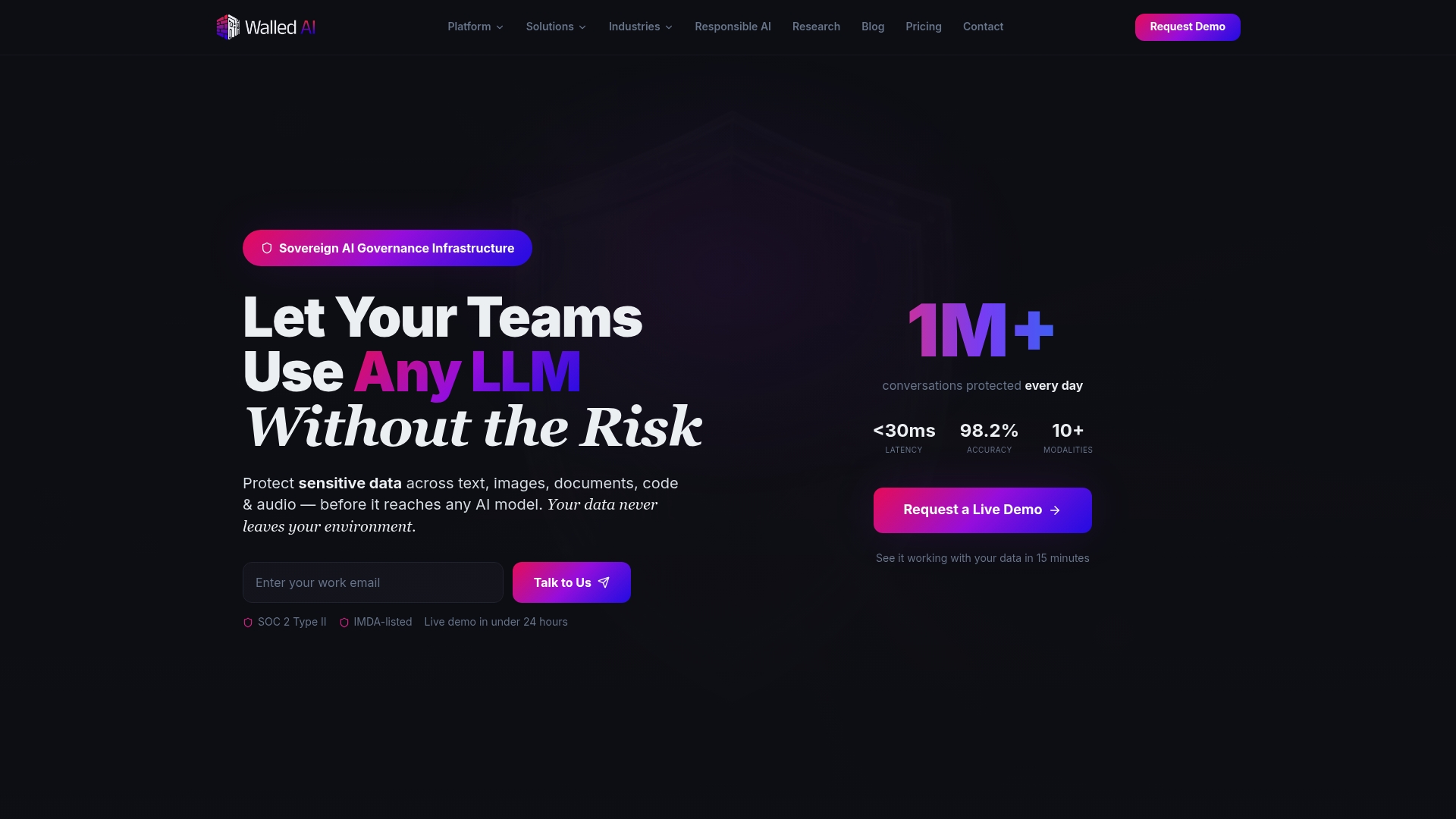
Organizations seeking SurePath.ai alternatives often face critical challenges in maintaining data sovereignty and enforcing AI governance without adding operational risks. Common concerns include preventing sensitive data exposure, blocking prompt injection attacks, and meeting regulatory requirements like PDPA, GDPR, and the EU AI Act. Walled addresses these pain points with an on-premises, private cloud, and air-gapped AI governance platform designed for enterprises in regulated sectors. Its real-time AI Data Loss Prevention inspects and masks sensitive information before any AI model interaction, establishing strong guardrails across diverse AI workflows.
Walled provides centralized policy enforcement, immutable audit trails, and continuous validation of AI outputs to help compliance and security teams maintain audit readiness and operational trust. Visit Walled to explore how its governance framework supports secure deployment of generative AI and AI copilots without risking data leakage or compliance violations.
For security, compliance, and AI governance teams evaluating SurePath.ai alternatives, integrating Walled offers a tailored approach that balances enterprise control with AI innovation. Review Walled’s features to assess its fit for your on-premises or private cloud needs and schedule a consultation to discuss managing AI risks with granular data protection.
FAQ
What capabilities does Walled offer for AI security and governance?
Walled provides real-time interception and masking of sensitive data before any model sees it. This is achieved through its AI data loss prevention feature, which ensures that sensitive fields are protected during interactions. Organizations looking to maintain strict security protocols should explore this capability further.
How does Prompt Security compare to Walled?
Prompt Security excels in its deep integration with machine control points and agentic AI systems, allowing enforcement at the machine level. Walled, on the other hand, is designed for enterprises needing vendor-neutral governance while ensuring data security within their infrastructure. Organizations focused on machine-level safeguards may find Prompt Security particularly valuable.
Which platform offers better deployment flexibility between Walled and AlertAI?
Walled supports on-premise, private cloud, and air-gapped deployment modes, making it ideal for organizations that value infrastructure control. In contrast, AlertAI runs a zero egress enclave inside client infrastructure, which enhances security for regulated environments. Organizations needing flexibility for deployment should consider Walled's diverse options.
Can organizations rely on Walled for compliance with the EU AI Act?
Walled’s design supports compliance under the EU AI Act by ensuring data residency and governance. Its features, such as masking sensitive data and logging interactions, align well with the requirements detailed in the Act. Companies in regulated sectors can feel confident when implementing Walled’s solutions for compliance needs.
What is Walled's latency performance for real-time workflows?
Walled reports low latency under 30 milliseconds, which supports real-time enterprise workflows effectively. This metric highlights its suitability for organizations looking for quick response times while maintaining data security. It's an important consideration for teams focused on operational efficiency.