

AI compliance monitoring is defined as the continuous process of collecting, analyzing, and acting on data about AI system performance to verify ongoing adherence to regulatory requirements, industry standards, and organizational policies. The industry term for this practice is AI governance monitoring, though "AI compliance monitoring" is the phrase most compliance officers use in practice. 77% of companies identify AI compliance as a top priority, driven largely by the EU AI Act's penalties of up to €35 million or 7% of global annual turnover. That scale of financial exposure makes continuous oversight a governance necessity, not an optional program. Frameworks including the EU AI Act, ISO 42001, and the NIST AI Risk Management Framework each impose specific monitoring obligations that regulated organizations must meet in 2026 and beyond.
What are the core regulatory requirements driving AI compliance monitoring?
The EU AI Act is the most consequential regulation shaping AI compliance monitoring today. Its Article 72 mandates a written post-market monitoring plan as part of the technical documentation for every high-risk AI system. That plan must systematically collect and analyze performance data covering accuracy, reliability, bias, and data quality throughout the system's operational life.
Compliance programs for high-risk AI systems under the EU AI Act follow a structured timeline. Full compliance typically requires 12–24 months, broken into three phases: 3–6 months for gap assessment, 6–12 months for technical documentation, and 3–6 months for registration. Organizations that underestimate this timeline consistently find themselves short on documentation when regulators request evidence.
ISO 42001 addresses AI management systems at the organizational level. Its Clause 9 requires monitoring, measurement, analysis, and evaluation of both AI system performance and governance processes to support continual improvement. Metrics organizations must track under Clause 9 include accuracy rates, bias indicators, error rates, and audit results with documented findings.
The NIST AI Risk Management Framework structures compliance work into two distinct functions. MEASURE and MANAGE divide the work clearly: MEASURE covers continuous monitoring of AI system outputs and behaviors, while MANAGE drives the organizational responses when monitoring detects a deviation. Together, these two functions form the operational backbone of any credible AI regulatory monitoring program.
The table below summarizes the key monitoring obligations across the three major frameworks.
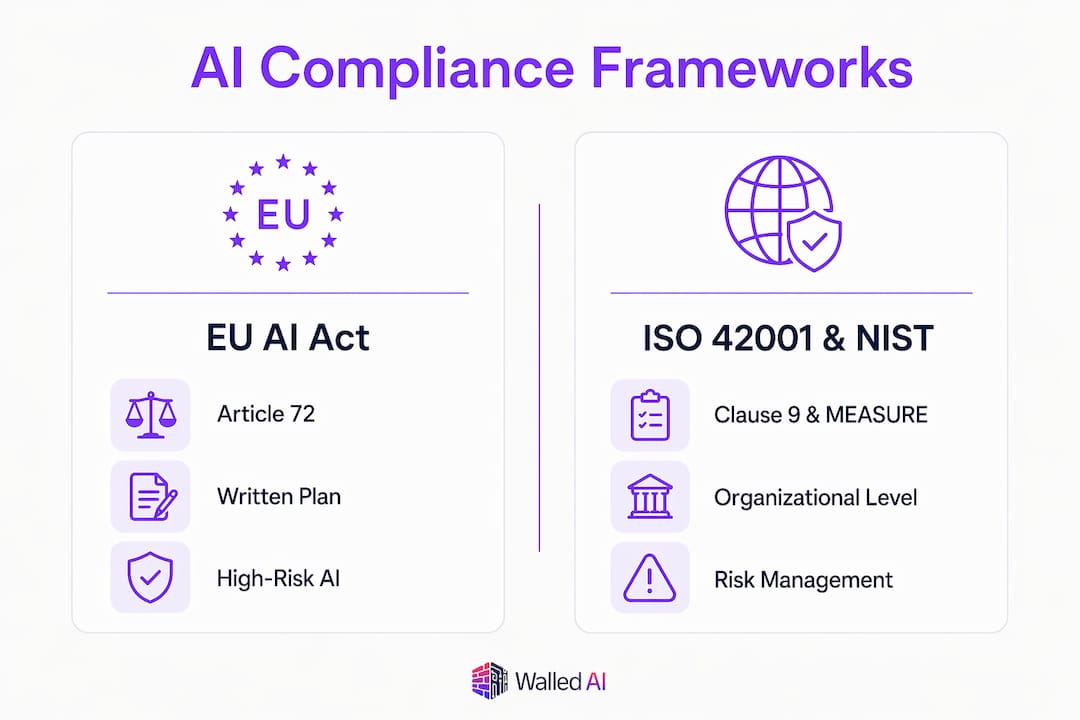
| Framework | Core monitoring obligation | Key metrics required |
|---|---|---|
| EU AI Act (Article 72) | Written post-market monitoring plan | Accuracy, reliability, bias, data quality |
| ISO 42001 (Clause 9) | Measurement, analysis, and evaluation | Error rates, bias indicators, audit results |
| NIST AI RMF | MEASURE and MANAGE functions | Performance deviations, governance responses |
For a detailed breakdown of the EU AI Act's compliance obligations and deadlines, the EU AI Act compliance guide from Walled covers the full regulatory timeline through august 2026.
Which methods and tools support effective AI compliance monitoring?
Effective AI compliance monitoring combines automated technical controls with structured human oversight. Neither works adequately in isolation. Automated monitoring tools, dashboards, and analytics platforms provide continuous visibility into AI system outputs, flag statistical anomalies, and generate audit trails without manual intervention. Human oversight then interprets those signals, makes judgment calls on borderline cases, and ensures that corrective actions are proportionate and documented.
Practical methods organizations use include:
- Automated performance dashboards that track accuracy, bias, and error rates in real time against predefined thresholds
- Incident tracking registers that log every detected deviation, the response taken, and the outcome
- Risk registers aligned with ISO 42001 that map each AI system to its risk classification and monitoring frequency
- AI compliance gap analysis conducted at regular intervals to identify where current controls fall short of regulatory requirements
- Internal audit cycles with documented results, typically quarterly for high-risk systems and annually for lower-risk deployments
Gap analysis deserves particular attention. Structured gap registers aligned with ISO 42001 help organizations prioritize remediation efforts rather than spreading resources across every identified issue simultaneously. Without priority mapping, compliance teams spend time on low-risk gaps while critical exposures remain unaddressed.
A recurring problem is organizational bias in monitoring investment. Tech teams over-invest in monitoring infrastructure while compliance teams focus too heavily on risk reporting without taking technical action. The result is a program that generates data but does not close gaps. Effective monitoring requires both groups working from a shared risk register with clear ownership of each remediation item.

Pro Tip: Run a quarterly gap analysis review that includes both your technical team and compliance officers in the same session. Shared visibility prevents the reporting-without-action failure mode that undermines most AI compliance programs.
How do organizations implement ongoing AI compliance monitoring?
Operationalizing AI compliance monitoring requires a structured sequence of steps. Organizations that skip the early stages typically find their monitoring programs generating noise rather than actionable intelligence.
-
Build a complete AI system inventory. Catalog every AI system in use, including tools adopted by individual business units without central approval. Shadow AI tools adopted without oversight create inventory gaps that hinder compliance programs and prevent accurate risk classification.
-
Classify each system by risk level. Apply the EU AI Act's risk categories or your organization's internal classification framework. High-risk systems require post-market monitoring plans; lower-risk systems require lighter documentation but still need periodic review.
-
Set performance indicators and thresholds. Define what acceptable performance looks like for each system. Establish the threshold at which a deviation triggers a corrective action. Thresholds without corrective action triggers are documentation without governance.
-
Build feedback loops into quality management. Monitoring data must flow back into the AI system's development and deployment cycle. A system that generates alerts no one acts on provides false assurance rather than genuine compliance.
-
Establish an internal audit cadence. High-risk AI systems warrant quarterly internal audits with documented results. Management review of audit findings should occur at least annually, with formal sign-off from the responsible executive.
-
Treat documentation as strategic evidence. Detailed system inventory and testing records serve as primary evidence of reasonable care during regulatory audits and litigation. Organizations that document only when required miss the opportunity to demonstrate proactive governance.
Regulated industries each face specific implementation pressures. Financial services organizations operating under MAS TRM guidelines must demonstrate model risk management that aligns with AI monitoring requirements. Healthcare organizations must reconcile AI monitoring obligations with HIPAA data handling constraints. Government agencies often require air-gapped deployments where monitoring data never leaves the controlled environment. The enterprise AI governance framework published by Walled addresses how international standards apply across these sectors.
Pro Tip: Assign a named owner to every AI system in your inventory. Ownership without accountability produces monitoring data that no one acts on. Named ownership creates the organizational pressure that makes compliance programs function.
What are the key challenges in AI compliance monitoring?
AI compliance monitoring faces several obstacles that compliance officers must anticipate rather than discover mid-program. Understanding these challenges in advance allows organizations to design programs that address them from the start.
-
Shadow AI detection. Employees adopt AI tools without informing IT or compliance teams. These undocumented systems create blind spots in the compliance inventory and expose the organization to unclassified risk. Regular network audits and acceptable use policies reduce but do not eliminate this problem.
-
Incomplete risk classification. Organizations often classify AI systems based on their intended use rather than their actual deployment context. A system classified as low-risk at procurement may operate in a high-risk context after deployment. Classification must be reviewed whenever a system's use case changes.
-
Balancing automation and human oversight. Automated monitoring tools generate large volumes of alerts. Without human review processes, alert fatigue sets in and genuine compliance failures go unaddressed. The balance between technical and human oversight is the defining challenge of mature AI compliance programs.
-
Documentation quality. Monitoring data has limited value if the documentation surrounding it is incomplete or inconsistent. Regulators assess documentation quality as a proxy for governance maturity. Poor documentation signals poor governance even when the underlying controls are sound.
-
Evolving regulatory requirements. The EU AI Act's implementing acts and technical standards continue to develop. ISO 42001 guidance evolves as certification bodies accumulate audit experience. Compliance programs built around a static interpretation of current requirements will fall short as those requirements sharpen. Organizations need adaptive processes that incorporate regulatory updates on a defined schedule.
-
Cross-team coordination. Effective AI compliance monitoring requires compliance officers, data scientists, IT security teams, and business unit leaders to work from a shared framework. Siloed programs produce inconsistent monitoring, duplicate effort, and gaps at the boundaries between teams. The compliance challenges in AI adoption that organizations face most often trace back to coordination failures rather than technical shortcomings.
Key Takeaways
Effective AI compliance monitoring requires continuous oversight tied to specific regulatory frameworks, not periodic reviews or one-time assessments.
| Point | Details |
|---|---|
| Regulatory frameworks are specific | EU AI Act Article 72, ISO 42001 Clause 9, and NIST AI RMF each impose distinct monitoring obligations organizations must meet. |
| Documentation is primary evidence | Detailed system records and testing logs demonstrate reasonable care during audits and regulatory inquiries. |
| Shadow AI creates critical gaps | Undocumented AI tools prevent accurate risk classification and leave organizations exposed to unclassified regulatory risk. |
| Gap analysis must be continuous | Structured gap registers with priority mapping prevent resource misallocation and keep remediation focused on high-risk exposures. |
| Automation and human oversight both matter | Overfocus on technical monitoring tools without human review processes produces alert fatigue and missed compliance failures. |
What I have learned building AI compliance programs from the ground up
The most common mistake I see compliance officers make is treating AI compliance monitoring as a project with a completion date. It is not. The EU AI Act's post-market monitoring obligation is permanent for high-risk systems. ISO 42001 Clause 9 requires continual evaluation, not a one-time audit. Organizations that build their programs around a launch milestone rather than an ongoing operational rhythm will find themselves rebuilding from scratch every time a regulatory update arrives.
Gap analysis is the tool I rely on most, but only when it is treated as a diagnostic process rather than a deliverable. A gap analysis report filed and forgotten is worse than no gap analysis at all. It creates a false record of due diligence without producing any actual improvement. The programs that work run gap assessments on a defined cadence, assign owners to every finding, and track remediation progress in the same register where the gaps were identified.
The shadow AI problem is underestimated by nearly every organization I have worked with. Compliance officers assume their AI inventory is complete because they approved the tools on the list. The tools not on the list are the problem. A quarterly network audit specifically designed to surface unapproved AI tool usage is not optional for any organization operating under the EU AI Act or ISO 42001.
Documentation is the area where I push hardest against organizational resistance. Technical teams view documentation as overhead. Regulators view it as the primary evidence of governance maturity. Organizations that document proactively, including testing records, threshold decisions, and corrective action outcomes, are in a fundamentally stronger position during an inquiry than those that document reactively.
— Rishabh
How Walled supports AI compliance monitoring for regulated organizations
Regulated organizations need more than policy documents to meet their AI compliance obligations. They need technical controls that enforce those policies in real time.
Walled provides a unified AI governance platform purpose-built for regulated industries. Its mid-market AI governance solution delivers automated monitoring of AI interactions, real-time data loss prevention, immutable audit trails, and compliance reporting aligned with the EU AI Act, GDPR, PDPA, and MAS TRM. Organizations in financial services, healthcare, and government can deploy Walled on-premises or in air-gapped environments, ensuring that monitoring data never leaves their controlled infrastructure. For compliance officers who need to demonstrate continuous oversight without building a monitoring program from scratch, Walled provides the technical foundation that makes that possible.
FAQ
What is AI compliance monitoring?
AI compliance monitoring is the continuous process of collecting and analyzing data about AI system performance to verify ongoing adherence to regulatory requirements, industry standards, and organizational policies. It covers accuracy, bias, reliability, and data quality throughout the system's operational life.
Which regulations require AI compliance monitoring?
The EU AI Act's Article 72 mandates written post-market monitoring plans for high-risk AI systems. ISO 42001 Clause 9 requires ongoing measurement and evaluation of AI governance performance. The NIST AI Risk Management Framework structures monitoring through its MEASURE and MANAGE functions.
How long does it take to build an AI compliance monitoring program?
Full compliance programs for high-risk AI systems typically require 12–24 months, covering gap assessment, technical documentation, and registration phases. Organizations that begin with a complete AI system inventory and risk classification move through this timeline more efficiently.
What is AI compliance gap analysis?
AI compliance gap analysis is a structured assessment that compares an organization's current AI controls against the requirements of applicable regulations and standards. Effective gap analysis produces a prioritized register of findings with named owners and remediation timelines, not just a list of deficiencies.
What is shadow AI and why does it matter for compliance?
Shadow AI refers to AI tools adopted by employees or business units without formal approval or documentation. These undocumented systems create gaps in the compliance inventory, prevent accurate risk classification, and expose organizations to regulatory liability under frameworks like the EU AI Act and ISO 42001.