

Governing AI agents across an organization requires a hybrid governance model that enforces centralized security and compliance standards while delegating execution authority to individual business units. Without this structure, AI deployments fragment into unmanaged, undocumented systems that expose organizations to regulatory penalties, data breaches, and operational failures. The core components of an effective AI governance strategy are:
- A hybrid governance model combining centralized policy frameworks with federated business unit execution
- A centralized agent registry that maintains full visibility into every deployed agent and prevents shadow AI
- Minimum security, compliance, and identity baselines applied uniformly before any agent is permitted to operate
- Automated compliance workflows that accelerate development without sacrificing oversight
- Continuous monitoring and immutable audit trails covering agent decisions, incidents, and lifecycle events
- Cross-functional governance committees uniting AI, legal, compliance, and security teams under shared accountability structures
Table of Contents
- How to design a hybrid governance model for AI agents
- How governance becomes an operational enabler, not a bottleneck
- Why transparency and auditability are non-negotiable
- How cross-functional collaboration strengthens AI governance
- How Walled supports enterprise-scale AI agent governance
- Walled gives your governance program a concrete foundation
- Key Takeaways
How to design a hybrid governance model for AI agents
The hybrid governance model is the most practical structure for enterprises deploying AI agents at scale. A central governance council defines enterprise-wide security baselines, data handling policies, and approval standards. Business units then implement those standards locally, retaining autonomy for low-risk applications while adhering to non-negotiable guardrails for high-risk deployments.
A hub-and-spoke operating model supports this structure effectively. The central council functions as the hub, setting policies and maintaining enterprise-wide visibility. Designated Agent Governance Leads within each business unit serve as spokes, executing compliance requirements and reporting back to the center. This arrangement prevents both over-centralization, which creates bottlenecks, and under-centralization, which produces agent sprawl.
Risk-tiered classification is the mechanism that makes this model work in practice. Agents are categorized by their function, data access scope, and potential impact. High-risk agents, such as those making credit decisions or processing regulated health data, require formal approval, continuous monitoring, and human-in-the-loop controls. Low-risk internal tools may proceed with lighter documentation and periodic review.
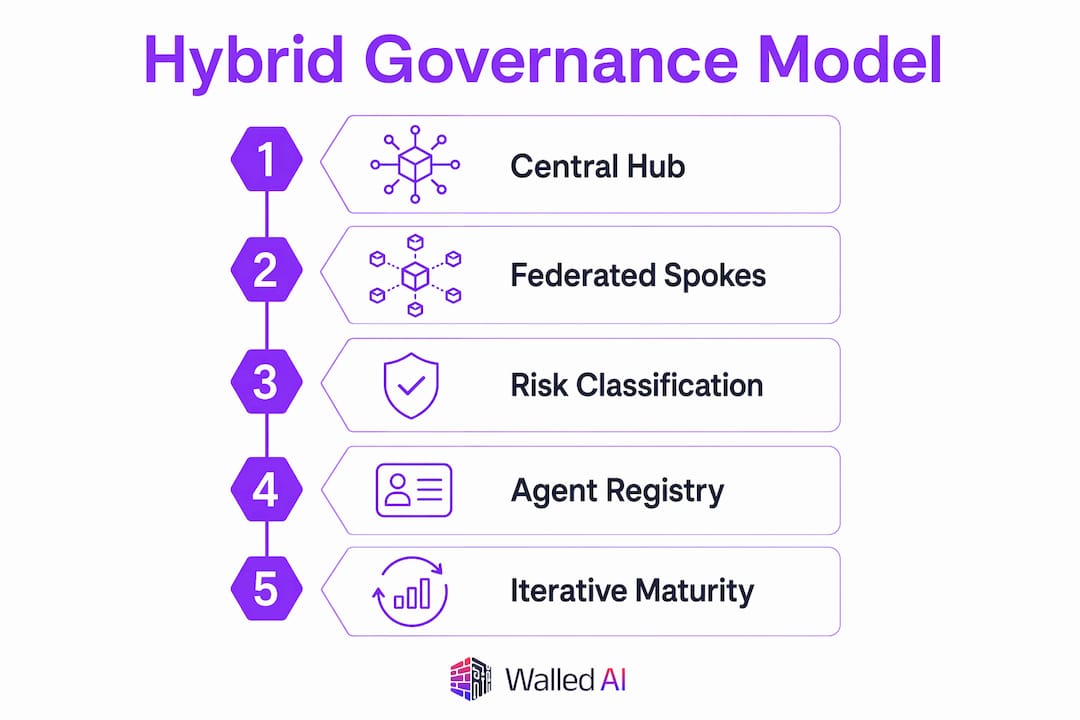
A centralized agent registry is foundational to preventing shadow AI. Every agent must be recorded with metadata covering ownership, purpose, permissions, version history, performance metrics, and security classification. Policies should require teams to search this registry before initiating new development, reducing duplication and improving discoverability across the organization.
Governance maturity typically progresses through stages. Organizations begin with tight centralized control, then gradually extend self-service capabilities to business units as trust and process discipline are established, while retaining central audit authority throughout.
How governance becomes an operational enabler, not a bottleneck
Governance fails when it functions purely as a compliance gate. Automating compliance checks and providing pre-approved agent development patterns allows teams to move faster while reducing security incidents and rework. The goal is to embed governance into the development lifecycle so that approval is a natural checkpoint rather than an external obstacle.

Deloitte's AI Governance Roadmap frames board-level oversight as a driver of trustworthy AI, not merely a risk control mechanism. Databricks similarly positions cross-functional governance as the foundation for scaling AI adoption with confidence, emphasizing that clear ownership, risk-based controls, and continuous oversight reduce surprises and keep systems aligned with business and regulatory expectations.
Pre-approved agent patterns and standardized integration templates are practical tools for accelerating development. When developers can select from a library of vetted patterns, they spend less time navigating approval processes and more time building. Governance checkpoints embedded in the development pipeline dynamically adjust required controls based on an agent's evolving risk profile.
Pilot programs help demonstrate governance benefits to skeptical teams, showing that effective governance can reduce incidents and speed approvals, which encourages broader adoption across the organization.
Pro Tip: Refine governance controls iteratively using real usage data. Governance frameworks that are adjusted based on observed agent behavior and incident patterns become more precise over time, reducing false positives and unnecessary friction for development teams.
Why transparency and auditability are non-negotiable
Documenting decision rationale and architectural patterns ensures organizations can explain and verify agent decisions accurately. This capability is not optional under frameworks like the NIST AI Risk Management Framework, which designates GOVERN as a cross-cutting function infused throughout all risk management activities, including mapping, measuring, and managing AI risks. The EU AI Act imposes similar documentation obligations for high-risk AI systems.
Audit trails must cover the complete agent lifecycle: creation, deployment, configuration changes, usage patterns, and incident history. For regulated decisions, such as a credit score calculation, it must be possible to reconstruct the full chain of agent actions without necessarily logging every intermediate step. Balancing comprehensiveness with storage, performance, and privacy constraints requires deliberate policy design rather than blanket logging.
Centralized registries serve a dual purpose here. They maintain operational metadata for governance teams and provide the traceability that regulators and internal auditors require. Organizations should also document AI compliance requirements systematically, capturing not just what agents do but why specific architectural decisions were made.
- Decision rationale documentation for every agent, covering the logic behind key outputs
- Immutable audit logs that cannot be altered after the fact, supporting regulatory inquiries
- Ownership and permission records maintained in the central registry with version history
- Incident logs capturing anomalies, policy violations, and remediation actions taken
- Architecture records documenting integration points and dependencies for each agent
How cross-functional collaboration strengthens AI governance
Without collaboration across AI, legal, compliance, security, and business teams, governance risks becoming purely technical compliance rather than integrated business strategy. A governance committee that includes representatives from each of these functions is the structural mechanism for preventing that outcome.
RACI models clarify who is responsible, accountable, consulted, and informed for each governance decision. Without this clarity, accountability for AI outcomes fragments across teams, and no single function owns the controls. Governance committees should meet on a defined cadence, with escalation paths documented in advance for high-risk incidents.
Training programs must reach beyond the AI development team. Staff who interact with AI systems, including customer-facing employees and business analysts, need sufficient literacy to recognize when agent behavior falls outside expected parameters and to escalate appropriately. The Singapore Model AI Governance Framework specifically recommends training staff to interpret AI outputs and detect bias, not just technical teams.
Human-in-the-loop controls are a governance requirement for high-risk decisions, not an optional enhancement. Governance frameworks should define precisely when human review is required, how interventions are documented, and how those records feed back into the audit trail. For AI governance in financial services, this requirement is particularly acute given regulatory scrutiny of automated decision-making.
- Governance committees with defined membership from AI, legal, compliance, security, and business functions
- RACI models establishing clear accountability for every governance decision and outcome
- Cross-functional training ensuring all staff understand AI risk, not just technical practitioners
- Human-in-the-loop requirements for high-risk decisions, with documented intervention procedures
- Predefined escalation paths for incidents, with response playbooks reviewed by all stakeholders
How Walled supports enterprise-scale AI agent governance
Walled provides a unified AI control plane that governs AI interactions across browser-based tools, desktop applications, custom AI applications, and agentic workflows. Before any data reaches an AI model, the platform performs real-time inspection and AI Data Loss Prevention, detecting and masking sensitive information including intellectual property, source code, customer data, credentials, and regulated information.
The platform protects against AI-specific threats that standard security controls do not address: prompt injection attacks, jailbreak attempts, and policy bypasses. It continuously validates AI-generated responses for factual accuracy, hallucinations, and policy compliance, providing the reliability assurance that regulated industries require for AI-assisted decision-making.
Walled's enterprise governance capabilities include immutable audit trails, centralized policy enforcement, and compliance reporting aligned with GDPR, PDPA, the EU AI Act, and MAS TRM. For organizations in sectors with strict data residency requirements, the platform supports on-premises, private cloud, and air-gapped deployments, ensuring sensitive data never leaves customer-controlled environments.
- Unified control plane governing all AI interaction types from a single policy enforcement point
- Real-time AI-DLP masking sensitive data before it reaches any AI model
- Threat protection against prompt injections, jailbreaks, and unauthorized policy bypasses
- Continuous response validation for hallucinations, accuracy, and compliance adherence
- Immutable audit trails and compliance reporting for GDPR, PDPA, EU AI Act, and MAS TRM
- Flexible deployment across on-premises, private cloud, and air-gapped environments
- Adversarial testing and red teaming to identify vulnerabilities before production deployment
- Governance APIs for custom agents and applications requiring tailored control configurations
For organizations in regulated industries such as financial services and healthcare, Walled's architecture addresses the specific data sovereignty and compliance obligations that generic AI platforms cannot meet.
Walled gives your governance program a concrete foundation
Governing AI agents at enterprise scale demands more than policy documents. It requires real-time enforcement, continuous monitoring, and audit-ready documentation that holds up under regulatory scrutiny. Walled delivers exactly that: a sovereign AI governance platform that enforces your policies at the point of AI interaction, not after the fact.
Organizations deploying AI agents in mid-market and regulated environments can be operational with Walled in minutes, not months. The platform's mid-market governance solution is purpose-built for teams that need enterprise-grade controls without the implementation overhead of a multi-year deployment. Whether your priority is GDPR compliance, data residency, or protection against prompt injection, Walled provides the control plane your governance program requires. Contact the Walled team to assess your current AI agent exposure and configure a deployment aligned with your compliance obligations.
Key Takeaways
A hybrid governance model combining centralized policy oversight with federated business unit execution is the most effective structure for managing AI agents at enterprise scale.
| Point | Details |
|---|---|
| Adopt a hybrid model | Central councils set security baselines; business units execute compliance locally within those guardrails. |
| Maintain a centralized registry | Every agent must be documented with ownership, permissions, and version history to prevent shadow AI deployments. |
| Automate compliance workflows | Pre-approved agent patterns and embedded lifecycle checkpoints reduce rework and accelerate development approvals. |
| Require cross-functional governance | RACI models, governance committees, and human-in-the-loop controls embed accountability across AI, legal, compliance, and security teams. |
| Deploy Walled for enforcement | Walled provides real-time AI-DLP, immutable audit trails, and threat protection aligned with GDPR, PDPA, and the EU AI Act. |