

AI compliance documentation requirements define the structured evidence and records organizations must maintain to prove their AI systems conform to legal, ethical, and safety standards under regulations including the EU AI Act, GDPR, and emerging US frameworks. The industry term for this practice is AI technical documentation, and it spans the full system lifecycle from design through post-market monitoring. Compliance officers and legal professionals must treat these records not as a writing exercise but as a continuously maintained evidence architecture. Frameworks like EU AI Act Annex IV, ISO/IEC 42001, and the NIST AI Risk Management Framework each impose distinct but overlapping obligations. Getting the structure right before deployment is the difference between audit readiness and regulatory exposure.
What are the AI compliance documentation requirements under EU AI Act Annex IV?
The EU AI Act Annex IV mandates technical documentation covering nine detailed sections, and organizations must maintain this file for at least 10 years after market placement, updating it with every substantial system change. That retention period is longer than most enterprise software cycles, which means documentation governance must be a permanent operational function, not a project.
The nine sections cover:
- General system description: Intended purpose, deployment context, and the categories of users the system affects
- Development methods and data governance: Training data sources, data sheets, model cards, and preprocessing decisions
- Risk management system: Identification, evaluation, and mitigation of foreseeable risks throughout the lifecycle
- Human oversight design: Technical measures enabling operators to monitor, intervene, and override the system
- Logging and traceability: Automated records of system decisions, inputs, and operational events
- Performance metrics and testing: Accuracy, robustness, and fairness benchmarks with test methodologies
- Change management records: Version histories, retraining logs, and documentation of post-deployment modifications
- Post-market monitoring plan: Procedures for collecting and analyzing real-world performance data
- Conformity assessment declaration: Formal attestation that the system meets applicable requirements
The technical documentation file under Article 11 must exist before product deployment, remain current with system evolution, and be readable by regulatory authorities upon request. Failure to integrate updates is one of the most common top-tier compliance failures in audits. Regulators do not accept documentation that describes a prior version of the deployed system.
Pro Tip: Build model cards and data sheets as living documents attached to your model registry. When a model is retrained or updated, the card updates automatically. This eliminates the gap between the deployed system and its documentation.

How to build an effective AI compliance documentation workflow
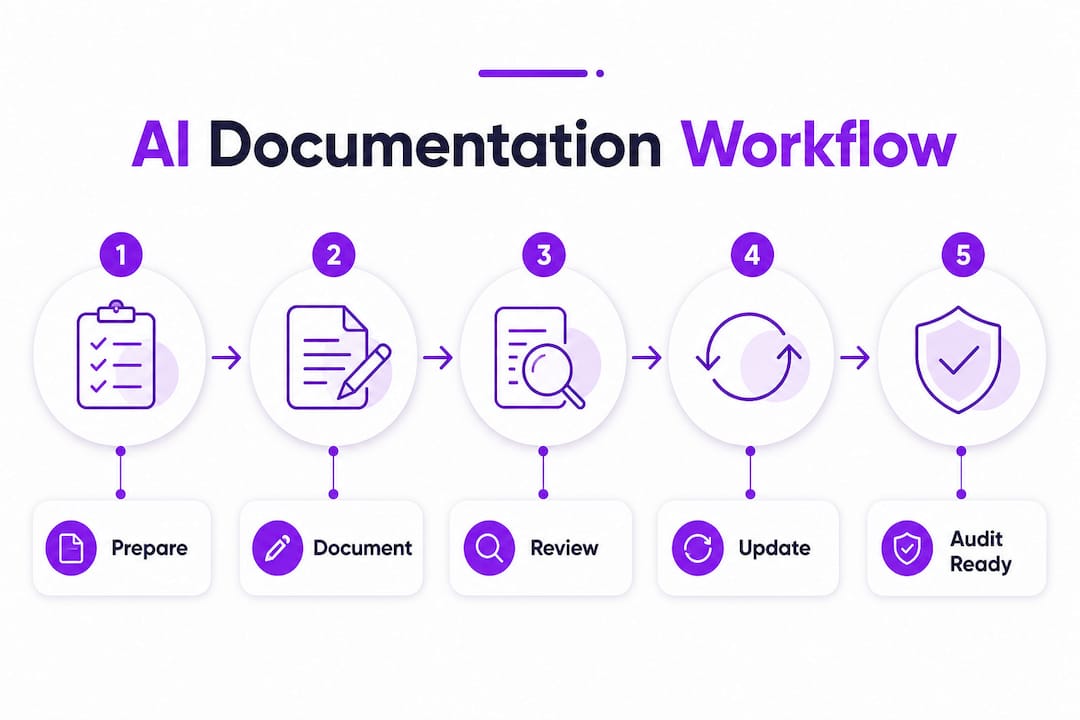
Compliance documentation is most effective when it is live and version-controlled alongside AI system updates, reducing audit risk and reflecting the actual deployed system state. The practical implication is that documentation must attach to lifecycle events, not be assembled retrospectively when an audit notice arrives.
A structured workflow follows this sequence:
- Inventory all AI systems before documentation begins. Classify each by risk tier, regulatory scope, and deployment context. This step determines which frameworks apply and what evidence each system requires.
- Assign documentation ownership at the model level. Each AI system should have a named compliance owner responsible for keeping records current through development, retraining, and deployment changes.
- Wire documentation triggers to lifecycle events. Model releases, retraining runs, and deployment updates should automatically generate version-stamped documentation entries. Manual compilation at audit time is a structural failure point.
- Automate logging and evidence collection. Article 12 of the EU AI Act requires automatic, continuous system-generated logging to identify risks and monitor operations, explicitly rejecting manual PDF audit trails as non-compliant. Automated logs must capture decisions, provenance, and data quality in real time.
- Integrate with enterprise GRC frameworks. Embedding AI documentation into existing Governance, Risk, and Compliance programs using a control-based governance model aligned to NIST 800-53 produces auditable mechanisms that go beyond principle-based frameworks. This integration prevents AI compliance from operating as a siloed function.
- Establish a documentation review cadence. Quarterly reviews catch gaps caused by incremental system changes that individually fall below the threshold for triggering a formal update but collectively alter the system's risk profile.
The most common pitfall is treating documentation as a static artifact. A PDF produced at deployment and never updated is not compliant documentation. It is a liability.
Pro Tip: Map each documentation artifact to the specific regulatory article it satisfies. When an auditor requests evidence for Article 12 logging, you produce the artifact directly rather than searching across systems.
How do overlapping AI compliance standards affect documentation in 2026?
As of mid-2026, US and EU organizations must align AI documentation with overlapping frameworks including OMB M-26-04, Colorado SB 24-205, and the EU AI Act, building a foundational documentation stack across five core artifact types. That convergence creates both complexity and an opportunity: organizations that structure documentation around shared requirements can satisfy multiple frameworks from a single evidence base.
The five foundational artifacts every enterprise AI compliance program requires are:
- Model card: Describes the model's purpose, training data, performance characteristics, and known limitations
- Acceptable use policy: Defines permitted and prohibited uses, operator obligations, and user rights
- Impact assessment: Evaluates risks to individuals, groups, and society, including bias and fairness analysis
- Red-team report: Documents adversarial testing results, identified vulnerabilities, and remediation actions
- Incident response plan: Specifies triage workflows, escalation paths, and regulatory notification timelines
Incident response plans require particular attention to regional reporting timelines. The RAISE Act specifies 72-hour notification requirements, while California imposes 15-day reporting windows. These timelines must be built into the incident response plan explicitly, not left to interpretation at the time of an incident.
ISO/IEC 42001 provides the management system foundation that unifies these artifacts across frameworks. A unified governance structure leveraging ISO 42001 as the foundational management system, layered with prescriptive frameworks like the EU AI Act, significantly lowers audit burdens and reduces redundant documentation. Organizations that implement ISO 42001 first and then map framework-specific requirements onto it spend less time producing duplicate evidence for each regulator.
The NIST AI Risk Management Framework complements ISO 42001 by providing structured risk measurement and categorization language that regulators across jurisdictions recognize. Using NIST AI RMF terminology in impact assessments and risk management records makes those documents legible to a broader range of auditors.
For compliance officers managing cross-border AI data compliance, the priority is identifying the highest-obligation framework that applies to each system and using it as the documentation ceiling. Systems that meet EU AI Act Annex IV requirements will generally satisfy less prescriptive US state-level obligations.
What are the best practices for AI compliance reporting and audit readiness?
Audit readiness is not a state achieved once before an inspection. It is a continuous condition maintained through disciplined documentation governance. Organizations often fail to maintain documentation in clear, regulator-understandable language as required by AI Act Article 21, leading to audit difficulties and non-compliance findings. Technical accuracy alone is insufficient if the documentation is not structured for external review.
The following practices define a mature AI compliance reporting posture:
- Maintain stable, traceable version histories. Every documentation update must carry a timestamp, the identity of the person who made the change, and the trigger event that prompted the update. Regulators treat undated or unattributed changes as evidence of poor controls.
- Conduct internal audit rehearsals. Quarterly dry runs where compliance teams produce a complete documentation dossier on demand reveal gaps before regulators do. The rehearsal should simulate an external audit request with a defined response window.
- Map evidentiary sources explicitly. Each claim in the technical documentation file should reference the specific system log, test result, or governance record that supports it. Auditors should be able to trace any assertion back to primary evidence without asking follow-up questions.
- Write for the auditor, not the engineer. AI Act Article 21 requires documentation to be understandable to regulatory authorities. Technical jargon that is clear to the development team may be opaque to a legal or regulatory reviewer. Plain language summaries alongside technical appendices satisfy both audiences.
- Enforce the 10-year retention requirement. The EU AI Act mandates a minimum 10-year retention period for technical documentation after market placement. Enterprise records management systems must classify AI documentation accordingly and prevent premature deletion.
- Monitor for documentation gaps during retraining. Model retraining phases are the most common source of undocumented system changes. Every retraining run should trigger a documentation review checkpoint.
Pro Tip: Assign a "documentation debt" metric to each AI system. Track the number of system changes that occurred without a corresponding documentation update. A rising debt score is an early warning indicator of audit risk.
For legal professionals managing AI compliance risks across a portfolio of systems, the documentation debt metric provides a quantifiable signal that can be reported to the board and used to prioritize remediation resources.
Key Takeaways
Effective AI compliance documentation is a continuously maintained evidence architecture, not a static file produced at deployment and left unchanged.
| Point | Details |
|---|---|
| Annex IV is the baseline | EU AI Act Annex IV requires nine documentation sections, maintained for at least 10 years post-deployment. |
| Automate logging from day one | Article 12 mandates continuous system-generated logs; manual PDF audit trails do not satisfy the requirement. |
| Five artifacts cover most frameworks | Model cards, acceptable use policies, impact assessments, red-team reports, and incident response plans satisfy overlapping US and EU obligations. |
| ISO 42001 reduces duplication | Using ISO/IEC 42001 as the management foundation maps framework-specific requirements onto a single evidence base. |
| Write for auditors, not engineers | Article 21 requires documentation to be understandable to regulatory authorities, not just internal technical teams. |
Documentation as governance architecture: a practitioner's view
The organizations I see struggle most with AI compliance documentation share a common pattern. They treat documentation as a writing project assigned to a compliance analyst after the AI system is already deployed. By that point, the development team has moved on, training data provenance is partially reconstructed from memory, and the risk management decisions made during development were never recorded at all. The resulting document is technically formatted but evidentially hollow.
The shift that changes outcomes is treating documentation as the output of governance workflows, not the input to an audit response. When a model card is generated automatically from the model registry, when risk assessments are completed before deployment approval, and when logging is wired into the system architecture rather than bolted on afterward, the compliance dossier exists continuously. Auditors receive a complete, traceable record because the record was built as the system was built.
The regulatory direction in 2026 makes this approach mandatory rather than aspirational. The EU AI Act's Article 12 logging requirements, the 72-hour incident notification timelines under the RAISE Act, and the ISO 42001 management system standard all assume that documentation is a live operational function. Organizations that delay this transition face not just audit risk but the compounding cost of reconstructing evidence for systems that have already been modified multiple times since deployment.
The compliance officers who get this right are the ones who sit at the table during AI system design, not the ones called in to document what was already built.
— Rishabh
How Walled supports enterprise AI compliance documentation
Enterprise compliance teams managing AI documentation obligations across multiple frameworks need infrastructure that connects governance controls to the systems they govern.
Walled provides a unified AI control plane with immutable audit trails, centralized policy enforcement, and compliance reporting built for regulatory frameworks including the EU AI Act, GDPR, PDPA, and MAS TRM. The platform's real-time inspection and automated logging satisfy Article 12's continuous monitoring requirements without manual intervention. For compliance officers who need AI governance deployed rapidly, Walled's mid-market solution delivers audit-ready infrastructure without extended implementation cycles. Teams managing enterprise-scale AI governance with on-premises or air-gapped requirements can deploy Walled in sovereign environments where sensitive documentation never leaves controlled infrastructure.
FAQ
What is AI compliance documentation?
AI compliance documentation is the set of technical and procedural records that prove an AI system meets legal, ethical, and safety requirements under applicable regulations. Under the EU AI Act, this includes system descriptions, risk management records, logging mechanisms, and conformity assessments.
What does EU AI Act Annex IV require?
Annex IV requires nine categories of technical documentation covering system description, development methods, data governance, risk management, human oversight, logging, performance testing, change management, and post-market monitoring. Organizations must retain this documentation for at least 10 years after market placement.
How long must AI compliance records be retained?
The EU AI Act mandates a minimum retention period of 10 years for technical documentation following market placement. Records must remain accessible and current, reflecting the actual deployed system state at any point during that period.
What is the difference between a model card and a technical documentation file?
A model card is a concise artifact describing a model's purpose, training data, and performance characteristics. A technical documentation file under Article 11 is the complete compliance dossier that incorporates the model card alongside risk assessments, logging records, and conformity declarations.
How does ISO 42001 relate to EU AI Act documentation requirements?
ISO/IEC 42001 defines the management system framework for AI governance, providing the organizational structure within which EU AI Act documentation requirements operate. Organizations that implement ISO 42001 first can map Annex IV and other framework-specific obligations onto a single governance foundation, reducing redundant documentation across regulatory regimes.