

Types of AI compliance risks are defined as distinct categories of vulnerabilities that emerge when organizations deploy AI systems, spanning model failures, data privacy breaches, algorithmic bias, and regulatory non-conformance. Compliance officers navigating frameworks like the EU AI Act, GDPR, PDPA, and MAS TRM face a risk environment that differs fundamentally from traditional IT governance. Unlike legacy software, AI systems can fail silently, discriminate invisibly, and expose sensitive data through mechanisms that standard security controls never anticipated. Understanding each category is the first step toward building a governance program that holds up under regulatory scrutiny.
1. What are the types of AI compliance risks?
The primary types of AI compliance risks fall into five categories: model risk, bias and fairness risk, data leakage risk, regulatory risk, and operational risk. Each category carries distinct legal, financial, and reputational consequences. Compliance officers who treat these as a single undifferentiated "AI risk" will systematically under-invest in the controls that matter most. Addressing them requires category-specific mitigation strategies, not a one-size-fits-all policy.
AI-specific compliance issues in AI require distinct mitigation approaches from traditional cybersecurity risks because vulnerabilities can reside in model logic, not just infrastructure. That distinction matters enormously for how you design controls, assign accountability, and structure audit evidence.

2. What is AI model risk and why does it matter for compliance?
AI model risk arises from flawed design, biased training data, or incorrect predictions, which can produce unreliable or unfair outcomes at scale. In regulated sectors like healthcare, finance, and insurance, a model that systematically mispredicts can trigger patient harm, wrongful credit denials, or discriminatory underwriting decisions. Each of those outcomes carries direct regulatory liability.
Compliance officers should understand three specific model failure modes:
- Biased outputs: Models trained on unrepresentative data produce skewed predictions that violate fairness obligations under the EU AI Act and sector-specific rules.
- Model inversion: Adversaries reconstruct training data from model outputs, exposing personal information that organizations believed was protected.
- Accuracy drift: Models degrade over time as real-world data distributions shift, producing outputs that no longer meet the accuracy standards documented at deployment.
Mitigation requires model validation before deployment, ongoing bias testing, and continuous performance monitoring against defined thresholds. Compliance teams should require model cards documenting training data sources, known limitations, and validation results for every AI system in production.
Pro Tip: Require model owners to submit a written validation report before any AI system touches regulated data. Treat that report the same way you treat a legal opinion: it must be signed, dated, and retained as audit evidence.
3. How do AI bias and fairness risks affect compliance obligations?
Bias in AI systems originates from training data that reflects historical inequities, causing discrimination in recruitment, credit scoring, and law enforcement use cases. The compliance consequence is direct: discriminatory AI outputs can violate anti-discrimination law, consumer protection regulations, and the fairness requirements embedded in the EU AI Act. Reputational damage compounds the legal exposure when bias incidents become public.
Bias manifests through several mechanisms that compliance officers need to recognize:
- Historical data bias: Training sets built from past decisions inherit the prejudices embedded in those decisions.
- Sampling bias: Underrepresentation of demographic groups in training data causes models to perform poorly for those groups.
- Proxy discrimination: Models learn to use neutral variables (zip code, device type) as proxies for protected characteristics.
- Feedback loops: Biased outputs influence future training data, amplifying the original distortion over time.
EU AI Act Annex III classifies AI systems used in employment, education, credit, and law enforcement as high-risk, imposing extensive fairness and non-discrimination obligations on those systems. Organizations deploying AI in any of these domains must conduct bias impact assessments, document corrective actions, and maintain evidence that fairness controls are operating as intended.
4. What are the common types of AI data leakage risks?
AI data leakage involves the exposure of sensitive information through AI models or workflows, and it is categorically different from traditional breaches that target storage systems. Traditional breaches extract data from databases or file servers. AI data leakage exploits the model itself as the attack surface. That distinction means conventional data loss prevention tools often fail to detect it.
Common leakage patterns include:
- Training data memorization: Large language models can reproduce verbatim fragments of their training data, including personal information, source code, or proprietary documents.
- Prompt injection attacks: Malicious inputs manipulate AI systems into revealing confidential context or bypassing access controls.
- Context window exposure: Sensitive information passed into an AI session can be extracted by a subsequent user or a compromised workflow.
- Model inversion attacks: Repeated queries allow adversaries to reconstruct data used to train a model, even without direct access to the training set.
Regulatory obligations under GDPR, CCPA, and the EU AI Act all apply when AI-related leakage exposes personal data. Organizations must treat each leakage vector as a separate control requirement, not a single "AI security" checkbox. Technical mitigations include automated data classification, real-time AI Data Loss Prevention (AI-DLP), and prompt injection defense deployed before data reaches any AI model.
Pro Tip: EU AI Act Article 12 requires automated, machine-readable audit trails recording full AI operational lifecycles. Manual logs and PDF exports do not meet this standard. Build tamper-proof, automated logging into your AI governance architecture from day one.
For organizations operating across jurisdictions, cross-border AI data compliance adds another layer of obligation, since data residency rules and transfer restrictions interact directly with how AI models are trained and served.
5. Which regulatory risks arise from AI non-compliance?
The EU AI Act creates the most consequential regulatory risk structure currently in force for AI governance. It classifies AI systems into four tiers: prohibited practices, high-risk systems, transparency-risk systems, and minimal-risk systems. Each tier carries different compliance obligations and penalty exposure.
EU AI Act penalties are structured as follows:
- Prohibited AI practices: Fines up to 35 million euros or 7% of global annual turnover, whichever is higher.
- High-risk system violations: Fines up to 15 million euros or 3% of global annual turnover.
- Informational obligation failures: Fines up to 7.5 million euros or 1% of global annual turnover.
Those figures represent the upper bound of a tiered structure, not automatic penalties. The practical compliance challenge is that the Act's obligations are extensive and the deadline for full conformance is august 2026. Organizations that have not yet mapped their AI systems against the risk tiers face acute exposure.
High-risk AI systems include those used in biometrics, critical infrastructure, education, employment, healthcare, and justice. These systems face documentation, transparency, human oversight, and accuracy obligations that go well beyond what most current AI governance programs address. Compliance officers should prioritize a full AI system inventory and risk-tier classification as the foundation of any regulatory response program. The EU AI Act compliance guide provides a detailed breakdown of obligations by tier.
6. What operational and third-party risks complicate AI compliance?
Operational AI risks include over-reliance on AI outputs, silent model degradation, and insufficient human oversight. These risks produce compliance failures even when the underlying AI technology is technically sound. A model that was accurate at deployment can drift into unreliability over months, and without active monitoring, no one detects the failure until harm has already occurred.
Third-party AI vendor risk is equally significant. Organizations remain legally responsible for AI outputs even when the AI is embedded in a vendor's black-box product. Vendor model updates, retraining decisions, or service failures can introduce liability that the organization never anticipated and cannot directly observe.
Practical steps to manage these risks include:
- Vendor due diligence: Require AI vendors to disclose model architecture, training data sources, known limitations, and change management processes before contract execution.
- Contractual safeguards: Include provisions requiring advance notice of model changes, audit rights, and liability allocation for AI-related failures.
- Continuous monitoring: Implement automated performance tracking that flags accuracy degradation, output anomalies, or policy violations in real time.
- Human oversight protocols: Define escalation paths that require human review before AI outputs trigger consequential decisions in regulated domains.
An enterprise AI risk assessment framework helps compliance teams systematically identify which third-party AI integrations carry the highest exposure and prioritize controls accordingly.
Key Takeaways
Managing AI compliance risks requires category-specific controls across model integrity, bias detection, data leakage prevention, regulatory tier mapping, and operational oversight, because no single policy addresses all five risk types simultaneously.
| Point | Details |
|---|---|
| Model risk demands validation | Require signed model validation reports before any AI system processes regulated data. |
| Bias requires active detection | Conduct bias impact assessments for all AI systems in EU AI Act Annex III high-risk domains. |
| Data leakage needs AI-specific controls | Deploy AI-DLP and prompt injection defense, since traditional data loss prevention tools miss AI-specific vectors. |
| Regulatory penalties are severe | EU AI Act fines reach 7% of global turnover for prohibited AI practices, making tier classification urgent. |
| Third-party risk stays with you | Organizations remain liable for vendor AI outputs and must enforce contractual oversight rights. |
Why AI compliance risk is not just an IT problem
The most common mistake I see compliance teams make is delegating AI risk entirely to the technology function. That approach fails because the highest-consequence AI risks, bias, regulatory non-conformance, and third-party accountability, are governance and legal problems, not engineering problems. A model that passes every technical test can still violate the EU AI Act if it lacks the required documentation, human oversight mechanisms, or audit trail.
What I have found actually works is treating AI compliance as a cross-functional discipline from the start. Compliance, legal, data protection, and technology teams each own a distinct piece of the risk picture. When those functions operate in silos, critical gaps appear at the boundaries. A legal team that does not understand model drift cannot assess vendor liability accurately. A technology team that does not understand GDPR cannot design compliant data pipelines.
The other insight that changes how organizations approach this is the audit trail requirement. Most teams think about audit trails as a documentation exercise. EU AI Act Article 12 makes them a technical requirement. Tamper-proof, machine-readable, automated logs are not optional for high-risk systems. Organizations that build manual logging processes now will face expensive remediation when regulators begin enforcement. Build the automated infrastructure first, and the documentation follows naturally.
— Rishabh
How Walled addresses AI compliance risk across your organization
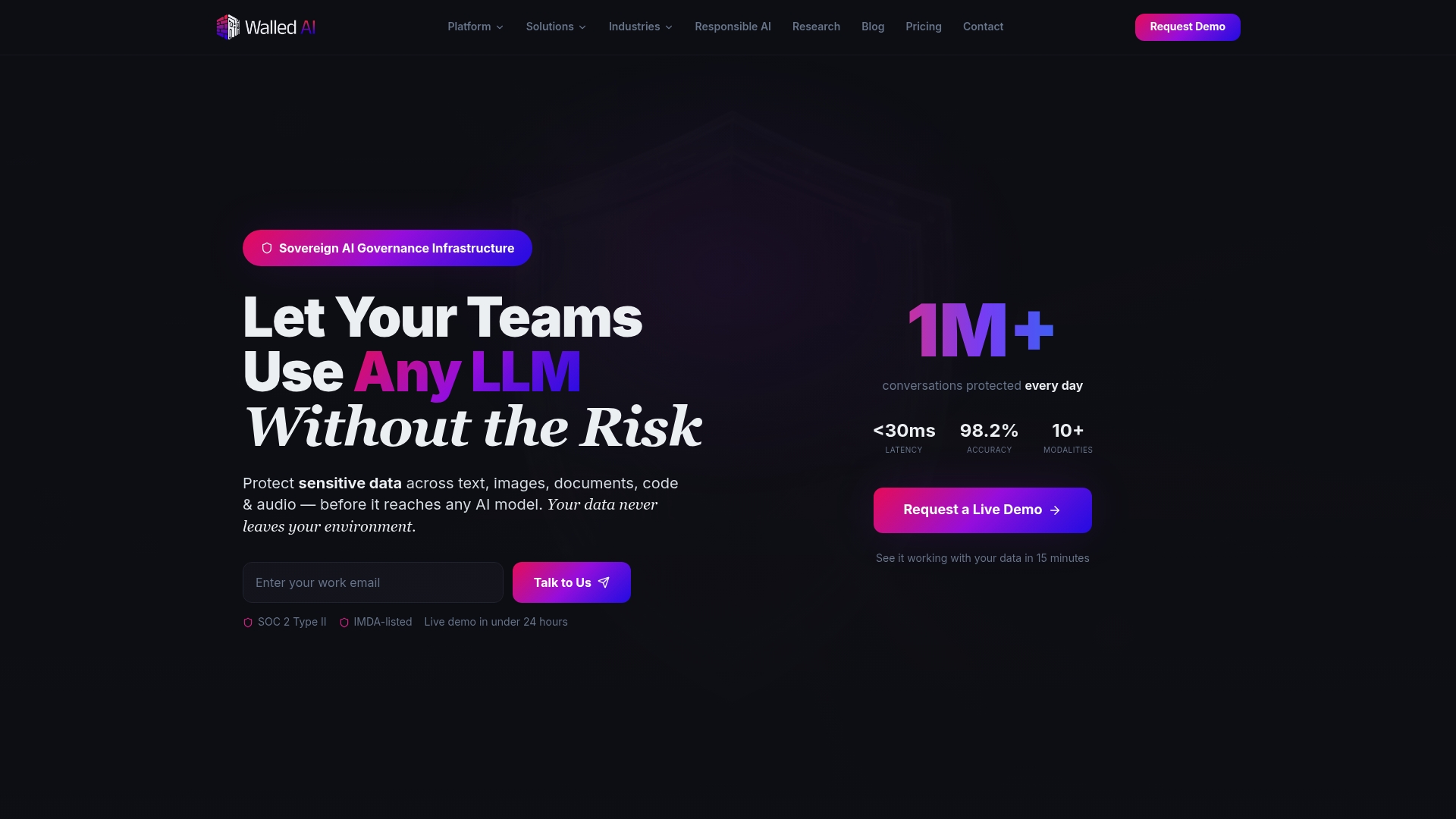
Walled provides a unified AI governance platform that addresses the full spectrum of AI compliance risks organizations face in 2026. Before any data reaches an AI model, Walled performs real-time AI-DLP, detecting and masking sensitive information including customer data, credentials, and regulated content. The platform defends against prompt injection attacks, jailbreak attempts, and policy bypasses while continuously validating AI-generated outputs for factual accuracy and policy conformance.
For compliance officers managing regulatory obligations under GDPR, PDPA, the EU AI Act, and MAS TRM, Walled delivers immutable audit trails, centralized policy enforcement, and a governance dashboard built for AI compliance reporting. Organizations in financial services, healthcare, and government can deploy Walled on-premises or in air-gapped environments, keeping sensitive data entirely within customer-controlled infrastructure. Mid-market compliance teams can deploy in minutes with governance controls that scale as AI adoption grows.
FAQ
What are the main types of AI compliance risks?
The main types are model risk, bias and fairness risk, data leakage risk, regulatory risk, and operational risk. Each requires distinct controls because the underlying failure mechanisms differ across categories.
How does AI data leakage differ from a traditional data breach?
AI data leakage exploits the model itself as the attack surface through mechanisms like training data memorization and prompt injection, while traditional breaches target storage systems or network infrastructure. Standard data loss prevention tools typically do not detect AI-specific leakage vectors.
What penalties does the EU AI Act impose for non-compliance?
Violations involving prohibited AI practices carry fines up to 35 million euros or 7% of global annual turnover. Informational obligation failures carry fines up to 7.5 million euros or 1% of global annual turnover.
What is AI compliance reporting?
AI compliance reporting is the process of documenting AI system behavior, audit trails, risk assessments, and policy conformance to satisfy regulatory obligations. The EU AI Act requires automated, machine-readable logs for high-risk AI systems, making manual reporting processes insufficient.
Are organizations liable for AI risks in third-party vendor products?
Yes. Organizations remain legally responsible for AI outputs even when the AI is embedded in a vendor's product. Contracts must include audit rights, change notification requirements, and liability provisions to manage this exposure effectively.