

An internal AI tool policy checklist is the structured set of controls, approvals, and governance steps an enterprise must implement to manage AI usage safely and meet regulatory obligations. Without a formal checklist, organizations expose themselves to data leakage, regulatory penalties under frameworks like the EU AI Act and NIST AI Risk Management Framework, and uncontrolled shadow AI adoption. The checklist covers data classification tiers, approved tool registries, technical enforcement controls, and audit logging requirements. Compliance officers who treat this checklist as a living governance document, rather than a one-time exercise, build the foundation for defensible, audit-ready AI governance.
1. What belongs on an internal AI tool policy checklist?
An effective internal AI tool policy checklist organizes governance controls into six core categories. Each category addresses a distinct compliance or operational risk.
- AI inventory and system registration. Every AI tool in use, including shadow AI and embedded SaaS features, must be documented with its purpose, owner, risk exposure, and version history. AI inventories must be updated at least quarterly to remain accurate. An outdated inventory is functionally useless during a regulatory audit.
- Data classification tiers. Effective AI policies categorize data into three tiers: Tier 1 covers public data, Tier 2 covers internal data without personally identifiable information, and Tier 3 covers sensitive data requiring role-based access controls. Tier assignment determines which AI tools employees may use for a given task.
- Approved and prohibited tool lists. Each data tier carries a corresponding list of permitted AI tools and explicitly prohibited ones. Tier 3 data, for example, requires tools with contractual data processing agreements and on-premises or private cloud deployment options.
- Human oversight and accountability roles. The checklist must name the AI system owner, the data protection officer, and the business unit lead responsible for each deployed tool. Accountability without named individuals is unenforceable.
- Incident response and audit logging. Every AI interaction involving Tier 2 or Tier 3 data requires logged prompts, outputs, and user identifiers. Incident response procedures must specify escalation paths, notification timelines, and remediation steps.
- Policy review cadence. The checklist must include scheduled review dates. Quarterly reviews by a cross-functional AI Governance Committee and annual comprehensive updates aligned to regulatory changes are the recognized standard.
Pro Tip: Keep the policy document itself concise. Policy documents of 8–12 pages drive higher adherence because engineers and staff can interpret them without constant legal consultation.
2. How to implement and enforce the AI acceptable use policy with technical controls

Policy documents alone do not prevent data exposure. Manual compliance is insufficient; technical controls are what ensure day-to-day adherence to AI policies. Compliance officers must pair written policy with enforcement mechanisms that operate automatically.
The core technical controls for an AI acceptable use policy include:
- Data Loss Prevention (DLP). Real-time DLP inspection intercepts sensitive data before it reaches an AI model. This is the primary control for Tier 3 data protection.
- Single Sign-On (SSO) and tool whitelisting. Approved AI tools are accessible only through SSO-gated access. Unapproved tools are blocked at the network or browser level.
- Prompt and output logging. All interactions with AI tools handling Tier 2 or Tier 3 data are logged to an immutable audit trail. Logs must capture user identity, timestamp, tool name, and data classification of the input.
- Automated approval workflows. Employees requesting access to a new AI tool submit a structured request that routes to the AI Governance Committee for review. This prevents unauthorized tool adoption.
- Violation consequences and escalation paths. The enforcement framework must link to formal consequences, training programs, and visibility dashboards. A first violation triggers mandatory retraining; repeat violations escalate to HR and legal review.
Pro Tip: Integrate your AI tool approval workflow directly into your existing IT service management system. Employees are far more likely to follow a process that fits their existing request habits than one that requires a separate portal.
Walled provides a unified AI control plane that enforces DLP, prompt logging, and policy controls across browser-based AI tools, desktop applications, and agentic workflows. This technical layer closes the gap between written policy and actual employee behavior. For compliance officers managing AI policy enforcement, pairing a written checklist with automated controls is the difference between a policy that exists and one that works.
3. Best practices for piloting, training, and rolling out the AI tool policy
Rolling out an AI governance policy without a pilot phase produces predictable failures. Pilots typically surface 10–20 issues categorized as either policy gaps or rollout and training improvements. Addressing these before enterprise-wide deployment prevents larger compliance failures.
A structured rollout follows five steps:
- Select a pilot business unit. Choose a team that uses AI tools heavily. Their friction points will be representative of the broader organization's challenges.
- Run the pilot for four to six weeks. Observe where employees work around the policy, which tools generate exception requests, and where the data classification guidance is unclear.
- Capture and categorize feedback. Separate policy gaps (rules that are missing or contradictory) from training gaps (rules that exist but employees do not understand). Each category requires a different fix.
- Conduct mandatory training at launch. A 30-minute training session at rollout, covering data tiers, approved tools, and incident reporting, is the recognized minimum. Annual refreshers maintain awareness as the tool landscape changes.
- Communicate through multiple channels. FAQs posted on the intranet, manager briefings, and a direct message from senior leadership all reinforce the policy's authority. Employees who see leadership visibly comply are significantly more likely to follow suit.
The five-step governance policy lifecycle, which includes inventorying current AI use, forming a cross-functional drafting team, anchoring to a recognized framework, drafting the policy, and conducting a pilot with mandatory training, provides the structural backbone for this rollout process.
4. How to maintain and update the AI governance checklist
An AI governance checklist loses value the moment it stops reflecting current tool usage and regulatory requirements. Maintenance is not optional. It is a compliance obligation under frameworks like the EU AI Act and ISO/IEC 42001.
The maintenance structure should include:
- Quarterly AI Governance Committee reviews. The committee includes the CTO, CISO, Legal, HR, and product leads who review exceptions, incidents, and tool usage data. This cross-functional composition prevents any single function from creating blind spots.
- Exception and incident tracking. Every approved exception and every recorded incident feeds back into the policy. Patterns in exception requests reveal where the approved tool list is too restrictive. Patterns in incidents reveal where controls are insufficient.
- Annual comprehensive updates. Each year, the full checklist is reviewed against regulatory changes, new AI tool categories, and the organization's updated risk register. The EU AI Act's August 2026 obligations, for example, require specific documentation and human oversight controls that must be reflected in the checklist.
- Version control and employee acknowledgment. Every policy update receives a version number and a release date. Employees must acknowledge the updated version within 30 days of publication.
| Review type | Frequency | Owner | Output |
|---|---|---|---|
| Exception and incident review | Quarterly | AI Governance Committee | Updated approved tool list |
| Regulatory alignment check | Annually | Legal and Compliance | Revised policy document |
| Employee acknowledgment | Per update | HR | Signed acknowledgment records |
| Risk register linkage | Annually | CISO | Updated AI risk register |
Linking the checklist directly to the organizational risk register ensures that AI-related risks appear alongside other enterprise risks. This visibility drives appropriate resource allocation and executive attention.
5. What tools and frameworks support effective AI governance
Recognized frameworks give an internal AI governance program its structural credibility. Mapping your policy to NIST AI RMF and the EU AI Act produces audit-ready documentation and demonstrates regulatory alignment to examiners and regulators. ISO/IEC 42001 adds a certifiable management system layer for organizations that need third-party validation.
Beyond frameworks, compliance officers need functional tool categories to operationalize the checklist:
AI inventory and shadow AI discovery tools scan the network, browser extensions, and SaaS integrations to identify AI tools in use that have not been formally registered. Shadow AI is the most common source of uncontrolled data exposure in enterprises.
Technical compliance dashboards aggregate prompt logs, DLP alerts, and exception requests into a single view. Without this visibility, the Governance Committee is reviewing anecdotal reports rather than actual usage data.
Procurement and vendor risk management integration ensures that every new AI tool purchase triggers a vendor risk assessment before deployment. The pre-deployment review checklist, which includes bias testing, security review, and legal sign-off, shifts governance from reactive to proactive. This is compliance by design, not compliance by accident.
AI governance software platforms provide the unified control layer that connects policy rules to technical enforcement. Walled, for example, performs real-time AI DLP, prompt injection detection, and immutable audit logging across all AI interactions. For organizations subject to GDPR, PDPA, or MAS TRM, this level of technical enforcement is what makes a policy defensible in a regulatory examination. The enterprise AI governance framework that underpins these tools must align with the same standards the policy references.
For organizations in regulated sectors, the EU AI Act compliance requirements before august 2026 make this framework alignment a legal necessity, not a best practice.
Key Takeaways
An effective internal AI tool policy checklist combines data classification tiers, technical enforcement controls, cross-functional governance, and scheduled reviews to produce a defensible, audit-ready AI governance program.
| Point | Details |
|---|---|
| Data classification is foundational | Assign every AI use case to Tier 1, 2, or 3 before approving any tool. |
| Technical controls enforce what policy cannot | DLP, SSO, and prompt logging close the gap between written rules and actual behavior. |
| Pilots surface real-world gaps | Run a four-to-six-week pilot before enterprise rollout to identify policy and training failures. |
| Quarterly reviews keep the checklist current | The AI Governance Committee must review exceptions, incidents, and tool usage data every quarter. |
| Framework alignment ensures audit readiness | Map the policy to NIST AI RMF, EU AI Act, or ISO/IEC 42001 to produce defensible documentation. |
What I've learned from building AI policies that actually get followed
The most common failure I see in enterprise AI governance is not a bad policy. It is a good policy that no one enforces. Organizations spend months drafting a thorough checklist, then deploy it as a PDF on the intranet and consider the job done.
The policies that actually work share one characteristic: they were drafted by cross-functional teams that included legal, security, HR, and business unit leads from the start. When the people who will live under the policy help write it, they stop treating it as an obstacle and start treating it as a shared standard.
The second thing I have learned is that exception tracking is more valuable than most compliance officers realize. Every exception request is a data point. When 40 employees in the same department request access to the same unapproved tool within 60 days, that is not a compliance problem. That is a signal that the approved tool list has a gap. Treating exceptions as intelligence rather than violations produces a policy that improves continuously rather than one that calcifies.
Finally, the organizations that achieve the best outcomes are the ones that pair their written policy with technical enforcement from day one. Policy without enforcement is a statement of intent. Policy with enforcement is a control.
— Rishabh
How Walled supports enterprise AI governance and policy enforcement
Compliance officers who need to move from a written checklist to an enforced governance program have a direct path with Walled.
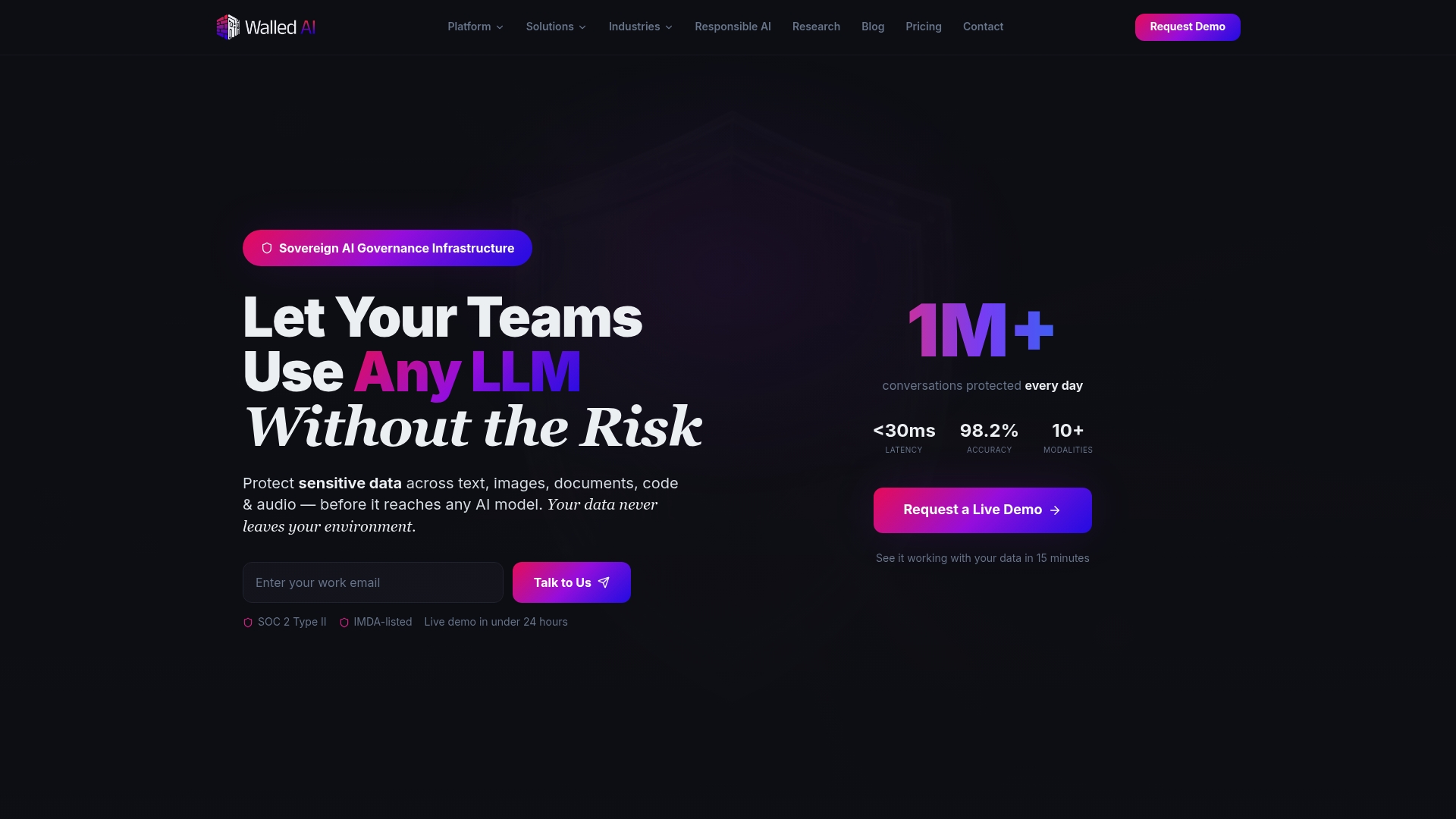
Walled provides the technical enforcement layer that most enterprise AI policies lack. The platform performs real-time AI DLP, detects prompt injection and jailbreak attempts, and maintains immutable audit logs across every AI interaction. It maps directly to NIST AI RMF, GDPR, PDPA, MAS TRM, and EU AI Act obligations. Walled supports on-premises, private cloud, and air-gapped deployments, so sensitive data never leaves your controlled environment. Whether you are managing AI governance for financial services or deploying governance infrastructure for a technology firm, Walled provides the enforcement controls your checklist requires. For enterprise teams ready to operationalize their policy, enterprise AI governance with Walled deploys without rebuilding existing infrastructure.
FAQ
What is an internal AI tool policy checklist?
An internal AI tool policy checklist is a structured set of governance controls covering AI inventory, data classification, approved tool lists, technical enforcement, and review cadence. It gives compliance officers a repeatable framework for managing AI usage and satisfying regulatory audits.
How often should the AI governance checklist be updated?
The AI Governance Committee should review the checklist quarterly for exceptions and incidents, with a full annual update aligned to regulatory changes and the organizational risk register.
What data tiers should an AI acceptable use policy include?
Effective AI policies use three tiers: Tier 1 for public data, Tier 2 for internal data without PII, and Tier 3 for sensitive data requiring role-based access controls and contractual data processing agreements.
Why is technical enforcement necessary alongside a written AI policy?
Manual compliance alone is insufficient to prevent data exposure. Technical controls such as DLP, SSO-gated tool access, and prompt logging ensure that policy rules are applied automatically at every AI interaction, not just when employees remember to follow them.
Which frameworks should an enterprise AI policy align with?
NIST AI RMF, the EU AI Act, and ISO/IEC 42001 are the three most widely recognized frameworks for enterprise AI governance. Mapping your policy to these frameworks produces audit-ready documentation and demonstrates regulatory alignment to examiners.