

AI policy enforcement is the process of applying organizational AI rules through runtime technical controls and oversight mechanisms to ensure compliant, ethical, and secure AI operations. The industry term for this practice is AI governance enforcement, and it sits at the operational core of any serious AI governance framework. Understanding what AI policy enforcement means in practice is the difference between a documented policy and one that actually protects your organization. Compliance officers and organizational leaders who treat enforcement as a technical afterthought expose their organizations to regulatory penalties, data breaches, and reputational harm under frameworks including the EU AI Act, NIST AI RMF, and ISO/IEC 42001.
What is AI policy enforcement and why does it matter?
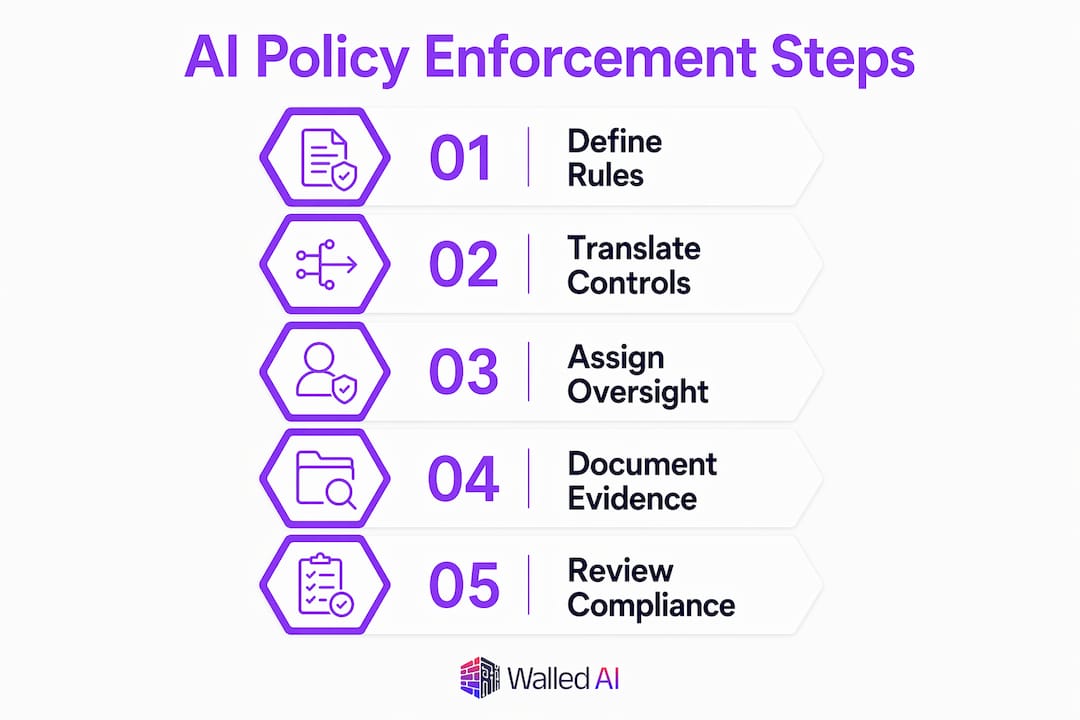
AI policy enforcement operationalizes AI governance by translating written rules into technical controls that govern approved tools, permitted use cases, data handling procedures, and access rights at runtime. A policy document sitting in a shared drive is not enforcement. Enforcement is the operational machinery that activates those rules every time an AI system processes a request, generates an output, or handles sensitive data.
The distinction matters because regulators do not accept documentation as proof of compliance. Auditors look for evidence that controls were applied, monitored, and logged. Organizations that rely on static policy documents without linking them to technical controls and named accountable owners produce what governance professionals call "checkbox compliance." That approach fails under scrutiny from regulators enforcing the EU AI Act or MAS TRM.

AI policy management, the broader discipline, covers policy creation, ownership assignment, and review cycles. Enforcement is the subset that operates at runtime. Both are necessary, but enforcement is where governance either succeeds or breaks down in practice.
What are the key components of AI policy enforcement in enterprises?
Effective enforcement in an enterprise environment requires four interconnected components working together.
- Policy-to-control translation: Every written rule must map to a specific technical control. Approved tool lists become allowlists enforced at the network or application layer. Data handling rules become real-time scanning and masking configurations. Use case restrictions become access control policies tied to user roles and business units.
- Inline runtime enforcement: Policy enforcement occurs inline within AI workflows, scanning inputs and outputs in real time to prevent data exposure and misuse before it occurs. This is not a post-hoc audit function. Controls must intercept interactions as they happen.
- Centralized visibility: Governance teams require a unified view that maps AI usage to identity, data classification, and risk intent. Without centralized visibility, compliance officers cannot confirm that policies are being applied consistently across business units, tools, or geographies.
- Human oversight and accountability: Each AI workflow must have a named, competent individual assigned as the oversight owner. That person holds authority to interpret system behavior, intervene in real time, and escalate issues through documented protocols.
Pro Tip: Build a policy-to-control register that lists each policy rule, the technical control that enforces it, and the named owner responsible for that control. This single document becomes your primary evidence artifact during a regulatory audit.
These four components form the foundation of a centralized AI policy enforcement program. Organizations that implement all four reduce the gap between written governance intent and operational reality.
How does AI policy enforcement align with key regulatory frameworks?
The EU AI Act, NIST AI RMF, and ISO/IEC 42001 each impose distinct but overlapping enforcement obligations on organizations that deploy AI systems.
| Framework | Core enforcement obligation | Key evidence requirement |
|---|---|---|
| EU AI Act | Deployer documentation, human oversight, transparency notices, logging | Per-workflow deployer obligations record |
| NIST AI RMF | Risk identification, measurement, management, and governance functions | Risk treatment documentation and control mapping |
| ISO/IEC 42001 | AI management system with defined roles, objectives, and controls | Audit-ready management system records |
| GDPR / PDPA | Data minimization, purpose limitation, and subject rights in AI processing | Data processing records and impact assessments |
The EU AI Act places specific obligations on deployers of high-risk AI systems. These include maintaining technical documentation per workflow, issuing transparency notices to affected individuals, and assigning human oversight to competent named persons. Auditors prioritize traceability. An organization that cannot connect its AI inventory to risk assessments, vendor documentation, and oversight assignments will have its evidence dismissed as paper-only compliance.
NIST AI RMF provides a voluntary but widely adopted structure organized around four functions: Govern, Map, Measure, and Manage. Organizations that align their enforcement programs with NIST AI RMF gain a structured method for identifying risks, applying controls, and demonstrating accountability. ISO/IEC 42001 formalizes this into a certifiable management system, which is increasingly requested by enterprise procurement teams and regulators in regulated sectors.
Pro Tip: Maintain one deployer-obligations file per AI workflow rather than one master document for all AI systems. Regulators verify governance at the workflow level, not the organizational level.
The EU AI Act compliance obligations that take effect in august 2026 make per-workflow documentation a practical necessity, not a best practice. Organizations that start building this evidence base now will be significantly better positioned than those that wait.
What technological approaches support centralized AI policy enforcement?
Centralized AI policy enforcement requires architectural integration with the layers where AI models are accessed and used. Three primary approaches address this requirement.
- Managed gateways and routing layers: A managed gateway centralizes model access and routing, providing a single enforcement point for data-use policies, access controls, and usage visibility across all AI interactions. This approach prevents shadow AI use by routing all model traffic through a governed layer. Gateways alone do not replace a full governance program, but they establish the baseline infrastructure for enforcement.
- Inline scanning and AI Data Loss Prevention (AI-DLP): Before any data reaches an AI model, inline scanning detects and masks sensitive information including intellectual property, source code, customer data, credentials, and regulated information. This control prevents data leakage at the point of interaction rather than detecting it after the fact. Walled applies this approach through real-time inspection across browser-based AI tools, desktop applications, and agentic workflows.
- SDKs and governance APIs: Organizations building custom AI applications require enforcement controls embedded directly within those applications. Governance APIs and SDKs allow development teams to integrate policy checks, output validation, and audit logging into custom workflows without rebuilding enforcement logic from scratch.
The benefit of centralized enforcement over distributed, developer-level controls is consistency. When policies are applied at a central layer, compliance officers gain a single source of truth for monitoring, reporting, and evidence collection. Distributed controls applied inconsistently across teams create audit gaps that regulators identify quickly. Walled's enterprise AI governance platform addresses this by providing a unified control plane across all AI interaction channels.
How can organizations implement effective human oversight within AI policy enforcement?
Human oversight is a legal requirement under the EU AI Act for high-risk AI systems, not an optional governance practice. Effective human oversight requires assigning specific competent natural persons who are authorized to interpret system behavior and intervene. Naming a department does not satisfy this requirement.
Implementing effective oversight involves four practical steps:
- Name the oversight owner: Assign a specific individual, not a team or role title, as the authorized oversight person for each AI workflow. Document their name, qualifications, and the scope of their authority.
- Define intervention authority: Specify what actions the oversight owner can take, including pausing a workflow, rejecting an AI output, or escalating to senior leadership. Oversight without intervention authority is observation, not governance.
- Document escalation paths: Create a written escalation protocol that defines trigger conditions, escalation recipients, and response timeframes. This protocol must be tested, not just written.
- Integrate with incident response: Connect AI oversight protocols to the organization's existing incident response program. AI-related incidents, including data exposure, hallucinated outputs used in decisions, and prompt injection attacks, require the same structured response as cybersecurity incidents.
Pro Tip: Review human oversight requirements under AI laws annually as regulations evolve. The EU AI Act's implementing acts will add specificity to oversight obligations through 2026 and beyond.
Oversight owners must receive documented training on the AI system they govern. Regulators will ask for evidence of competence, not just assignment. Organizations that treat oversight as a checkbox appointment rather than a substantive role create liability rather than protection.
What are common challenges in sustaining AI policy enforcement?
Sustaining enforcement over time is harder than establishing it initially. Organizations face several recurring challenges that undermine governance programs after launch.
- Paper-only policies: Policies that lack direct linkage to technical controls and named owners produce checkbox compliance rather than effective enforcement. This is the most common governance failure mode. Every policy statement must trace to a control, and every control must have an owner.
- Tool proliferation: Employees adopt new AI tools faster than governance teams can assess and approve them. Without a managed gateway or allowlist enforcement, shadow AI use creates unmonitored data flows outside the policy boundary.
- Evolving use cases: AI capabilities expand continuously. A governance program designed for a specific set of approved use cases becomes outdated as teams experiment with new applications. Enforcement programs require a defined process for evaluating and onboarding new use cases.
- Audit trail gaps: Immutable audit logs are the primary evidence artifact in a regulatory investigation. Organizations that do not capture prompt-level interaction logs, output records, and policy decision events cannot reconstruct what happened during an incident.
Best practices for sustaining enforcement include assigning per-workflow deployer obligations, maintaining a live AI inventory, scheduling quarterly control reviews, and using a governance dashboard that surfaces compliance status in real time. Organizations in financial services face additional pressure from sector-specific regulators who conduct thematic reviews of AI governance programs with increasing frequency.
Key Takeaways
Effective AI policy enforcement requires connecting written policies to runtime technical controls, named oversight owners, and immutable audit evidence at the workflow level.
| Point | Details |
|---|---|
| Enforcement is operational, not documentary | Written policies require runtime technical controls to constitute genuine compliance. |
| Per-workflow records strengthen audits | Maintaining one deployer-obligations file per AI workflow satisfies EU AI Act traceability requirements. |
| Named oversight owners are mandatory | Assigning a specific competent individual, not a department, meets regulatory human oversight standards. |
| Centralized gateways reduce shadow AI risk | Routing all model traffic through a managed layer provides consistent policy application and visibility. |
| Audit trails are primary evidence | Immutable prompt-level logs and policy decision records are the artifacts regulators examine first. |
Why enforcement is where AI governance actually lives
Most governance programs I have seen fail at the same point. Leadership approves a policy framework, legal reviews it, and the document gets published. Then nothing changes operationally. The AI tools employees use every day continue to process sensitive data without any runtime controls applied. The policy exists. The enforcement does not.
The uncomfortable truth about AI governance is that the document is the easy part. Connecting each policy statement to a specific technical control, assigning a named owner who has actual intervention authority, and capturing evidence that the control fired correctly on every interaction. That is where most organizations fall short. And that is exactly where regulators look first.
What I find most telling is how organizations respond when asked to demonstrate that their AI policies are working. The ones with genuine enforcement programs can pull a governance dashboard, show policy decision logs, and name the oversight owner for any given workflow within minutes. The ones with paper-only programs start searching for documents and making calls. Regulators notice that difference immediately.
The organizations that get this right treat enforcement as infrastructure, not administration. They invest in centralized control planes, automate data classification, and build oversight protocols that are tested regularly. They also recognize that enforcement is not a one-time implementation. AI capabilities and regulatory requirements both evolve, and enforcement programs must evolve with them.
— Rishabh
How Walled supports centralized AI policy enforcement
Organizations that need to move from policy documentation to operational enforcement require a platform built for that specific purpose.
Walled provides a unified AI control plane that applies centralized policy enforcement across browser-based AI tools, desktop applications, custom AI applications, and agentic workflows. The platform performs real-time AI-DLP inspection before data reaches any model, enforces approved tool and use case policies, and captures immutable audit trails for regulatory reporting. Walled supports mid-market organizations that need governance deployed quickly, as well as regulated sectors including financial services, healthcare, and government. The platform's governance dashboard surfaces compliance status, policy violations, and oversight assignments in a single view, giving compliance officers the evidence base they need for EU AI Act, GDPR, PDPA, and MAS TRM obligations.
FAQ
What is AI policy enforcement in simple terms?
AI policy enforcement is the process of applying an organization's AI rules through runtime technical controls that govern how AI tools are used, what data they can access, and who oversees their operation. It is the operational execution of a written AI governance policy.
How does AI policy enforcement differ from AI policy management?
AI policy management covers the creation, ownership, and review of AI policies. AI policy enforcement is the subset that applies those policies in real time through technical controls, monitoring, and human oversight during actual AI operations.
What regulations require AI policy enforcement?
The EU AI Act imposes enforcement obligations on deployers of high-risk AI systems, including documentation, human oversight, logging, and transparency requirements. NIST AI RMF and ISO/IEC 42001 provide governance frameworks that organizations use to structure their enforcement programs.
What does effective human oversight require under the EU AI Act?
Effective human oversight requires assigning a specific, competent named individual with authority to interpret AI system behavior, intervene in real time, and escalate issues through documented protocols. Naming a department or team does not satisfy this requirement.
What is the biggest risk of not enforcing AI policies?
The biggest risk is regulatory exposure combined with data loss. Organizations without runtime enforcement cannot demonstrate compliance to auditors, cannot prevent sensitive data from reaching AI models, and cannot reconstruct what happened during an incident.