

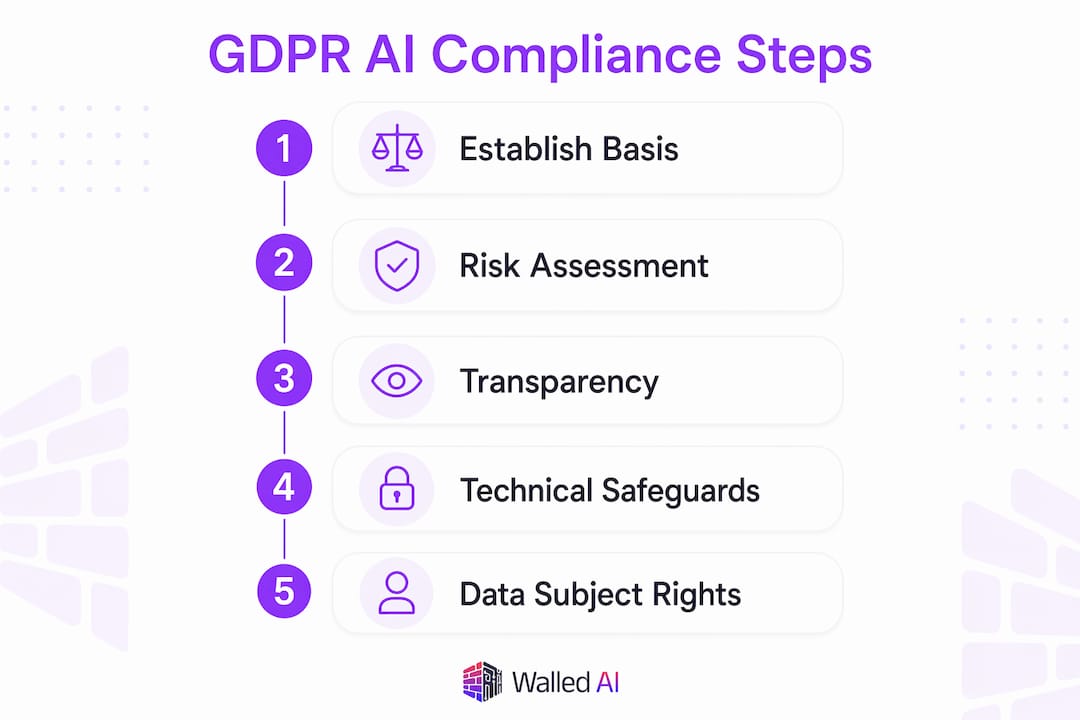
GDPR AI compliance is the obligation for organizations to ensure that AI systems processing personal data do so lawfully, fairly, and transparently under the General Data Protection Regulation. It is not a single certification or a one-time audit. It is a continuous governance obligation that spans the entire AI lifecycle, from model development and training through deployment, monitoring, and eventual decommissioning.
At its core, GDPR AI compliance requires organizations to satisfy the following:
- Lawful basis: Every AI processing activity involving personal data must rest on a valid legal ground under Article 6 GDPR, most commonly legitimate interest or consent.
- Fairness and transparency: Data subjects must receive meaningful information about how AI systems use their data, including the logic and purpose behind automated decisions.
- Purpose limitation and data minimization: Personal data collected for AI must be limited to what is strictly necessary for a defined, legitimate purpose, per Article 5 GDPR.
- Accountability: Controllers must document their compliance posture and demonstrate it to supervisory authorities on demand.
- Technical and organizational safeguards: Measures such as pseudonymization, access controls, and human oversight must be embedded from the design stage onward.
The EDPB Opinion 28/2024 is the most consequential regulatory guidance issued to date on this topic. It addresses when AI models can be considered anonymous, how controllers can justify legitimate interest as a legal basis during both development and deployment, and what downstream liability follows from unlawful data processing in the training phase. Compliance officers who have not yet reviewed Opinion 28/2024 should treat it as required reading.
What legal bases apply to GDPR AI data processing obligations?
The GDPR provides six legal bases under Article 6, but for most AI processing scenarios, legitimate interest and consent are the most relevant. Consent is technically available but practically difficult: it must be specific, informed, unambiguous, and freely withdrawable at any time, conditions that are rarely met at the scale AI systems require.
Legitimate interest is therefore the basis most organizations rely on, and the EDPB has confirmed it can apply to AI model development and deployment. However, three cumulative conditions must all be satisfied:
- Legitimate interest test: The interest must be lawful, clearly articulated, and real rather than hypothetical.
- Necessity test: The processing must be genuinely required to pursue that interest. If the same purpose could be achieved using synthetic or non-personal data, the necessity test fails.
- Balancing test: The controller's interest must not be overridden by the rights and freedoms of the data subjects, taking into account the volume of data, the context of collection, and the impact on individuals.
Beyond the legal basis, Article 5 GDPR principles impose additional constraints that are particularly demanding in AI contexts:
- Purpose limitation: AI systems must not repurpose data in ways incompatible with the original collection purpose.
- Data minimization: Only data adequate and necessary for the defined purpose may be processed. The GDPR's data minimization obligation applies fully to AI, despite arguments that AI models benefit from larger datasets.
- Accuracy: AI-generated outputs involving personal data must be verified for correctness, given the risk of hallucination.
- Storage limitation: Personal data used in AI training must be erased or anonymized once it is no longer needed.
True anonymization carries a high bar. The EDPB requires that both the likelihood of direct extraction of personal data from a trained model and the likelihood of obtaining personal data through queries be insignificant for any data subject. Organizations claiming anonymization must conduct and document thorough evaluations, including testing against exfiltration, regurgitation, and reconstruction attacks.
How do transparency and documentation requirements apply to AI systems?
Transparency is one of the most operationally challenging GDPR obligations for AI. Articles 12 through 14 GDPR require organizations to provide data subjects with meaningful information about the logic, significance, and envisaged consequences of automated processing. When AI systems make or substantially influence decisions about individuals, that obligation intensifies.

The EDPB has emphasized that AI opacity, the difficulty of explaining how a model reaches a particular output, does not excuse non-compliance. Organizations must build proactive technical interfaces capable of explaining AI decisions in terms data subjects can understand. Explainability is not merely a design preference; it is a regulatory requirement. For a practical framework on meeting these obligations, the AI transparency requirements guide from Walled provides detailed 2026 guidance.
Documentation obligations run parallel to transparency. Key requirements include:
- Records of processing activities (Article 30): Controllers must maintain detailed records covering the purposes of AI processing, categories of data, retention periods, and security measures.
- Data Protection Impact Assessments (DPIAs): Under Article 35 GDPR, DPIAs are mandatory for high-risk processing. AI systems involving large-scale data, profiling, or systematic monitoring almost always meet this threshold. Even where a DPIA is not strictly required, it is considered best practice.
- Legitimate interest assessments: Where legitimate interest is the chosen legal basis, the three-step assessment must be documented and retained.
- Ongoing updates: GDPR compliance is an iterative process. Legal analyst Avi Gesser has noted that compliance must extend well beyond initial checkboxes to include risk assessments updated whenever data, purpose, or model behavior changes. A DPIA completed at deployment is not valid indefinitely if the model is subsequently fine-tuned or its use case expands.
What technical and organizational safeguards support GDPR-compliant AI deployment?
Article 25 GDPR requires data protection by design and by default, meaning safeguards must be embedded at the earliest stage of AI development, not retrofitted after deployment. The EDPB's guidance on data protection by design specifically calls out pseudonymization, continuous monitoring, and human oversight as critical controls throughout the AI system's lifespan.
Practical safeguards that compliance officers should verify are in place include:
- Pseudonymization: Replacing direct identifiers in training and inference data with tokens or codes, reducing re-identification risk without eliminating data utility.
- Access controls and data segmentation: Restricting which personnel and systems can access personal data used in AI pipelines.
- Continuous monitoring: Tracking model behavior over time to detect performance drift, bias emergence, or unexpected data outputs that may create new compliance risks.
- Human oversight mechanisms: Ensuring that consequential automated decisions remain subject to meaningful human review, particularly in high-risk contexts.
- Adversarial testing: Conducting regular red-team exercises to assess whether models can be manipulated into revealing training data or producing non-compliant outputs.
Vendor procurement deserves particular attention. Contracts alone do not insulate an organization from downstream GDPR liability if the AI vendor has processed personal data unlawfully during model development. Controllers deploying third-party AI models must conduct due diligence to verify the vendor's data processing history, particularly whether the training data was lawfully obtained. Organizations seeking structured guidance on data privacy in AI governance will find that procurement controls are consistently identified as a high-priority gap. Walled addresses this through real-time AI Data Loss Prevention, immutable audit trails, and centralized policy enforcement that operates before data reaches any AI model.
What are the rights of data subjects in AI processing contexts?
Article 22 GDPR grants data subjects the right not to be subject to decisions based solely on automated processing when those decisions produce legal or similarly significant effects. This provision applies directly to AI systems used in credit scoring, recruitment screening, insurance underwriting, and similar high-stakes domains.
Where Article 22 applies, organizations must:
- Provide the data subject with a meaningful explanation of the decision and the logic applied.
- Offer a mechanism for the data subject to request human review of the automated decision.
- Allow the data subject to contest the decision and present their case.
Beyond Article 22, data subjects retain their full suite of GDPR rights in AI contexts: the right to access their data, the right to rectification, the right to erasure, the right to restriction of processing, and the right to object. The right to object is particularly relevant where legitimate interest is the legal basis, since data subjects may object at any time and the controller must cease processing unless it can demonstrate compelling legitimate grounds that override the individual's interests.
What are the roles of data controllers and processors when deploying AI?
The controller-processor distinction under GDPR carries significant consequences in AI deployments. The controller determines the purposes and means of processing and bears primary accountability. The processor acts on the controller's instructions and must implement appropriate technical and organizational measures, but cannot independently determine how personal data is used.
When an organization deploys a third-party AI model, it typically acts as the controller for the deployment phase. The AI model provider may act as a processor, a joint controller, or an independent controller, depending on the degree of autonomy it exercises over the data. Controllers must use only processors that provide sufficient guarantees of GDPR compliance, and those guarantees must be formalized in a data processing agreement covering the subject matter, duration, nature, and purpose of the processing.
Data Protection Officers play a central coordination role. They advise on DPIAs, monitor internal compliance, review data sharing agreements with AI providers, and maintain the records of processing activities. Organizations that have not formally mapped their AI systems against controller-processor boundaries face material accountability gaps.
How do cross-border data transfers affect AI processing under GDPR?
AI model training and inference frequently involve cross-border data flows, particularly when cloud infrastructure, third-party APIs, or globally distributed development teams are involved. GDPR Chapter V restricts transfers of personal data to countries outside the European Economic Area unless an adequate level of protection is guaranteed.
For transfers to the United States, the EU-U.S. Data Privacy Framework provides a transfer mechanism for certified organizations. Standard Contractual Clauses remain the most widely used instrument for transfers to non-adequate countries. Binding Corporate Rules are available for intra-group transfers within multinational organizations.
Controllers must assess whether their AI vendor's infrastructure routes personal data through jurisdictions without an adequacy decision, and if so, whether appropriate transfer mechanisms are in place. This assessment should be documented as part of the broader DPIA and records of processing activities. Walled's support for on-premises and air-gapped deployments directly addresses this risk by ensuring personal data never leaves the customer's controlled environment.
What enforcement actions illustrate GDPR non-compliance in AI?
Regulatory enforcement has made clear that GDPR obligations apply to AI systems with full force. The Dutch "Toeslagenaffaire" case is among the most cited examples: the Dutch Data Protection Authority fined the Tax Administration for using a machine learning algorithm to create risk profiles for detecting child care benefit fraud. The system produced erroneous profiles and excluded thousands of individuals from social protection, violating principles of fairness, accuracy, and non-discrimination under GDPR.
Regulators across the EU have also scrutinized large language model providers for failing to establish a valid legal basis for training data collection, inadequate transparency notices, and insufficient mechanisms for data subjects to exercise their rights. The Italian Data Protection Authority temporarily blocked access to a major generative AI service in 2023 over these concerns, demonstrating that enforcement can be swift and operationally disruptive.
The lesson for compliance officers is that AI-related GDPR enforcement is no longer theoretical. Supervisory authorities are actively investigating AI data practices, and the EDPB's Opinion 28/2024 has given them a detailed analytical framework to apply. Organizations that cannot demonstrate a documented legitimate interest assessment, a current DPIA, and functioning data subject rights mechanisms are exposed.
Walled provides enterprise AI governance infrastructure purpose-built for organizations that must meet GDPR, the EU AI Act, and other regulatory frameworks without compromising AI adoption. Through real-time AI-DLP, automated data classification, immutable audit trails, and on-premises deployment options, Walled enables compliance officers to govern AI interactions across every channel, from browser-based tools to agentic workflows, with full visibility and control.
Key Takeaways
GDPR AI compliance requires organizations to establish a lawful basis, document ongoing risk assessments, embed technical safeguards by design, and maintain data subject rights mechanisms across the full AI lifecycle.
| Point | Details |
|---|---|
| Legitimate interest requires three tests | Controllers must satisfy the legitimacy, necessity, and balancing tests before relying on Article 6(1)(f) for AI processing. |
| DPIAs are mandatory for high-risk AI | Article 35 GDPR requires impact assessments for AI involving large-scale data, profiling, or systematic monitoring. |
| Anonymization threshold is high | The EDPB requires that re-identification risk be insignificant for any data subject, verified through adversarial testing. |
| Compliance is iterative, not one-time | DPIAs and legitimate interest assessments must be updated whenever data, purpose, or model behavior changes. |
| Vendor procurement carries downstream liability | Deploying a third-party AI model does not transfer GDPR accountability; controllers must conduct due diligence on training data provenance. |