

An enterprise AI acceptable use policy (AUP) is a formal, organization-wide document that defines exactly how employees and contractors may use AI tools within a business environment, covering which tools are permitted, what data may be processed, and what consequences follow from violations. Its core purpose is to manage AI-related risk, satisfy regulatory obligations, and prevent unauthorized or unsafe AI usage before it creates legal or operational exposure. The policy typically covers all personnel, all AI tool categories (consumer, enterprise-licensed, and embedded), and all data classifications the organization handles.
The urgency for formal policies is real and largely unmet. Only 28% of organizations have a formal, comprehensive AI AUP in place as of may 2025, according to ISACA, leaving the majority of enterprises exposed to unmanaged AI risk. ISACA itself offers a customizable AI AUP template that organizations can adapt rather than build from scratch. Tenable and other security authorities similarly advocate formal AI usage governance as a prerequisite for enterprise security posture.
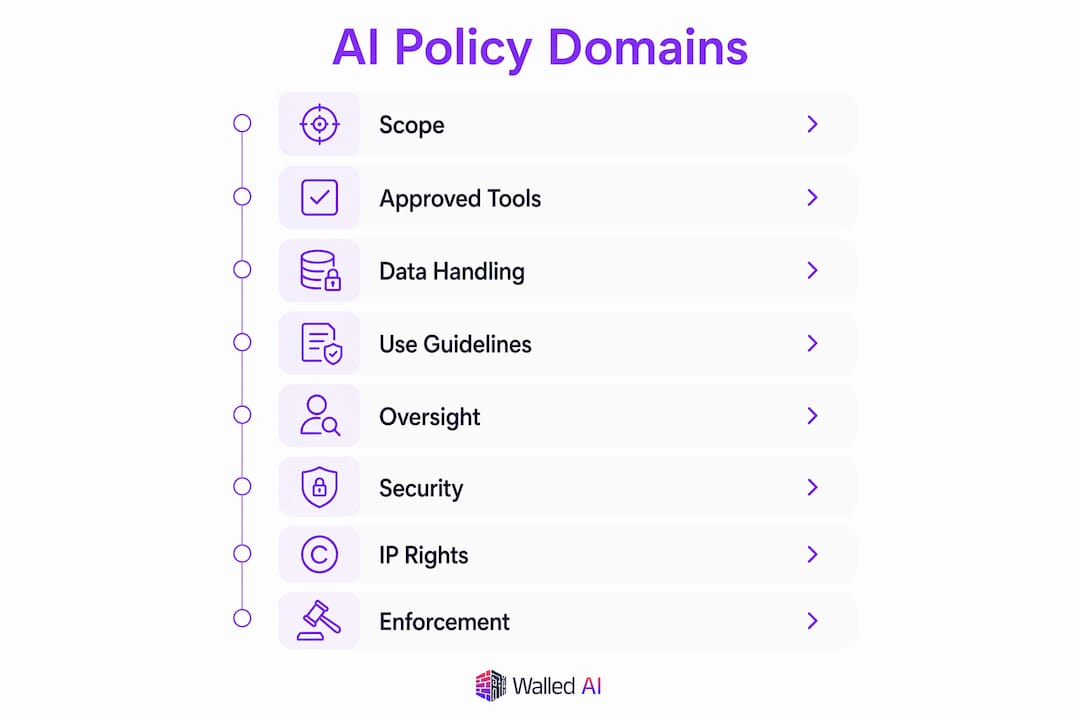
An effective enterprise AI acceptable use policy addresses eight core domains:
- Scope and applicability: who the policy covers and which AI tools it governs
- Approved and prohibited tools: a maintained registry of sanctioned AI tools and explicit prohibitions
- Data classification and handling: rules for what data may enter AI systems at each sensitivity tier
- Use case guidelines: permitted and prohibited AI applications, including ethical boundaries
- Human oversight and accountability: requirements for human review of AI outputs and clear ownership
- Security and privacy requirements: confidentiality obligations, access controls, and incident protocols
- Intellectual property and copyright: ownership of AI-generated content and restrictions on training-data use
- Enforcement and disciplinary actions: graduated consequences tied to specific violations
What does an enterprise AI acceptable use policy actually contain?
The eight domains above form the skeleton of any credible corporate AI policy. Each one requires specific, verifiable language, not aspirational statements.
Scope and applicability
The policy must name every category of personnel it covers: full-time employees, contractors, vendors with system access, and any third party operating AI tools on the organization's behalf. It should also enumerate the tool categories in scope, distinguishing between browser-based generative AI tools, AI-embedded productivity applications (such as Microsoft Copilot or Google Gemini), custom-built AI agents, and agentic workflows. A policy that says "all AI tools" without further definition creates enforcement gaps the moment a new tool category appears.
Approved and prohibited tools
The approved tools registry is not a static list. A living registry with a transparent IT review and submission process is the only reliable way to prevent shadow AI adoption, where employees use unsanctioned tools because the approval process is too slow or opaque. The registry should distinguish three tiers: consumer tools (generally prohibited for any work-related data), enterprise-licensed tools (permitted within defined data boundaries), and internally built or API-accessed models (governed by separate technical controls). Prohibited tools should be listed explicitly, not implied.

Data classification and handling
MIT's tiered framework offers a practical model: public AI tools are not recommended even for low-risk data used in work contexts, licensed enterprise tools are permitted for low- and medium-risk data, and high-risk data is prohibited from all generative AI tools without exception. Enterprises can adapt this into four tiers: public (freely shareable), internal (business-use only), confidential (restricted to named roles or systems), and restricted (regulated data such as PII, PHI, or financial records). Each tier carries explicit rules about which AI tool categories may process it.
Use case guidelines and ethical AI alignment
This section defines what employees may and may not do with AI tools. Permitted uses typically include drafting internal documents, summarizing non-confidential research, writing and reviewing code against approved repositories, and generating ideas for internal review. Prohibited uses include submitting regulated data to consumer AI tools, using AI to make autonomous decisions in high-stakes contexts without human review, and generating content that misrepresents AI involvement. The EU AI High-Level Expert Group's Ethics Guidelines for Trustworthy AI identify seven requirements for trustworthy AI systems, including human agency and oversight, technical robustness, privacy and data governance, transparency, fairness, societal well-being, and accountability. These principles translate directly into use case restrictions and approval criteria.
Human oversight and accountability
Every AI-assisted output that influences a business decision, customer communication, or regulated process requires a named human reviewer. The U.S. Department of Energy's AI usage guidelines require a human in the loop to validate AI-generated content and prevent plagiarism or copyright issues, noting that AI tools cannot be held accountable for ethics breaches. The AUP should specify who holds accountability for each AI use case category and what verification steps are mandatory before AI output is acted upon. For AI-generated content published externally, disclosure obligations should be stated explicitly.

Security, privacy, and incident reporting
Employees must understand that submitting confidential data to an AI tool is equivalent to transmitting it to a third party. The AUP should require that any accidental submission of restricted data to an AI tool be reported immediately through a defined incident reporting channel, with a clear escalation path to the security team. IEEE's Ethically Aligned Design framework emphasizes that transparency in AI policy, covering both model explainability and clear communication of policy processes, builds the trust that makes compliance sustainable.
Intellectual property and copyright
AI-generated content raises unresolved questions about ownership and originality. The AUP should state that employees may not submit proprietary source code, trade secrets, or unpublished research to any AI tool not covered by a data processing agreement. It should also address the organization's position on AI-generated content ownership and require disclosure when AI tools contribute substantially to deliverables.
Enforcement and disciplinary actions
Separating the employee-facing AUP from the broader AI governance framework keeps the document focused and increases adherence. The enforcement section should define a graduated disciplinary ladder: a first violation triggers mandatory retraining, a second triggers a formal written warning, and a third triggers escalation to HR with potential role restrictions. Specific violations, such as submitting restricted data to a consumer AI tool, should carry defined consequences rather than leaving outcomes to managerial discretion.
How to implement and enforce an AI acceptable use policy effectively
Policy text alone does not change behavior. The OECD's AI ethics operationalization framework makes clear that moving from high-level AI ethics to practical enterprise policy requires socio-technical approaches that link abstract principles to specific employee tasks. That means combining clear written rules with technical controls that enforce them automatically.
Pro Tip: Write the AUP in plain language with concrete "do this, not that" examples. Risk-aligned, practical AI AUPs with specific examples reduce employee confusion and compliance errors far more effectively than abstract rule sets.
Policy rollout and employee training
Roll out the AUP through a structured training program, not a single email. Training should cover the data classification tiers, the approved tools registry, and the incident reporting process, with role-specific modules for high-risk functions such as finance, legal, and engineering. Completion tracking is mandatory: compliance teams need evidence that every covered employee has acknowledged the policy, particularly for regulatory audits. Annual recertification keeps the policy current as the AI tool landscape evolves.
Technical enforcement controls
A policy without a gate is unenforceable. Effective AI AUP enforcement requires:
- AI Data Loss Prevention (AI-DLP): real-time inspection of data entering AI tools, with automatic masking or blocking of sensitive content before it reaches a model
- Tool allowlisting: network-level controls that block access to non-approved AI tools, preventing shadow AI adoption regardless of employee intent
- Prompt injection and jailbreak detection: automated guardrails that identify and block attempts to bypass policy controls through adversarial inputs
- Continuous monitoring and audit trails: immutable logs of AI interactions that support both internal audits and regulatory reporting
Transparent tool approval processes
The approved tools registry must have a submission and review workflow that employees can actually use. When the approval process takes weeks and lacks clear criteria, employees route around it. A transparent, efficient IT review process with defined timelines and published evaluation criteria reduces the incentive to adopt tools informally. Publishing the registry on an internal portal, with clear status indicators for tools under review, signals that the organization takes AI governance seriously without treating employees as adversaries.
Monitoring, auditing, and incident response
Continuous monitoring detects policy violations that training and controls miss. Audit logs should capture which tools employees access, what data categories are processed, and whether any policy exceptions are triggered. When a violation occurs, the incident response workflow should activate within a defined timeframe: the affected employee is notified, the security team investigates, and remediation steps are documented. AI transparency requirements for both model behavior and policy enforcement processes build the organizational trust that sustains long-term compliance.
Integrating the AUP with existing enterprise policies
The AI AUP does not replace existing IT security, data privacy, or acceptable use policies. It extends them. Cross-references to the organization's data classification policy, information security policy, and privacy notice ensure that employees understand how AI-specific rules fit within the broader compliance framework. A comprehensive AI governance framework addresses program-level oversight, risk appetite, and board accountability, while the AUP handles the employee-facing rules. Keeping these documents distinct, as recommended by governance authorities, prevents policy bloat and makes each document more usable.
How Walled approaches advanced AI policy enforcement
Policy text and training programs address the human side of AI governance. The technical side requires an enforcement layer that operates in real time, before sensitive data reaches an AI model. Walled's approach centers on an AI control plane that governs AI interactions across browser-based tools, desktop applications, custom AI applications, and agentic workflows from a single enforcement point.
| Capability | Traditional policy approach | Walled AI control plane |
|---|---|---|
| Data loss prevention | Manual review guidelines | Real-time AI-DLP masking before data reaches the model |
| Tool governance | Approved tools list (static) | Dynamic allowlisting with network-level enforcement |
| Threat detection | User reporting | Automated detection of prompt injection and jailbreak attempts |
| Output validation | Human spot-checks | Continuous hallucination and compliance validation |
| Audit and reporting | Periodic manual audits | Immutable audit trails with real-time compliance reporting |
| Deployment options | Cloud-dependent | On-premises, private cloud, and air-gapped environments |
Before any data reaches an AI model, Walled performs real-time inspection and AI-DLP, detecting and masking sensitive information including intellectual property, source code, customer data, credentials, and regulated information. This addresses the most common failure mode in enterprise AI governance: an employee submitting restricted data to a consumer or enterprise AI tool without realizing the policy implications.
Walled also protects against AI-specific threats that traditional security controls do not cover. Prompt injection attacks, jailbreak attempts, and policy bypass techniques are detected and blocked automatically, without requiring the employee to recognize the threat. The platform continuously validates AI-generated responses for factual accuracy and policy compliance, reducing the risk that hallucinated or non-compliant outputs influence business decisions.
For regulatory compliance, Walled's centralized monitoring and immutable audit trails support obligations under GDPR, the EU AI Act, PDPA, and MAS TRM. Organizations in regulated industries, including financial services, healthcare, and government, can demonstrate compliance through structured reporting rather than manual evidence collection. Walled supports on-premises, private cloud, and air-gapped deployments, ensuring that sensitive data never leaves customer-controlled environments, a requirement that consumer and standard enterprise AI tools cannot meet. The platform's enterprise AI governance capabilities align with ISACA's recommended policy domains and Tenable's security-first AI governance principles, grounding technical enforcement in recognized industry frameworks.
For organizations building or refining their AI risk assessment methodology, Walled's governance APIs also support custom applications and agentic workflows, extending policy enforcement beyond standard browser-based AI tools to the full scope of enterprise AI activity.
Key Takeaways
An enterprise AI acceptable use policy is only as effective as the technical controls and training programs that back it up. Policy text without enforcement infrastructure leaves organizations exposed, as the 28% adoption rate of formal AI AUPs demonstrates.
| Point | Details |
|---|---|
| Formal policy is the starting point | Only 28% of organizations have a formal AI AUP; the majority remain exposed to unmanaged AI risk. |
| Eight domains form the core | Scope, tools, data handling, use cases, human oversight, security, IP, and enforcement must all be addressed explicitly. |
| Technical controls are mandatory | AI-DLP, tool allowlisting, and continuous monitoring enforce what policy text alone cannot. |
| Separate AUP from governance framework | Keeping the employee-facing AUP distinct from the broader governance policy improves adherence and reduces document bloat. |
| Walled enforces policy in real time | Walled's AI control plane applies AI-DLP, threat detection, and audit trails across all AI tool categories before data reaches a model. |
Why most AI policies fail before they are ever tested
The conventional wisdom on enterprise AI policy development focuses almost entirely on document quality: clear language, comprehensive scope, legal review, executive sign-off. Those things matter. But the more common failure is not a poorly written policy. It is a well-written policy that no one enforces, because enforcement was never designed into the system.
The gap between a signed AI AUP and actual employee behavior is wider than most compliance teams expect. Employees do not typically violate AI policies out of malice. They do it because the approved tool is slower, the approval process is opaque, or they genuinely do not know that the data they are pasting into a consumer AI tool qualifies as confidential. Shadow AI adoption follows the path of least resistance, and a policy document sitting in an intranet folder offers no resistance at all.
What actually changes behavior is a combination of clear, specific rules and technical controls that make the compliant path the easy path. When the approved enterprise AI tool is as accessible as the consumer alternative, and when the network blocks the consumer tool anyway, the policy becomes self-enforcing. Training still matters, but it works best when it explains why the controls exist, not just what they are.
The other underappreciated challenge is policy maintenance. AI tool capabilities change faster than annual review cycles. A policy written in early 2025 may not address agentic AI workflows, embedded AI features in productivity software, or AI-generated code review tools that became standard by late 2025. Organizations that treat the AUP as a living document, with a defined review trigger tied to material changes in the AI tool landscape, stay ahead of the compliance curve. Those that treat it as a one-time project find themselves governing a 2024 AI environment in 2026.
Walled gives enterprises real-time AI governance, not just a policy document
Most organizations that need to govern AI tool usage already have the policy problem partially solved. What they lack is the enforcement infrastructure to make that policy real. Walled closes that gap by placing a unified AI control plane between employees and every AI tool they use, applying automated data classification and real-time AI-DLP before sensitive data reaches any model.
For mid-market organizations that need to deploy AI governance quickly without a large security team, Walled's mid-market AI governance platform deploys in minutes and covers browser-based AI tools, desktop applications, and custom AI agents from a single control point. Financial services firms, healthcare organizations, and government agencies benefit from sector-specific deployment options, including air-gapped environments that satisfy the strictest data sovereignty requirements. Walled also supports compliance reporting for GDPR, the EU AI Act, PDPA, and MAS TRM, turning audit preparation from a manual exercise into a structured, continuous process. For teams building their first formal AI AUP or upgrading an existing one, Walled's governance resources, including policy examples, enforcement checklists, and implementation guides, provide a practical starting point grounded in current regulatory requirements.