

Enterprise AI policy is defined as a formal organizational framework that governs how employees, contractors, and systems may use artificial intelligence tools, data, and automated decision-making. Compliance officers and IT managers searching for enterprise AI policy examples face a concrete problem: most published templates are either too abstract to enforce or too narrow to cover the full scope of modern AI adoption. The most effective corporate AI strategy combines a structured governance framework anchored to standards like the NIST AI RMF, the EU AI Act, and ISO/IEC 42001 with enforceable, operational rules that cover every AI touchpoint across the enterprise.
What are the key elements of enterprise AI policy examples?
A well-structured AI governance framework covers eight core domains: scope, definitions, approved tools, prohibited uses, data handling, human oversight, vendor requirements, incident response, and review cadence. Each domain translates a governance principle into a rule that employees can follow and auditors can verify. Policies that skip even one domain create exploitable gaps, particularly around data classification and vendor accountability.
The most commonly overlooked element is data classification mapping. Effective enterprise AI guidelines tie each internal data tier directly to permitted AI tool categories. For example, restricted data requires an enterprise data processing agreement and on-premise deployment before it can interact with any AI system. This mapping converts legal language into a technical constraint that engineers and end users can actually apply.

Human oversight requirements belong in every policy that touches high-risk decisions. Automated hiring, credit scoring, healthcare recommendations, and compliance control bypasses all require a documented human review step before any AI output takes effect. Policies that omit this requirement expose organizations to liability under the EU AI Act and similar regulations.
Core elements compliance officers should verify are present in any enterprise AI policy:
- Scope: Covers all employees, contractors, and third-party integrations
- Approved tools registry: Lists sanctioned AI products with version and data-tier permissions
- Prohibited uses: Explicitly names high-risk and forbidden applications
- Data classification mapping: Links each data tier to permitted AI tool categories
- Human oversight mandates: Specifies which decisions require human review before action
- Pre-deployment review: Defines the approval process for new AI systems
- Vendor requirements: Mandates data processing agreements and transparency disclosures
- Incident response: Sets escalation timelines and notification obligations
- Review cadence: Schedules annual updates and trigger-based interim reviews
10 practical enterprise AI policy provisions to implement
1. Mandatory AI training before system access
All employees and contractors must complete documented AI training before accessing any enterprise AI tool. The City of Boston's generative AI policy mandates annual DoIT-approved training tracked through audits. Training records serve as evidence of due diligence during regulatory reviews and reduce the likelihood of accidental data exposure.
2. Approved tools registry with controlled onboarding
An approved tools registry lists every sanctioned AI product, its permitted data tiers, and any conditions of use. Providing a sanctioned registry reduces shadow AI adoption by giving employees a clear, accessible alternative to unsanctioned tools. New tools enter the registry only after a formal security and compliance review.
Pro Tip: Set a maximum approval window of two to four weeks for tool requests. An AI Governance Committee that takes longer loses credibility, and employees route around the process.
3. Prohibitions on automated high-risk decisions
Policies must explicitly prohibit AI from making final decisions on hiring, credit, healthcare treatment, or regulatory compliance without a documented human review step. High-risk AI uses such as these appear in most enterprise policy templates because regulators specifically target them. The prohibition should name the decision category, the required review role, and the documentation standard.
4. Data handling rules tied to classification tiers
Restricted and confidential data cannot be submitted to any AI tool that lacks an enterprise data processing agreement and on-premise or private cloud deployment. Translating data tiers into enforceable technical constraints prevents unauthorized data exposure through consumer-grade AI tools. The policy should list each tier with a concrete example of what it covers, such as customer PII, source code, or financial records.
5. Prohibition on deceptive AI content and impersonation
Policies must forbid using AI to generate content that deceives recipients or impersonates individuals without explicit consent. The City of Boston's policy explicitly prohibits unauthorized AI-generated translation, meeting note distribution, and identity impersonation. This provision protects organizations from reputational and legal exposure tied to AI-generated misinformation.
6. Incident reporting and escalation timelines
Every AI policy needs a defined incident response procedure with specific timelines. A practical provision requires employees to report suspected AI-related data incidents within 24 hours of discovery, with escalation to the security team within 48 hours. Clear timelines reduce ambiguity and support compliance with breach notification obligations under GDPR and PDPA.
7. Human-in-the-loop requirements for AI-assisted decisions
For AI systems that inform but do not finalize decisions, the policy must specify what "human review" means in practice. A strong provision states that a qualified reviewer must independently assess the AI output, document their conclusion, and retain that record for audit purposes. Vague language like "humans should review AI outputs" fails this test because it is not verifiable.
8. Vendor transparency and data processing agreement requirements
Any third-party AI vendor must provide a current data processing agreement, disclose the AI models used, and confirm data residency before the enterprise deploys their product. This provision directly supports AI transparency requirements under the EU AI Act and aligns with ISO/IEC 42001 supply chain controls. Vendor non-compliance triggers automatic suspension of the tool from the approved registry.
9. Quarterly AI Governance Committee reviews
Mandatory quarterly meetings of an AI Governance Committee keep the policy current and enforce accountability. The committee reviews exception requests, investigates incidents, approves new tools, and confirms that existing approvals remain valid. This cadence prevents policies from becoming static documents that no longer reflect the actual AI environment.
10. Technical enforcement through policy-as-code
Automated remediation workflows embedded in CI/CD pipelines block unapproved AI models, flag vulnerable dependencies, and notify security teams without manual intervention. Policy-as-code converts written rules into executable controls that apply consistently at the developer level. This approach is the difference between a policy that exists on paper and one that actually governs behavior.
Comparing governance enforcement approaches
Enterprises operationalize AI policies through two distinct approaches: static legal documents and operational frameworks with automated enforcement. The gap between them determines whether a policy actually reduces risk.
"AI governance must move from static documents to operational frameworks fully integrated with engineering to withstand regulatory scrutiny. An 'engineering-first' approach embeds controls directly into the tools and pipelines developers use every day, making compliance the path of least resistance rather than an afterthought."
The table below compares the two approaches across the dimensions that matter most to compliance officers and IT managers.
| Dimension | Static legal document | Operational framework |
|---|---|---|
| Enforcement mechanism | Manual audits and policy acknowledgment | Policy-as-code in CI/CD pipelines |
| Shadow AI risk | High; employees route around unclear rules | Low; approved registry provides sanctioned alternatives |
| Audit readiness | Dependent on manual record-keeping | Immutable logs and automated compliance reports |
| Tool approval speed | Weeks to months with no structured process | Two to four weeks via AI Governance Committee |
| AI asset visibility | Limited; no formal inventory | AI Bill of Materials tracks all models and dependencies |
| Regulatory alignment | Aligned at signing; drifts over time | Continuously updated against EU AI Act, NIST AI RMF, ISO 42001 |
The AI Bill of Materials, or AIBOM, deserves particular attention. It tracks model provenance, training data lineage, runtime dependencies, vendor APIs, and deployment environments. Auditors increasingly flag organizations that lack this inventory because it is the foundation of any credible AI compliance posture.
How to tailor AI policy examples to your organization
No single AI policy template fits every enterprise. The right starting point is choosing a compliance anchor framework such as the EU AI Act, ISO/IEC 42001, or NIST AI RMF, then building outward from its requirements. Leading enterprises align multiple frameworks simultaneously to reduce audit overhead and address supply chain security in a single governance structure.
Practical steps for tailoring an AI policy to organizational context:
- Map your data classification scheme first. Every policy provision that touches data must reference your internal tiers, not generic labels.
- Align prohibitions with industry-specific risks. Financial services organizations prioritize credit decision controls. Healthcare organizations prioritize clinical recommendation oversight. Government agencies prioritize data residency and air-gapped deployment.
- Assign clear accountability roles. Name the AI Governance Committee chair, the data protection officer, and the escalation path for each policy domain.
- Balance innovation with control. An approved tools registry enables sanctioned AI use without blocking productivity. Pair it with a fast-track review process for low-risk tools.
- Treat the policy as a living document. Annual updates and trigger-based reviews triggered by new tools, regulatory changes, or security incidents keep the policy current.
Pro Tip: Build your EU AI Act obligations into the policy's prohibited uses and human oversight sections from the start. Retrofitting these requirements after the policy is published is significantly harder than designing for them upfront.
The most durable AI policies embed accountability at every level. Engineers know which data tiers they can use with which tools. Managers know which decisions require human sign-off. Compliance officers know which incidents trigger regulatory notification. That clarity is what separates a governance document from a governance program.
Key Takeaways
Effective enterprise AI governance requires operational enforcement, not just written policy, to achieve regulatory compliance and reduce shadow AI risk.
| Point | Details |
|---|---|
| Define scope precisely | Cover all employees, contractors, and third-party integrations from the first draft. |
| Map data tiers to AI tools | Link each classification tier to permitted tool categories with concrete technical constraints. |
| Mandate human oversight | Name the decision categories, review roles, and documentation standards for high-risk AI uses. |
| Enforce through automation | Embed policy-as-code in CI/CD pipelines and maintain an AIBOM for full audit visibility. |
| Review on a fixed cadence | Hold quarterly governance committee meetings and trigger interim reviews after incidents or regulatory changes. |
Why most enterprise AI policies fail before they start
After reviewing AI governance programs across multiple sectors, the pattern is consistent. Organizations invest significant effort in drafting policy language and almost none in the enforcement infrastructure that makes that language real. A policy that prohibits unauthorized AI tool use but provides no approved alternative simply pushes employees toward shadow AI. A policy that mandates human oversight but defines it as "reviewing AI output" without specifying what that review must include produces no accountability at all.
The organizations that get this right treat their AI policy as an engineering problem, not a legal one. They ask: how does this rule get enforced at the point of action? That question leads to approved registries with fast-track onboarding, policy-as-code in development pipelines, and real-time data classification enforcement rather than annual acknowledgment forms. Cross-functional AI governance boards that include legal, security, engineering, and business unit representatives make better decisions faster than any single team working in isolation.
The uncomfortable truth is that most AI policies are written to satisfy an audit, not to change behavior. The difference shows up immediately when a new AI tool becomes popular and employees start using it before it clears review. Organizations with operational governance frameworks catch this within days through monitoring and automated alerts. Organizations with static documents find out months later, if at all. The 2026 regulatory environment, particularly under the EU AI Act and human oversight mandates, will make that distinction consequential.
— Rishabh
How Walled supports enterprise AI policy enforcement
Walled provides a unified AI control plane that converts written policy into technical enforcement across every AI touchpoint in the enterprise.
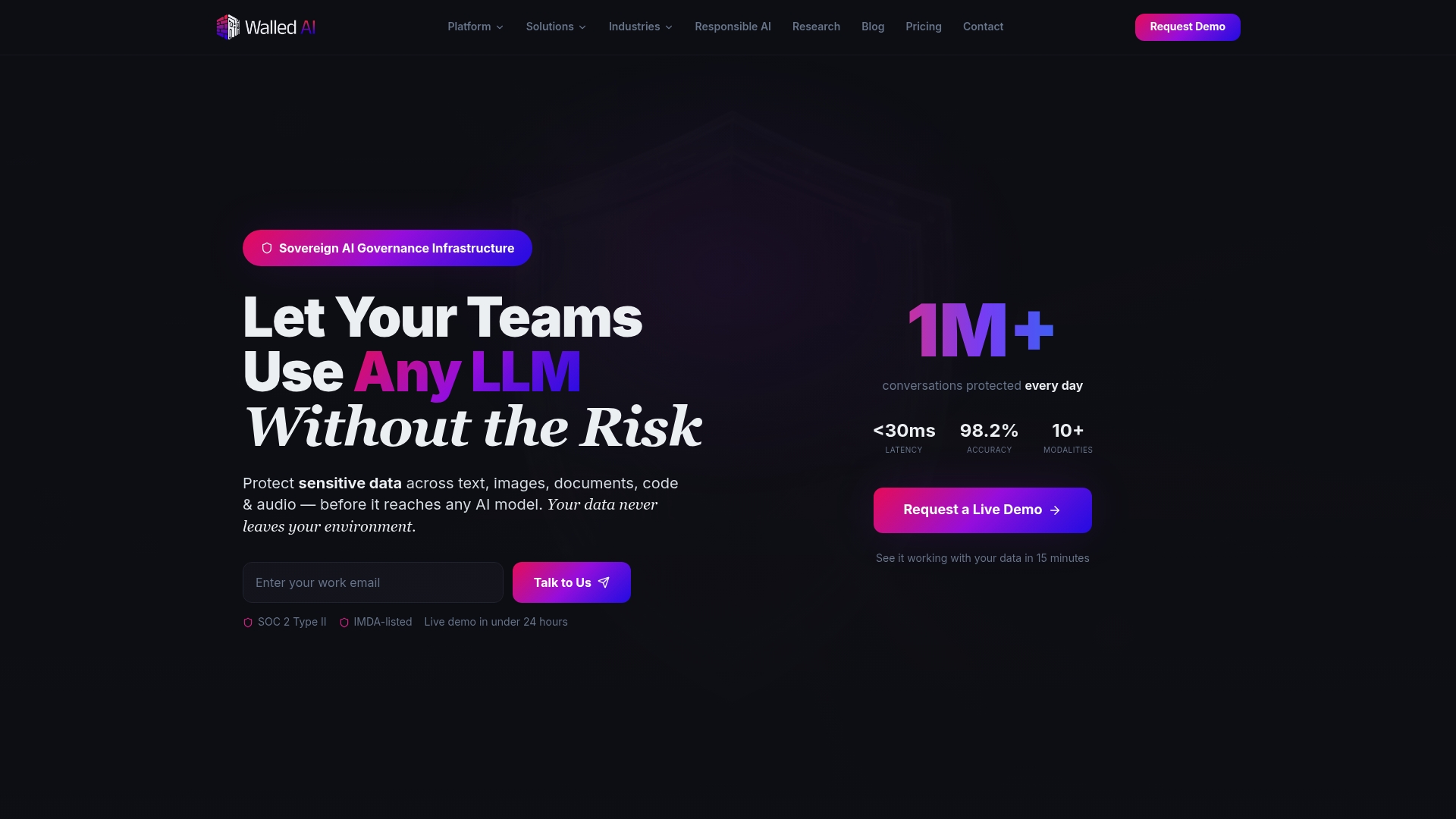
Before any data reaches an AI model, Walled performs real-time inspection and AI Data Loss Prevention, detecting and masking restricted data based on your internal classification tiers. The platform enforces your approved tools registry, blocks policy-violating interactions, and generates immutable audit trails that satisfy regulatory obligations under GDPR, PDPA, the EU AI Act, and MAS TRM. For organizations in regulated industries, Walled's enterprise AI governance solutions support on-premises, private cloud, and air-gapped deployments, ensuring sensitive data never leaves your controlled environment. Teams that need AI governance for financial services or other regulated sectors can deploy governance controls aligned to their specific risk profile.
FAQ
What is an enterprise AI policy?
An enterprise AI policy is a formal governance document that defines how employees, contractors, and systems may use AI tools, handle data, and make AI-assisted decisions. It typically covers approved tools, prohibited uses, data handling rules, human oversight requirements, and incident response procedures.
What are examples of prohibited uses in an AI policy?
Common prohibitions include automated hiring decisions without human review, AI-generated content that impersonates individuals, submission of restricted data to unapproved AI tools, and use of AI to bypass compliance controls. These categories appear consistently across enterprise AI policy templates and align with EU AI Act high-risk classifications.
How often should an enterprise AI policy be reviewed?
Policies require annual updates at minimum, with interim reviews triggered by new AI tool deployments, regulatory changes, or security incidents. Quarterly AI Governance Committee meetings provide the structured cadence needed to keep policies current.
What is the difference between an AI policy and an AI governance framework?
An AI policy defines the rules; an AI governance framework defines the structure, roles, and processes that enforce those rules. Effective programs require both, with the framework translating policy language into operational controls and accountability mechanisms.
How does policy-as-code support AI compliance?
Policy-as-code embeds governance rules directly into development pipelines, automatically blocking unapproved AI models and flagging vulnerable dependencies without manual intervention. This approach makes compliance the default behavior for engineering teams rather than a separate audit process.