

What is AI misuse risk?
AI misuse risk is the deliberate use of AI systems to cause harm, including fraud, deception, physical injury, or societal disruption. Unlike accidental AI failures or structural model flaws, misuse risk is defined by intent: a malicious actor consciously exploits AI capabilities to achieve harmful outcomes. The NIST AI Risk Management Framework formalizes this as "the composite measure of the probability that a harm occurs and the magnitude of the corresponding harm" when a model is deliberately exploited.
Several factors shape how severe that risk becomes:
- Malicious actor resources: Well-funded threat actors can access and fine-tune powerful models far more effectively than isolated individuals.
- Integration context: An AI system embedded in critical infrastructure carries substantially higher misuse potential than a standalone consumer chatbot.
- Dual-use capability: The same model that accelerates drug discovery can be repurposed to synthesize chemical weapons, a tension that makes capability restrictions difficult without also restricting beneficial innovation.
- Societal defensive measures: The strength of existing legal, technical, and institutional safeguards directly limits how far misuse can propagate.
Concrete examples span a wide threat surface: AI-generated spear phishing campaigns, non-consensual intimate imagery, synthesis of biological or chemical toxins, and autonomous disinformation at scale. Each represents a category where AI does not merely assist harm but actively amplifies it, enabling small groups to cause damage that previously required large organizational resources.
The four core types of AI risk you need to understand
AI risk does not reduce to a single failure mode. Four distinct categories capture the full spectrum: misuse, misapply, misrepresent, and misadventure. Understanding where each begins and ends is the prerequisite for building governance that actually fits the threat.
1. Misuse
Misuse is intentional. A threat actor deliberately exploits an AI system's capabilities to cause harm. The defining characteristic is malicious intent, which separates it from every other category. Examples include using a generative model to craft targeted phishing emails, generating deepfake audio to authorize fraudulent wire transfers, or querying a chemistry model for weapons synthesis pathways.
2. Misapply
Misapply occurs when an AI system is applied to a task or context for which it was not designed, producing inaccurate or harmful decisions without any malicious intent. A clinical decision-support model trained on one demographic population applied to a different one is a textbook misapplication. The harm is real; the intent is not.
- Common triggers: Scope creep in deployment, inadequate pre-deployment validation, and insufficient documentation of model limitations.
- Governance gap: Organizations often treat misapplication as a technical problem rather than a risk management failure.
3. Misrepresent
Misrepresent covers AI-generated content presented as factual, authoritative, or human-produced when it is not. This category includes AI-generated disinformation, fabricated research citations, and synthetic media used to manipulate public opinion. The harm often operates at scale: a single disinformation campaign can reach millions before correction mechanisms engage.
- Key distinction from misuse: Misrepresentation may or may not involve a malicious actor. A poorly governed AI system can generate misleading outputs without any deliberate exploitation.
4. Misadventure
Misadventure describes accidental harm arising from well-intentioned AI deployment. An autonomous vehicle that fails in an unanticipated edge case, or a hiring algorithm that inadvertently filters out qualified candidates, falls into this category. The organization acted in good faith; the harm emerged from gaps in testing, monitoring, or scenario coverage.
- Why it matters for governance: Misadventure is the most common category in practice, yet organizations frequently conflate it with misuse, leading to misdirected controls.
Real-world examples and documented impacts of AI misuse
The consequences of AI misuse are no longer theoretical. Documented incidents across financial services, politics, and public safety illustrate both the scale and the speed at which AI-enabled harm can materialize.

Financial fraud via deepfakes. A single deepfake fraud incident exceeded $25 million in losses, with attackers using synthetic video to impersonate a company executive during a video call and authorize a wire transfer. The attack required no physical access and bypassed standard identity verification.
Election disinformation at scale. AI-generated disinformation campaigns have affected millions of voters across multiple election cycles, producing synthetic audio, fabricated quotes, and coordinated inauthentic content at a pace that outstrips manual fact-checking capacity.
Biased automated decisions. Algorithmic bias in facial recognition and credit-scoring systems has affected an estimated 200 million people annually, with documented cases of wrongful arrests resulting directly from facial recognition errors.
Weaponization of generative models. Researchers have demonstrated that foundation models can be queried for detailed synthesis pathways for chemical and biological agents, a misuse vector that NIST's dual-use foundation model guidelines specifically address.
"AI misuse amplifies capabilities asymmetrically, enabling small malicious groups to cause damage previously requiring large resources. The dual-use nature of AI complicates mitigating misuse without restricting beneficial innovation." — SAFR Framework, Monetary Authority of Singapore
The organizational impacts extend beyond direct financial loss. Reputational damage from a single high-profile AI misuse incident can erode customer trust in ways that take years to recover. Privacy violations arising from AI-enabled surveillance or data exfiltration carry regulatory exposure under frameworks including GDPR, PDPA, and the EU AI Act. Societal harms, particularly from disinformation and biased automated decisions, create secondary liability risks that governance teams are only beginning to quantify.
How organizations can reduce AI misuse risk
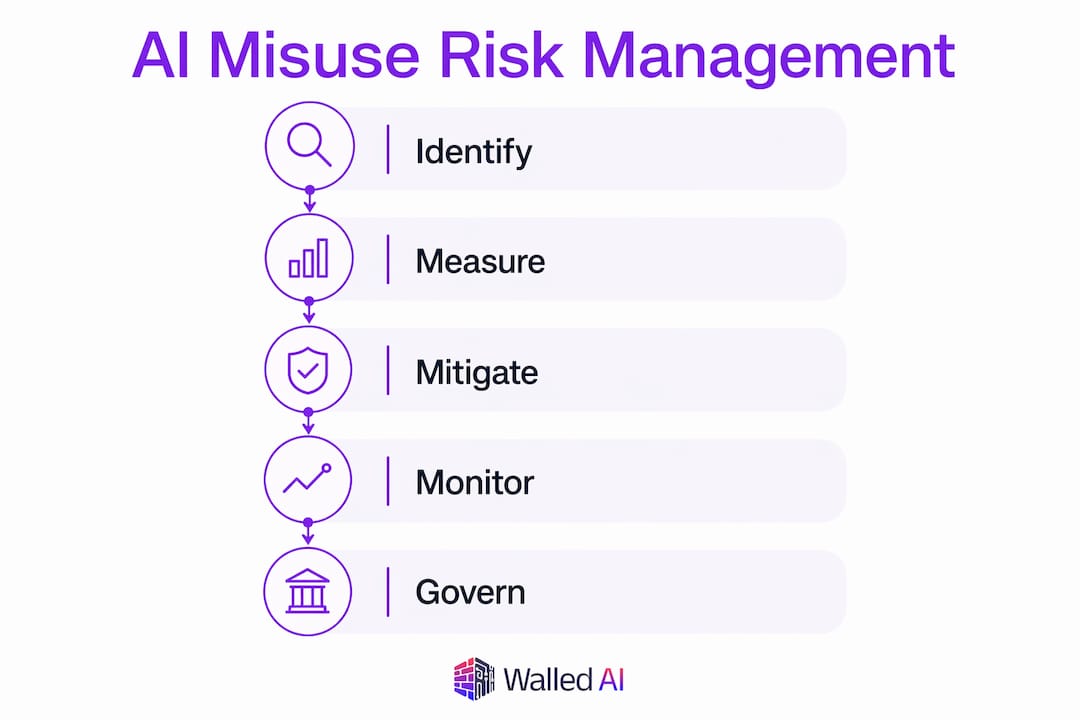
Effective AI misuse risk management requires a structured, continuous approach rather than a one-time compliance check. Organizations that treat AI risk as a deployment-gate activity rather than an ongoing discipline routinely miss capability drift, adversarial advances, and integration-level vulnerabilities that emerge after procurement.
Adopt a recognized governance framework
The NIST AI Risk Management Framework provides a structured methodology for identifying, measuring, and mitigating AI misuse risk across the model lifecycle. Financial institutions increasingly align with MAS TRM and the SAFR framework, which integrates real-time authorization and human oversight at every AI decision point. The EU AI Act's risk classification system adds a compliance layer that organizations operating in or serving EU markets must address by 2026.
For organizations building or refining their governance posture, an enterprise AI risk assessment provides a practical starting point for mapping model inventories, identifying high-risk deployments, and establishing baseline controls.
Implement continuous monitoring, not point-in-time reviews
A system that passes safety evaluation at procurement can drift into an unsafe state once updated, fine-tuned, or integrated with new data sources. Always-on monitoring addresses this by continuously validating model outputs against policy thresholds, flagging anomalies in real time, and maintaining immutable audit trails for regulatory review. Organizations in regulated industries should treat AI compliance monitoring as a core operational function, not a periodic audit task.

Pro Tip: Build your monitoring architecture to capture not just model outputs but the full interaction context, including prompts, retrieved data, and downstream actions. Misuse often becomes visible only when these elements are analyzed together, not in isolation.
Conduct pre-deployment safety evaluations and red-teaming
Before any model reaches production, organizations should run structured adversarial testing to identify misuse pathways specific to their deployment context. Red-teaming exercises that simulate threat actor behavior surface vulnerabilities that standard quality assurance processes miss. Output filtering, access controls, and Know-Your-Customer requirements for API access are additional pre-deployment interventions that reduce the attack surface.
Strengthen third-party AI vendor risk management
Standard security questionnaires are insufficient for assessing AI vendor risk. The opaque and complex nature of AI models means that a vendor's security posture on conventional IT dimensions tells organizations very little about model lineage, training data provenance, or the safeguards governing model updates. Procurement teams should embed AI-specific contractual requirements covering transparency about deployment scope, model versioning, and incident disclosure obligations.
This challenge is not unique to AI. QA and testing teams face analogous issues when test automation fails to surface edge-case behaviors, a parallel that underscores why AI-specific evaluation criteria must supplement, not replace, conventional vendor assessments.
Embed fairness, bias detection, and compliance controls
Bias in AI systems is both an ethical concern and a legal liability. Organizations should integrate bias testing into model validation workflows, document results, and establish remediation thresholds before deployment. Financial services firms subject to MAS TRM or the EU AI Act face explicit obligations to demonstrate that high-risk AI systems do not produce discriminatory outcomes. Embedding these controls at the development stage is substantially less costly than retrofitting them after deployment.
Align with regulatory and ethical frameworks
The regulatory environment for AI governance is consolidating rapidly. The EU AI Act's risk classification system, NIST's dual-use foundation model guidelines, and sector-specific frameworks like MAS TRM collectively define the compliance baseline for 2026 and beyond. Organizations should map their AI deployments against these frameworks, prioritize controls for high-risk classifications, and maintain documentation sufficient to demonstrate compliance during regulatory review. Ethical considerations, including transparency, accountability, and the right to explanation, are increasingly codified in these frameworks rather than treated as voluntary commitments.
How Walled supports AI misuse risk management
Walled provides a sovereign AI governance platform designed for organizations that need to manage AI misuse risk without slowing down legitimate AI adoption. The platform performs real-time inspection and AI Data Loss Prevention before any data reaches a model, detecting and masking sensitive information including intellectual property, customer data, and regulated content. Walled also protects against prompt injection attacks, jailbreak attempts, and policy bypasses, addressing the adversarial misuse vectors that standard security controls do not cover.
For financial services organizations managing AI governance obligations under MAS TRM, GDPR, or the EU AI Act, Walled delivers centralized policy enforcement, immutable audit trails, and compliance reporting within a single control plane. Mid-market organizations can access AI governance controls deployable on-premises or in private cloud environments, with no requirement to route sensitive data through external infrastructure.
Key Takeaways
AI misuse risk is the intentional exploitation of AI systems to cause harm, and managing it requires continuous governance, pre-deployment evaluation, and vendor-specific controls rather than one-time assessments.
| Point | Details |
|---|---|
| Misuse is defined by intent | AI misuse risk differs from accidental failures because a malicious actor deliberately exploits AI capabilities to cause harm. |
| Four risk categories exist | Misuse, misapply, misrepresent, and misadventure each require distinct governance responses; conflating them leads to misdirected controls. |
| Documented losses are severe | A single deepfake fraud incident exceeded $25 million in losses, and biased AI systems have affected an estimated 200 million people annually. |
| Continuous monitoring is required | Systems safe at procurement can drift into unsafe states after updates; always-on monitoring closes the gap that point-in-time reviews leave open. |
| Vendor risk needs AI-specific controls | Standard security questionnaires do not assess model lineage or training data provenance; AI-specific contractual requirements are necessary. |