

Regulated industry AI adoption risks are defined as the operational, compliance, and governance challenges that arise when firms in heavily supervised sectors integrate AI systems into core business processes. These risks span model failures, data governance gaps, vendor opacity, and cybersecurity threats amplified by AI capabilities. Regulatory bodies including the European Central Bank, the Reserve Bank of India, and the Australian Prudential Regulation Authority have each issued binding expectations that make AI risk management a board-level obligation, not an IT concern. The shift from experimental to operational AI use has made these risks immediate and material, requiring firms to treat AI governance with the same rigor applied to credit or operational risk.
What are the primary risks of AI adoption in regulated industries?
Regulated industry AI adoption risks fall into five distinct categories, each with direct compliance consequences. Understanding all five is the starting point for any credible governance program.
Operational risk is the most immediate. AI models degrade over time as data distributions shift, a phenomenon called model drift. A credit scoring model trained on pre-pandemic behavior, for example, may systematically misprice risk in a changed economic environment. Without continuous monitoring, these failures accumulate silently before surfacing in regulatory reviews.
Compliance risk centers on explainability. AI black-box algorithms are fundamentally incompatible with regulatory requirements that demand firms explain decisions affecting customers. Compliance teams cannot satisfy explainability obligations when the model's reasoning is opaque, even if the output is statistically accurate.

Vendor and supply chain risk is underappreciated. Firms rarely control foundation models or upstream data sources, creating fourth-party dependencies that regulators cannot easily examine. When a foundation model provider updates its training data or architecture, the downstream compliance posture of the regulated firm changes without its knowledge.
Cybersecurity risk is escalating. The European Systemic Risk Board warns that frontier AI models increase cyber threats to the financial system, demanding greater operational resilience focus. AI tools can be exploited through prompt injection, data poisoning, and adversarial inputs that bypass conventional security controls.
Shadow AI is the fifth and most difficult risk to govern. Employees use consumer-grade AI tools outside approved channels, creating data leakage and recordkeeping gaps that compliance teams cannot detect without technical controls.
Pro Tip: Build a shadow AI detection capability before you build an AI policy. Policy without detection is unenforceable, and regulators are beginning to ask specifically how firms identify unauthorized AI use.
How are global regulators shaping AI risk management?
The regulatory posture on AI has moved from guidance to mandate across major jurisdictions. Firms that treated 2024 AI governance frameworks as advisory are now facing binding deadlines.
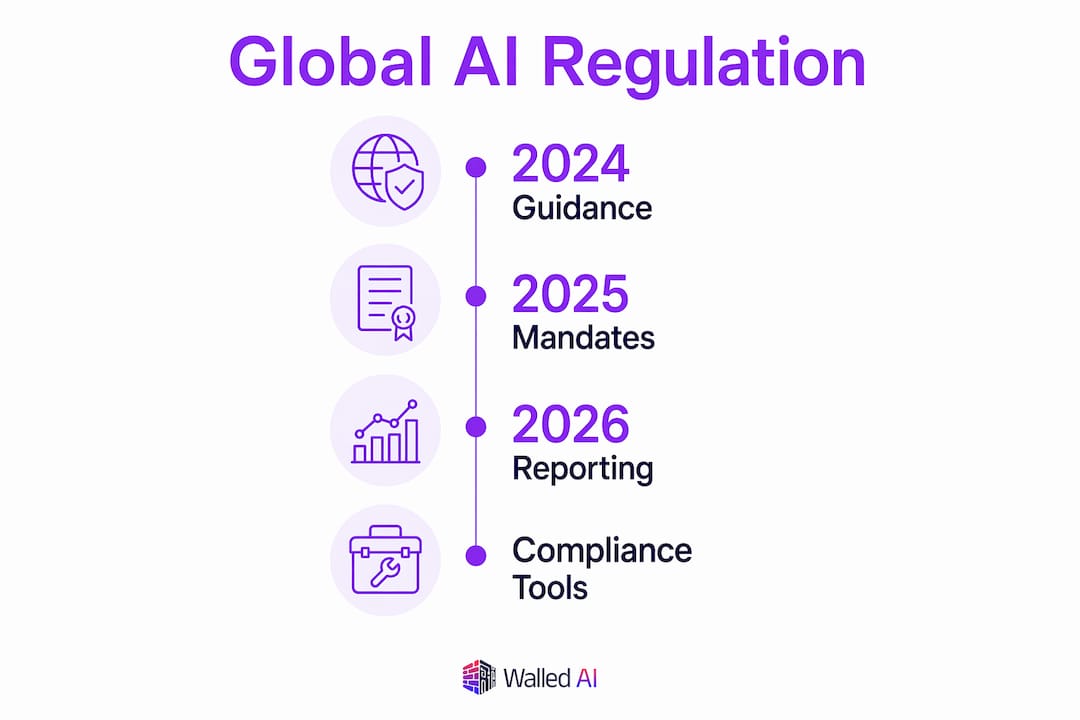
The European Central Bank requires the largest EU lenders to file detailed AI risk action plans by october 31, 2026. These plans must address internal AI risk governance and the vetting of external AI providers. The ECB's approach signals that AI vendor due diligence is now a supervisory expectation, not a best practice.
The Reserve Bank of India has taken the most operationally specific stance. RBI mandates that banks implement kill switches for AI models and require human override options on all customer-facing AI systems. The RBI framework also requires board-approved model risk policies and annual re-validation of AI risk tiering. This approach forces accountability to the highest governance level.
APRA has confirmed that existing prudential standards apply fully to AI, but its supervisory reviews found that entities' governance practices lag behind AI adoption pace. Internal audit functions lack the skills to assess AI risk, and assurance models are insufficient for adaptive AI systems that change behavior over time.
| Jurisdiction | Regulatory body | Key AI requirement | Deadline or status |
|---|---|---|---|
| European Union | European Central Bank | AI risk action plans from largest lenders | October 31, 2026 |
| India | Reserve Bank of India | Kill switches, human overrides, board-approved model risk framework | Active mandate |
| Australia | APRA | Prudential standards apply to AI; governance gap identified | Ongoing supervision |
| European Union | EU AI Act | Prescriptive risk-based classification for high-risk AI systems | Phased enforcement |
| United States | Multiple agencies | Principles-based guidance; sector-specific rules emerging | Evolving |
The contrast between the EU's prescriptive approach and the U.S. principles-based model creates compliance complexity for multinational firms. A firm operating in both jurisdictions must satisfy detailed EU AI Act requirements while also navigating fragmented U.S. agency guidance that varies by sector. Boards must understand this divergence because it affects how AI systems are designed, documented, and audited across geographies.
What challenges do regulated firms face in AI risk governance?
Governance frameworks exist on paper in most regulated firms. The gap between written policy and operational reality is where the real compliance challenges in AI adoption concentrate.
The explainability problem is structural. Probabilistic AI outputs cannot be reduced to a simple causal chain, yet regulations in lending, insurance, and healthcare require firms to explain individual decisions. Compliance teams are caught between the statistical nature of AI and the deterministic logic that regulatory frameworks assume.
Vendor opacity compounds the problem. AI model providers' innovation priorities do not align with regulated firms' compliance obligations, yet firms retain 100% accountability for AI outcomes regardless of what the vendor does. Contractual protections help, but they do not resolve the fundamental information asymmetry between a foundation model provider and its regulated customers.
Skill gaps in audit and risk functions are severe. Most internal audit teams were built to assess financial controls and process risks. Evaluating whether an AI model's training data introduces discriminatory bias, or whether a model's outputs meet explainability standards, requires data science literacy that most audit functions do not yet possess.
- AI inventory gaps: Firms cannot govern what they cannot see. Many organizations lack a complete catalog of AI systems in production, including those deployed by business units without central approval.
- Policy enforcement without technical controls: Written AI use policies are unenforceable without monitoring tools that detect policy violations in real time.
- Human oversight calibration: Regulators expect meaningful human oversight, not rubber-stamp review. Firms must define what constitutes a genuine human check and document it.
- Third-party audit rights: Vendor contracts often lack provisions for regulatory audit access to AI model documentation, training data, or incident logs.
Pro Tip: Require AI vendors to provide a "model card" at contract signing. A model card documents training data sources, known limitations, and performance benchmarks. If a vendor refuses, treat that refusal as a governance red flag.
How can regulated firms operationalize AI governance frameworks?
Operationalizing AI governance means embedding risk controls into the AI lifecycle, not appending them after deployment. The types of AI compliance risks that surface in production are almost always traceable to governance gaps at the design or procurement stage.
-
Build an AI inventory with risk tiering. Catalog every AI system in use, including third-party tools accessed by employees. Assign each system a risk tier based on its potential impact on customers, regulatory obligations, and data sensitivity. A living risk-tier classification, reviewed annually, ensures governance resources concentrate where the risk is highest.
-
Embed AI risk appetite at the board level. The board must approve a written AI risk appetite statement that defines acceptable use cases, prohibited applications, and escalation thresholds. This document becomes the anchor for all downstream AI governance decisions and satisfies the board accountability expectations of regulators including the RBI and ECB.
-
Implement continuous monitoring and lifecycle management. Deploy AI compliance monitoring that tracks model performance, data drift, and output quality in production. Monitoring must be continuous, not periodic, because model behavior can shift between annual reviews without triggering any manual alert.
-
Establish contractual provisions with AI vendors. Contracts with AI vendors must include audit rights, incident notification obligations, change management notice periods, and data handling requirements. Firms operating across borders should also address cross-border data compliance obligations in vendor agreements, particularly where training data or model inference occurs outside the firm's home jurisdiction.
-
Build interdisciplinary governance teams. Effective AI governance requires compliance officers, data scientists, risk managers, and legal counsel working from a shared framework. Siloed functions produce siloed governance. Firms that assign AI risk solely to IT or solely to compliance consistently underperform on supervisory assessments.
The comparison between reactive and proactive governance models is instructive. Reactive firms respond to regulatory findings after the fact, incurring remediation costs and reputational damage. Proactive firms treat AI governance as a continuous discipline, building audit trails, testing model outputs, and updating risk tiers before supervisors ask. Financial institutions must shift toward operational resilience, assuming AI disruptions will occur rather than only trying to prevent them.
Key Takeaways
Regulated industry AI adoption risks require proactive governance, continuous monitoring, and board-level accountability to satisfy the binding supervisory expectations now active across the EU, India, Australia, and beyond.
| Point | Details |
|---|---|
| Five core risk categories | Operational, compliance, vendor, cybersecurity, and shadow AI risks each require distinct controls. |
| Regulatory mandates are binding | ECB, RBI, and APRA have issued enforceable AI governance requirements with specific deadlines. |
| Explainability is a structural gap | Black-box AI outputs conflict with regulatory requirements for decision transparency in lending, insurance, and healthcare. |
| Vendor accountability stays with the firm | Regulated firms retain 100% accountability for AI outcomes regardless of vendor behavior or model changes. |
| Governance must be continuous | Annual reviews are insufficient. Continuous monitoring and living risk-tier classifications are now the regulatory baseline. |
The governance gap is wider than most boards realize
The firms I see struggling most with AI governance are not the ones that lack policy documents. They are the ones that confuse documentation with control. A written AI use policy filed in a SharePoint folder does not prevent an analyst from pasting client data into a consumer AI tool. That gap, between what is written and what is technically enforced, is where regulatory exposure concentrates.
What concerns me most is the pace mismatch. AI capabilities are advancing faster than most compliance functions can absorb. Regulators are accelerating their expectations in response, which means firms caught in the middle face a compounding problem. The ECB's october 2026 deadline for AI risk action plans is not the end of the supervisory cycle. It is the beginning of a much more intensive one.
The cultural shift required is also underestimated. Board members need enough AI literacy to ask meaningful questions of management. Not technical fluency, but enough understanding to distinguish a genuine governance program from a compliance theater exercise. Firms that invest in board-level AI education now will be better positioned when supervisors start asking boards directly what they know about their AI risk exposure.
Shadow AI remains the most underestimated threat. Every week that passes without technical detection controls is a week of unmonitored data exposure. Proactive governance means treating shadow AI as a current problem, not a future one.
— Rishabh
How Walled supports AI governance in regulated industries
Regulated firms need more than policy frameworks. They need technical controls that enforce governance in real time, across every AI interaction, before sensitive data reaches a model.
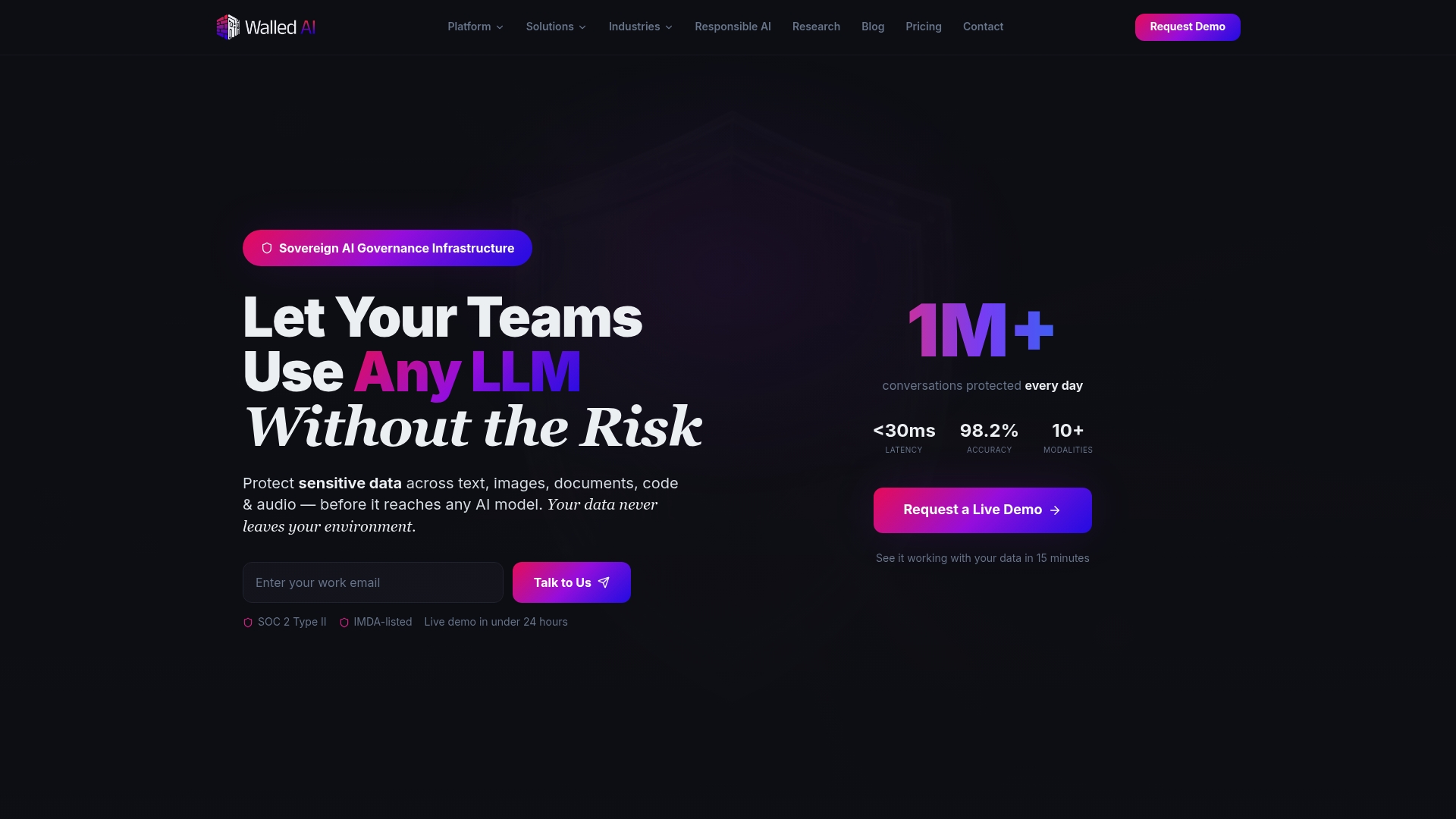
Walled provides a sovereign AI governance platform purpose-built for regulated industries. Before any data reaches an AI model, Walled performs real-time inspection and AI Data Loss Prevention, detecting and masking sensitive information including customer data, credentials, and regulated records. The platform enforces centralized policy, generates immutable audit trails, and produces compliance reporting aligned with GDPR, the EU AI Act, MAS TRM, and PDPA. For financial services firms managing AI governance obligations, Walled supports on-premises, private cloud, and air-gapped deployments, ensuring sensitive data never leaves controlled environments. Continuous monitoring, adversarial testing, and hallucination detection give compliance teams the assurance that AI outputs meet regulatory standards before they reach customers or records.
FAQ
What are regulated industry AI adoption risks?
Regulated industry AI adoption risks are the operational, compliance, vendor, and cybersecurity challenges that arise when firms in supervised sectors deploy AI systems. They include model failures, explainability gaps, shadow AI usage, and vendor opacity that complicate regulatory accountability.
Which regulators have issued binding AI governance requirements?
The European Central Bank requires the largest EU lenders to file AI risk action plans by october 31, 2026. The Reserve Bank of India mandates kill switches and board-approved model risk frameworks. APRA confirms existing prudential standards apply to AI and has identified governance gaps across Australian entities.
Why is explainability a compliance problem for AI?
AI models produce probabilistic outputs that cannot be reduced to a simple causal explanation. Regulations in lending, insurance, and healthcare require firms to explain individual decisions, creating a direct conflict with how most AI systems operate.
How should firms manage AI vendor risk?
Firms must include audit rights, incident notification requirements, and change management notice periods in AI vendor contracts. Because regulated firms retain full accountability for AI outcomes, vendor agreements must give compliance teams visibility into model changes and data handling practices.
What is shadow AI and why does it matter for compliance?
Shadow AI refers to AI tools used by employees outside approved channels and without IT or compliance oversight. It creates unmonitored data exposure, recordkeeping gaps, and policy violations that regulators increasingly expect firms to detect and prevent through technical controls, not just written policy.