

AI response validation is defined as the systematic process of verifying that AI-generated outputs meet required accuracy, format, and compliance standards before they reach downstream systems or end users. It sits at the critical interface between probabilistic large language model (LLM) outputs and the deterministic systems that consume them. Approximately 6.3% of LLM completions are syntactically or semantically invalid and require automated intervention before use. Production chatbots report about 8% first-pass validation failures, making retry and repair logic a production necessity. A multi-layer validation framework combining range checks, automated tests, and live monitoring can detect 95% of AI output errors before user exposure. That figure alone makes the case for treating validation as a first-class engineering concern, not an afterthought.
What does AI response validation encompass?
AI response validation covers two distinct but interdependent layers: syntactic validation and semantic validation. Conflating the two is the most common mistake practitioners make when building validation pipelines.
Syntactic validation confirms that the output conforms to an expected structure. JSON schema adherence, field presence, correct data types, and parseable formatting all fall into this category. Tools like Pydantic enforce these constraints programmatically. Syntactic validation is fast, deterministic, and automatable.

Semantic validation is harder. It checks whether the content is factually correct, contextually grounded, and consistent with business logic. Valid JSON output does not guarantee correctness; a response can pass every schema check and still contain a hallucinated fact, a misapplied business rule, or a policy violation. Semantic validation requires additional layers beyond parsing.
A production-grade validation system typically includes the following components:
- Output parsing and schema checks: Automated parsing confirms structural integrity before any further processing occurs.
- Content filtering: ML classifiers scan for personally identifiable information (PII), toxicity, and regulated content. These checks run in parallel with schema validation.
- Contextual grounding checks: LLM-based judges evaluate whether the response is grounded in the provided context or source documents, catching hallucinations that pass syntactic checks.
- Business rule enforcement: Custom validators confirm that numeric values fall within expected ranges, that referenced entities exist, and that logical relationships hold.
Layered guardrail systems combine deterministic checks, ML classifiers, and LLM-based judges to produce comprehensive output safety and compliance coverage. Each layer catches a different class of error. No single layer is sufficient on its own.
Validation policy also matters. Fail-closed validation blocks a response entirely when it fails a check. Fail-open allows the response through with a fallback or warning. The right choice depends on application risk. A medical diagnosis assistant warrants fail-closed behavior. A general-purpose content summarizer may tolerate fail-open with logging.
Pro Tip: Separate your syntactic and semantic validators into distinct pipeline stages. Running them together makes debugging harder and obscures which layer is generating failures.
How does AI response validation work in production pipelines?
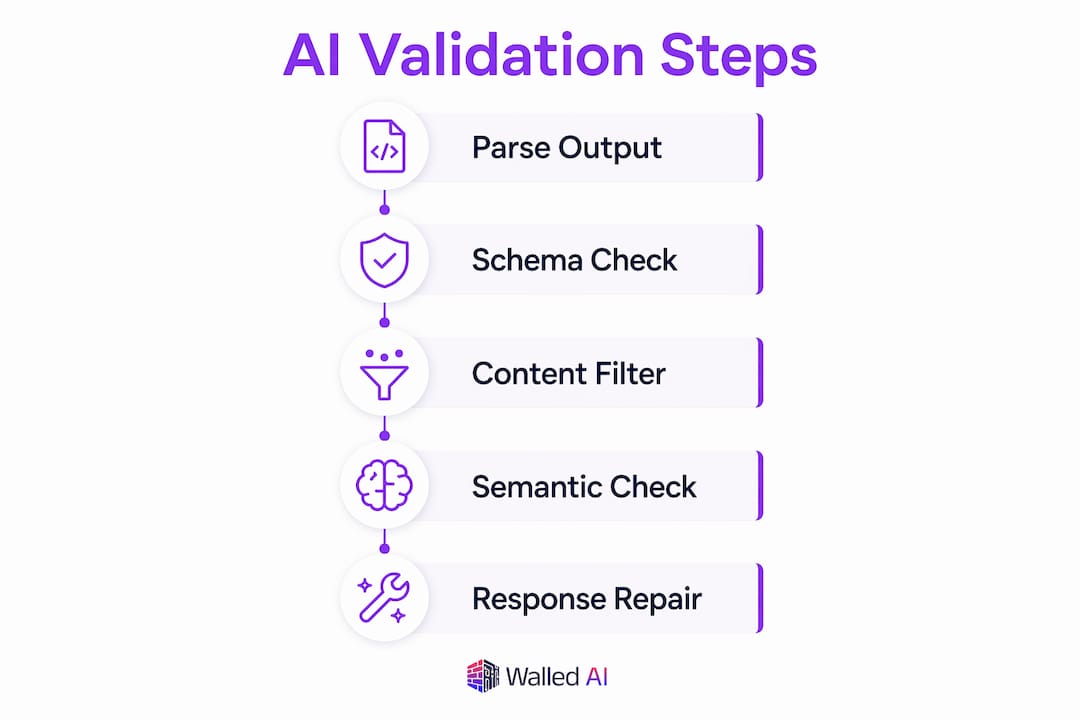
A production validation pipeline follows a structured sequence. Each stage gates the next, and failures trigger specific recovery actions rather than generic retries.
- Output parsing: The raw LLM response is parsed into the expected format. Malformed outputs are flagged immediately.
- Schema validation: Parsed output is validated against a predefined schema using tools like Pydantic or JSON Schema. Field types, required keys, and value constraints are checked.
- Content filtering: ML classifiers check for PII, toxicity, and policy violations. This stage runs in parallel where latency permits.
- Semantic and business-rule checks: Custom validators confirm factual grounding, logical consistency, and compliance with domain-specific rules.
- Repair and retry: On failure, heuristic repair runs first before invoking an LLM re-prompt. Heuristic fixes handle common formatting errors cheaply. LLM re-prompts with error context handle structural or semantic failures that heuristics cannot resolve.
- Logging and monitoring: Every validation failure is logged with its error type, stage, and input context for downstream analysis.
Schema-first prompt engineering and server-side constrained decoding reduce syntactic errors at the source. These techniques instruct the model to produce structured output from the start, reducing the volume of failures reaching the repair stage. They do not eliminate semantic errors.
The table below maps each pipeline stage to its primary error class and recovery action.
| Pipeline stage | Error class caught | Recovery action |
|---|---|---|
| Output parsing | Malformed structure | Reject and log |
| Schema validation | Type, field, constraint errors | Heuristic repair, then retry |
| Content filtering | PII, toxicity, policy breach | Fail-closed or redact |
| Semantic checks | Hallucination, logic errors | LLM re-prompt with error context |
| Logging | All failure types | Trend analysis and prompt refinement |
Logging validation failures and reviewing patterns monthly or quarterly is critical for ongoing quality improvement. Failure logs reveal systematic prompt weaknesses that no amount of retry logic can fix permanently.
Pro Tip: Always attempt a targeted heuristic repair before triggering a full LLM retry. Blind retries consume tokens, increase latency, and often reproduce the same error.
What are the benefits and challenges of AI response validation?
The benefits of response validation in AI systems are concrete and measurable. The challenges are equally real and deserve honest treatment.
Core benefits
- Downstream reliability: Validated outputs prevent malformed data from propagating into databases, APIs, and user interfaces. A single unvalidated hallucination in a financial report can trigger incorrect automated decisions.
- Compliance adherence: Content filtering and policy checks enforce regulatory requirements including GDPR, HIPAA, and the EU AI Act at the output layer, before data reaches end users.
- User trust: Consistent, accurate outputs build confidence in AI-assisted workflows. Inconsistent outputs erode it faster than any other factor.
- Audit trails: Logged validation events create the immutable records that compliance frameworks require. You can reconstruct exactly what the model produced and how the system responded.
Key challenges
"Schema enforcement secures output structure, but semantic accuracy and factual grounding require additional validation beyond syntactic checks. Treating a valid schema as a correctness guarantee is the most dangerous assumption in production AI."
Enforcing strict JSON schemas too early in the generation process degrades model reasoning performance. The model allocates attention to formatting compliance rather than logical reasoning, and accuracy drops. This is a documented tradeoff, not a theoretical concern.
Hallucinations present a persistent challenge. A model can produce a perfectly structured, policy-compliant response that contains a fabricated fact. Semantic validators catch many of these cases, but LLM-based judges introduce their own error rates. No validation system achieves zero false negatives.
Resource costs are also real. Retry loops consume tokens and add latency. Monitoring infrastructure requires maintenance. Teams that treat validation as a one-time setup rather than an ongoing operational practice accumulate technical debt that surfaces as production incidents. For a deeper look at why these failure modes matter at scale, the analysis of LLM output validation in enterprise AI is worth reviewing.
What are the best practices for AI response validation?
Effective validation requires deliberate design choices at every layer of the pipeline. The following practices reflect current production standards for AI practitioners building reliable systems.
- Use schema-first prompt engineering. Instruct the model to produce structured output from the start. Structured output APIs reduce syntactic failure rates before validation even runs.
- Separate reasoning from formatting. Reason in free text first, then format output in a second step. This preserves reasoning accuracy while still delivering schema-compliant output.
- Apply fail-open or fail-closed based on risk. Non-critical summarization tasks can tolerate fail-open with logging. Irreversible actions, financial transactions, and medical outputs require fail-closed enforcement.
- Implement layered validation. Run syntactic, semantic, and compliance checks as distinct stages. Each layer catches errors the others miss.
- Use cross-model testing and range checks. Cross-model tests and range checks supplement human review and catch systematic output errors that single-model evaluation misses.
- Log every failure with context. Store the input, the output, the failure type, and the stage. Aggregate these logs for monthly or quarterly review.
- Validate business rules explicitly. Schema compliance does not confirm that a numeric value is within an acceptable business range or that a referenced entity exists in your system.
- Adopt repair-then-retry logic. Heuristic fixes handle the majority of formatting failures cheaply. Reserve LLM re-prompts for failures that heuristics cannot resolve.
Pro Tip: Build a validation failure dashboard from day one. Teams that wait until production incidents occur to analyze failure patterns spend weeks reconstructing what a dashboard would have shown in minutes.
For practitioners working in regulated industries, the AI compliance monitoring guide covers how monitoring systems integrate with validation pipelines to meet sector-specific obligations.
Key Takeaways
Effective AI response validation requires layered syntactic, semantic, and compliance checks, combined with repair-then-retry logic and continuous failure monitoring, to prevent errors from reaching production systems.
| Point | Details |
|---|---|
| Syntactic vs. semantic validation | Schema checks confirm structure; semantic checks confirm factual accuracy and business logic correctness. |
| Multi-layer detection rate | A layered validation framework catches 95% of AI output errors before user exposure. |
| Repair-then-retry logic | Apply heuristic fixes before LLM re-prompts to reduce token costs and improve correction rates. |
| Fail-open vs. fail-closed policy | Match the validation failure policy to application risk; irreversible or high-stakes actions require fail-closed enforcement. |
| Continuous log analysis | Reviewing validation failure logs monthly or quarterly reveals systematic prompt weaknesses that retry logic cannot fix. |
Validation is harder than it looks, and that's the point
The most underestimated aspect of AI response validation is how quickly it reveals the limits of your prompt engineering. When I first started working with production LLM pipelines, the instinct was to treat validation as a safety net. The reality is that it functions more like a diagnostic instrument. Every failure pattern in your logs is a signal about where your prompts, your schemas, or your business logic are misaligned with what the model actually produces.
The industry has moved toward increasingly sophisticated guardrail architectures, combining deterministic checks, ML classifiers, and LLM-based judges in sequence. That progression is correct. But the teams that get the most value from validation are not the ones with the most complex systems. They are the ones that review their failure logs consistently and iterate on their prompts and validators in response to what those logs reveal.
Model improvements do reduce syntactic failure rates over time. They do not eliminate semantic errors, and they introduce new edge cases with each release. Validation systems need to evolve alongside the models they govern. Treating validation as a solved problem after initial deployment is how organizations accumulate silent failures that only surface when a downstream system produces a consequential error.
The human-in-the-loop question is also worth addressing directly. Automated validation handles volume. Human review handles nuance. The right balance depends on the risk profile of the application, but neither replaces the other. The enterprise AI risk assessment framework provides a structured way to map application risk to validation requirements, which is a useful starting point for teams designing their first production validation architecture.
— Rishabh
How Walled supports production AI response validation
Walled provides a unified AI governance platform built for organizations that need validation, monitoring, and compliance enforcement at the output layer of their AI systems.
Walled performs real-time inspection of AI-generated responses, checking for factual accuracy, hallucinations, PII exposure, and policy violations before outputs reach end users or downstream systems. The platform enforces compliance with GDPR, PDPA, the EU AI Act, and MAS TRM through centralized policy controls and immutable audit trails. For teams deploying AI in financial services, government, healthcare, and technology, Walled delivers the validation infrastructure that production AI requires. Organizations looking to deploy quickly can explore the mid-market governance solution for a governed AI environment that is operational within minutes.
FAQ
What is AI response validation?
AI response validation is the process of verifying that AI-generated outputs meet required accuracy, format, and compliance standards before they are used. It includes syntactic checks, semantic grounding, content filtering, and business rule enforcement.
How does AI response validation work?
Validation pipelines parse the raw output, apply schema checks, run content filters, and perform semantic grounding checks in sequence. Failures trigger heuristic repair or LLM re-prompts before the output is accepted or rejected.
Why is semantic validation necessary if schema validation passes?
Valid JSON output does not guarantee factual correctness or business logic compliance. A response can conform to a schema while containing hallucinated facts or violating domain-specific rules, which only semantic validation catches.
What is the difference between fail-open and fail-closed validation?
Fail-closed blocks a response entirely when it fails a validation check. Fail-open allows the response through with a fallback or warning. The choice depends on application risk; high-stakes or irreversible actions require fail-closed enforcement.
How often should validation failure logs be reviewed?
Reviewing validation failure logs monthly or quarterly is the established practice for maintaining AI output quality. Regular analysis reveals systematic prompt weaknesses and informs iterative improvements to both prompts and validators.