

Authorized users and autonomous AI agents now represent one of the most consequential security risks organizations face. An insider threat via AI tools occurs when individuals with legitimate access, or AI agents acting on their behalf, expose sensitive data, bypass policy controls, or facilitate unauthorized actions, whether through negligence, misuse, or deliberate intent. Check Point Research reports that by May 2026, 1 in every 14 AI interactions carried a real risk of sensitive data exposure, with the Business Services sector recording the highest rate of any industry. Most of that exposure came not from external attacks but from ordinary, approved use.
Key priorities for organizations responding to this risk:
- Visibility and control over all AI interactions, including those initiated by autonomous agents
- AI-specific telemetry combined with traditional behavioral signals for earlier detection
- Policy enforcement and governance aligned with CISA, OWASP GenAI Security Project, and National Insider Threat Task Force (NITTF) frameworks
- Real-time data loss prevention applied before prompts reach any AI model
How AI tools reshape the insider threat landscape
AI tools introduce threat vectors that traditional security controls were not designed to catch. The most common exposure path requires no malicious intent at all: an employee shares source code, customer records, or credentials inside a prompt, simply to get a more accurate answer. The AI model processes that data, potentially logging or transmitting it outside the organization's controlled environment.
Beyond accidental over-sharing, several AI-specific attack vectors have moved from theoretical to operational:
- Prompt injection: Malicious instructions embedded in content an AI reads during normal workflows, causing it to exfiltrate data or execute unauthorized commands. Check Point AI Security recorded a roughly fivefold increase in detections of large malicious prompt-injection payloads between March and May 2026.
- Jailbreak attacks: Crafted inputs that bypass an AI model's safety and policy guardrails, enabling access to restricted outputs or behaviors.
- Poisoned configurations: Tampered system prompts or retrieval sources that redirect AI agent behavior toward unauthorized actions.
- Autonomous agent abuse: AI agents with privileged access can read and execute instructions embedded maliciously in ordinary content, acting as insider threats without any human directing them.
Detecting these threats requires combining human behavioral signals with AI telemetry. Proofpoint cybersecurity notes that AI telemetry enhances detection accuracy and accelerates investigation timelines when integrated alongside traditional user behavior data. Organizations that rely solely on legacy user and entity behavior analytics (UEBA) tools miss the agent-layer activity entirely.
Pro Tip: Treat every AI agent action as a loggable event. Continuous monitoring of agent-initiated file reads, API calls, and data transfers provides the telemetry needed to detect subtle policy violations before they escalate.
Governance principles that reduce AI-driven insider risk
Reactive perimeter defenses are insufficient when the threat originates inside authorized workflows. CISA and the OWASP GenAI Security Project advocate for Secure by Design AI integration, embedding governance controls into AI systems from inception rather than layering them on after deployment.
Practical governance measures organizations should implement:
- Role-based access control (RBAC) scoped specifically to AI tools and autonomous agents, limiting what data each agent can read, write, or transmit
- Machine identity inventory tracking every AI agent, its permission set, and its data access scope
- Workforce communication programs that reduce careless data leaks by making policy expectations clear; the NITTF and UK NCSC both advise against isolating security teams and recommend inclusive workforce engagement
- Periodic AI red teaming to uncover prompt injection vulnerabilities and policy bypass paths before attackers exploit them
- Incident response procedures tuned for AI-speed attack chains, where autonomous remediation capabilities are increasingly necessary to close the authority gap between detection and containment
- SIEM and UEBA tools enhanced with machine learning capabilities to correlate AI interaction logs with anomalous user behavior, as recommended by FINRA's insider threat guidance
An internal AI tool policy checklist gives security teams a structured starting point for translating these principles into enforceable controls. Governance frameworks for specific regulated industries, including financial services, are covered in detail in Walled's AI governance for financial regulation guide.
Pro Tip: Apply technical controls that inspect prompt content and AI-generated output in real time. Policy documents alone do not prevent an employee from pasting a customer database into a generative AI chat window.
How Walled addresses AI insider threats and compliance requirements
Walled provides a unified AI control plane that governs interactions across browser-based AI tools, desktop applications, custom AI applications, and agentic workflows. Before any data reaches an AI model, Walled performs real-time AI Data Loss Prevention, detecting and masking sensitive information including intellectual property, source code, customer data, and credentials.
| Threat vector | Walled capability |
|---|---|
| Accidental data exposure in prompts | AI-DLP inspects and masks sensitive content before transmission |
| Prompt injection attacks | Real-time detection and blocking of malicious instruction payloads |
| Jailbreak and policy bypass attempts | Continuous guardrail enforcement across all AI interactions |
| AI hallucination and non-compliant output | Response validation for factual accuracy and policy adherence |
| Autonomous agent misuse | Governance APIs and agent-level access controls |
| Audit and regulatory reporting | Immutable audit trails with compliance reporting |
Walled's compliance coverage and deployment options:
- Regulatory frameworks: PDPA, GDPR, EU AI Act, MAS TRM, and emerging AI governance standards
- Insider threat categories mitigated: Accidental data leakage, malicious exfiltration, agent-facilitated abuse, prompt injection, jailbreak exploitation
- Deployment models: On-premises, private cloud, and air-gapped environments, ensuring sensitive data never leaves customer-controlled infrastructure
Walled Protect specifically addresses prompt injection defense, while the platform's automated data classification capability identifies sensitive data categories before they reach any external AI service.
What 2026 data reveals about AI insider threat trends
The exposure numbers from 2026 make the governance urgency concrete. High-risk generative AI prompts doubled from 2% to 4% over the past year. The average organization runs 10 AI applications per month, many without formal approval.
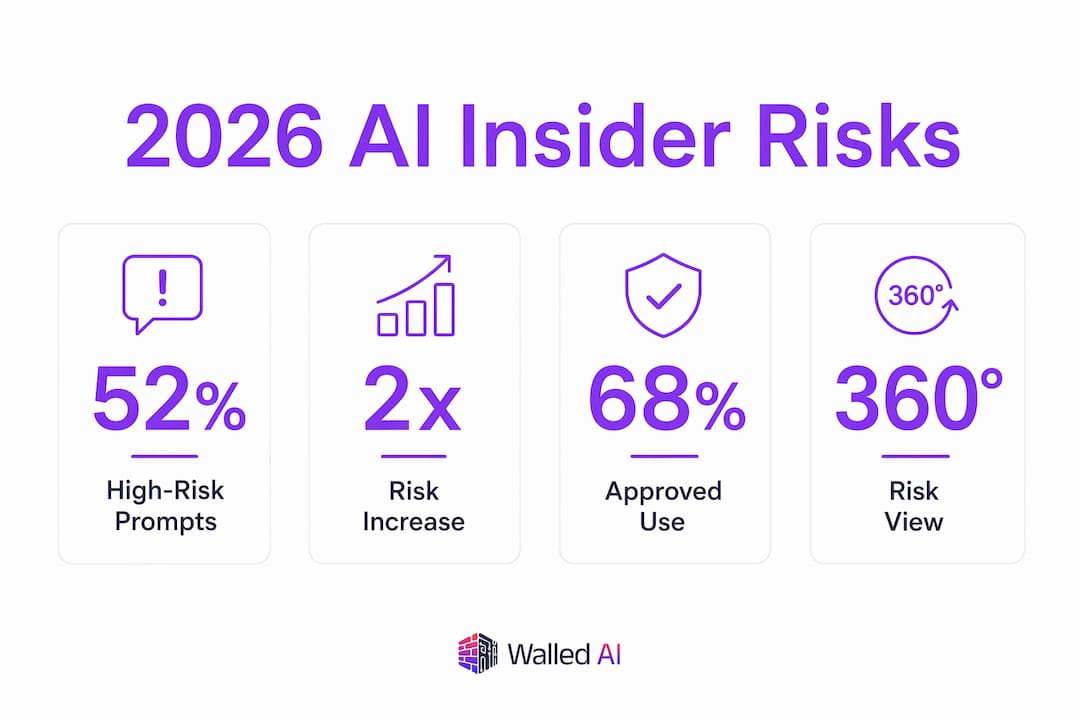
1 in every 14 AI interactions carried a real risk of sensitive data exposure by May 2026, according to Check Point Research, with Business Services recording the highest rate of any sector.
Key risk factors organizations should track:
- The doubling of high-risk prompts signals that workforce AI adoption is outpacing governance maturity
- Autonomous AI agents performing multi-step workflows create attack chains that compress traditional detection timelines
- Most exposure originates from approved use, not external attacks, making perimeter defenses structurally insufficient
- AI-driven attack lifecycles now move from reconnaissance to exfiltration faster than human-gated response processes can contain them
Organizations that unify technical, behavioral, and identity data streams gain the 360-degree view of insider risk needed for early intervention. Up-to-date AI telemetry, not annual audits, is what enables that.
How to build a risk assessment framework for AI-driven insider threats
Standard risk frameworks were designed around human actors and static data repositories. AI-driven insider threats require an updated assessment methodology that accounts for machine identities, dynamic data flows, and agent-initiated actions.
A practical AI-specific risk assessment covers four areas. First, organizations should identify their AI asset inventory, cataloging every AI tool, agent, integration, and the data each one can access. Second, they should classify data exposure risk by mapping which sensitive data categories flow through AI interactions, including source code, regulated personal data, and financial records. Third, behavioral baselining establishes what normal AI usage looks like for each role, making anomalous prompt patterns detectable. Fourth, residual risk scoring prioritizes remediation by combining data sensitivity, access scope, and behavioral deviation into a single risk signal.

The NITTF's maturity framework and CISA's Insider Threat Mitigation Guide both recommend incorporating AI-specific telemetry into existing risk assessment cycles rather than building parallel programs. Integrating AI risk into enterprise-wide assessments, as outlined in the CERT Common Sense Guide to Mitigating Insider Threats, ensures that AI tool risks receive the same governance rigor as traditional IT assets. An enterprise AI governance framework provides the structural scaffolding for operationalizing these assessments at scale.
Why vendor and third-party AI tools require their own risk controls
Third-party AI tools introduce supply chain risk that extends well beyond the organization's own workforce. When employees use externally hosted AI services, data leaves the organization's environment and enters vendor infrastructure governed by the vendor's own security posture, data retention policies, and subprocessor agreements.
Organizations should require AI vendors to provide documented data handling practices, including whether prompts are retained for model training, how long interaction logs are stored, and what subprocessors have access to submitted data. Contractual controls should specify data processing limitations, breach notification timelines, and audit rights. For vendors integrating AI agents into business workflows, the scope of agent permissions and the mechanisms for revoking access on termination deserve explicit attention.
The OWASP GenAI Security Project tracks emerging threat patterns specific to third-party AI integrations, including indirect prompt injection through vendor-supplied content pipelines. Organizations evaluating AI tool integrations can also reference EndPlex's API workbench for assessing how AI tool connections expose internal data through API interactions. Shadow AI, where employees adopt unapproved tools without procurement review, compounds this risk: Check Point Research found the average organization runs 10 AI applications per month, many outside formal approval processes.
Walled gives organizations control over AI adoption without slowing it down
Governance gaps in AI adoption do not have to mean choosing between productivity and security. Walled delivers the controls organizations need to govern AI interactions across their entire environment, from employee-facing tools to autonomous agents, without requiring organizations to restrict access or slow deployment.
Walled's mid-market AI governance solution deploys in minutes and applies real-time AI-DLP, prompt inspection, and policy enforcement across all AI tools from day one. For organizations in regulated industries, Walled maps directly to GDPR, PDPA, EU AI Act, and MAS TRM obligations, with immutable audit trails that satisfy compliance reporting requirements. Air-gapped and on-premises deployment options mean sensitive data never leaves the organization's controlled infrastructure. Security and compliance teams that need to demonstrate governance over AI adoption, without building custom tooling or waiting for lengthy procurement cycles, can start a conversation with Walled at walled.ai.
Key Takeaways
AI insider threats in 2026 originate primarily from approved use, not external attacks, making real-time prompt inspection and AI-specific governance controls the most direct line of defense.
| Point | Details |
|---|---|
| Exposure rate in 2026 | 1 in every 14 AI interactions carried a real risk of sensitive data exposure by May 2026, according to Check Point Research. |
| High-risk prompt growth | High-risk generative AI prompts increased substantially over the past year, signaling governance gaps. |
| Agent-layer risk | Autonomous AI agents must be governed as privileged identities with distinct access controls and audit logging. |
| Governance foundation | Secure by Design principles, RBAC, and AI-specific telemetry are the core controls recommended by CISA and NITTF. |
| Walled's role | Walled applies real-time AI-DLP and policy enforcement across all AI interactions, covering GDPR, PDPA, EU AI Act, and MAS TRM obligations. |